Categories
Blog Updates

ICAI AASB Issues Guidance on Labour Codes Impact

ICAI guidance on Labour Codes

The Government of India has implemented the consolidated Labour Codes with effect from 21 November 2025, replacing 29 existing labour laws.
This reform has wide-ranging implications for employee-related costs, statutory liabilities, and financial reporting across entities.

1. ICAI AASB Issues Guidance for Auditors

In response to the implementation of the Labour Codes, the Auditing and Assurance Standards Board (AASB) of the Institute of Chartered Accountants of India (ICAI) has issued guidance to assist auditors in addressing the accounting and audit implications arising from the new legal framework.

The guidance aims to promote consistent application, robust audit procedures, and adequate disclosures.

2. Impact of Revised Wage Definition and Expanded Coverage

The Labour Codes introduce:

  • A revised definition of ‘wages’, and
  • Expanded employee coverage under various labour and social security laws

These changes are expected to increase employee benefit obligations, particularly in respect of:

  • Gratuity, and
  • Leave-related liabilities

3. Accounting Treatment under Ind AS and AS

The guidance clarifies that:

  • Incremental employee benefit obligations arising from the Labour Codes are to be recognised as past service cost
  • Recognition should be in accordance with:
    1. Ind AS 19 – Employee Benefits, and
    2. AS 15 – Employee Benefits, as applicable

This has a direct impact on:

  • Profit or loss
  • Actuarial valuations
  • Measurement of defined benefit obligations

4. Audit Implications under SA 250

From an audit perspective, compliance with the Labour Codes falls within the scope of SA 250 – Consideration of Laws and Regulations in an Audit of Financial Statements.

Key audit implications include:

  • Heightened audit risk in areas such as:

    1. Payroll processing
    2. Statutory dues and compliances
    3. Actuarial assumptions and estimates
  • Increased risk of non-compliance or misstatement, particularly during the transition phase

5. Focus Areas for Auditors

The guidance emphasises the need for:

  • Focused audit procedures around employee benefit computations
  • Evaluation of management’s assumptions and actuarial valuations
  • Verification of statutory compliance with the Labour Codes
  • Ensuring robust disclosures relating to:
    1. Changes in employee benefit obligations
    2. Nature and financial impact of the Labour Codes

6. Key Takeaway

The implementation of the consolidated Labour Codes represents a significant structural shift in India’s labour law framework with substantial accounting and audit implications. The AASB’s guidance supports auditors in navigating increased complexity, ensuring appropriate recognition of employee benefit costs, strengthened compliance under SA 250, and transparent financial reporting.

Click Here To Read The Full Story

The post ICAI AASB Issues Guidance on Labour Codes Impact appeared first on Taxmann Blog.

source

Categories
Blog Updates

[Global IDT Insights] China Cuts Export VAT Rebates | Lithuania Revises VAT Rates

Global indirect tax updates

Editorial Team – [2026] 183 Taxmann.com 267 (Article)

Global IDT Insights provides a weekly snippet of tax news specifically related to Indirect Taxes from around the globe.

1. China Issues Announcement on Adjustment and Cancellation of Export VAT Rebates for Photovoltaic and Battery Products

China has issued a joint announcement through the Ministry of Finance and the State Taxation Administration addressing changes to export tax rebates related to value-added tax on specified products. The announcement sets out revisions to the export VAT rebate treatment for photovoltaic products and battery products, including partial reductions and complete withdrawal over a phased timeline.

The announcement defines the scope of the changes by identifying the affected product categories and specifying the revised rebate rates and effective dates. It focuses exclusively on the adjustment and elimination of export VAT rebates as part of China’s export tax policy framework.

Key aspects of this announcement include:

(a) Cancellation of Export VAT Rebates for Photovoltaic Products – Export tax rebates relating to value-added tax on photovoltaic products will be fully cancelled. This change applies to exports made on or after 01-04-2026. From this date, no export VAT rebate will be available for photovoltaic products covered by the announcement.

(b) Phased Reduction and Elimination of Export VAT Rebates for Battery Products – The export VAT rebate rate applicable to battery products will be reduced from 9% to 6% with effect from 01-04-2026. Following this interim reduction, the export VAT rebate for battery products will be completely eliminated. The full withdrawal of the rebate will take effect from 01-01-2027.

(c) Policy Objective and Industry Impact Noted in the Announcement – The announcement records that the adjustment measures have been welcomed by domestic industry stakeholders. According to the China Photovoltaic Industry Association, the changes are intended to support more rational pricing in overseas markets and to reduce the risk of trade frictions. The measures are also described as helping mitigate risks associated with rapid export price declines and potential trade disputes.

Source – Official Announcement

Click Here To Read The Full Article

The post [Global IDT Insights] China Cuts Export VAT Rebates | Lithuania Revises VAT Rates appeared first on Taxmann Blog.

source

Categories
Blog Updates

Inverted Duty Refund Allowed Even When Input and Output GST Rates Are Same | HC

inverted duty structure refund

Case Details: South Indian Oil Corporation vs. Assistant Commissioner Central Tax - [2026] 182 taxmann.com 864 (Karnataka)

Judiciary and Counsel Details

  • S.R. Krishna Kumar, J.
  • Venkatanarayana G.M., Adv. for the Appellant.
  • Akash B. Shetty, Adv. for the Respondent.

Facts of the Case

The petitioner was engaged in the procurement of edible oils falling under HSN Code 15 on payment of GST at the rate of 5 per cent, which were purchased in bulk and thereafter packed into retail containers of varying quantities and supplied as output under the same HSN Code 15 at the same rate. Due to a higher rate of tax suffered on certain inputs used in the packing process, accumulated and unutilised input tax credit (ITC) arose, and the petitioner filed refund applications claiming a refund of the accumulated credit on account of the inverted duty structure. The officer rejected the refund claiming inverted duty structure was not available where input and output tax rates were the same. The matter was accordingly placed before the High Court.

High Court Held

The High Court held that accumulation of credit arose due to the rate structure and not due to change in rates at different points of time. The restriction denying refund of accumulated credit in cases where the rate of tax on input and output supplies was the same stood deleted by way of substitution through Circular No. 173/05/2022-GST, dated 06-07-2022. The Court further held that the Department of Revenue was not justified in rejecting the petitioner’s refund claims. It was accordingly held that the petitioner was eligible to claim refund of accumulated ITC on account of inverted duty structure even where the tax rate on input and output supplies was the same, and the refund claim deserved to be allowed under Section 54 of the CGST Act and the Karnataka GST Act.

List of Cases Referred to

The post Inverted Duty Refund Allowed Even When Input and Output GST Rates Are Same | HC appeared first on Taxmann Blog.

source

Categories
Blog Updates

AO Must Tax Only Net Income Even If Section 11 Exemption Is Denied | ITAT

taxation of trust income

Case Details: Adhi Ganesh Mandir Charitable Trust vs. Income-tax Department [2026] 182 taxmann.com 796 (Mumbai-Trib.)

Judiciary and Counsel Details

  • Amit Shukla, Judicial Member & Arun Khodpia, Accountant Member
  • Bhupendra Shah for the Appellant.
  • Ujjawal Kumar, Sr. DR for the Respondent.

Facts of the Case

The assessee-trust filed its return, claiming exemption under Section 11. Assessing Officer (AO) denied exemption on the ground that the assessee did not hold a valid registration under section 12A/12AB for the relevant assessment year. Accordingly, he brought to tax the assessee’s entire receipts without allowing any deduction for expenditure.

On appeal, CIT(A) affirmed the action of AO. Aggrieved-assessee filed the instant appeal before the Tribunal.

ITAT Held

The Tribunal held that the assessee did not hold a valid registration under section 12A/12AB for the relevant assessment year. The claim of exemption under section 11 could not have been allowed for the said year. To this limited extent, the action of AO in denying exemption under section 11 does not call for any interference and stands on a firm statutory footing. However, the controversy does not rest merely on the denial of exemption under section 11, but extends to the manner in which the assessee’s income was computed thereafter.

Even where an assessee-trust is not entitled to exemption under section 11 for a particular assessment year, the computation of income has to be made in accordance with ordinary principles of commercial accounting, subject, of course, to the provisions of the Act. The denial of exemption does not confer an unfettered right upon the Revenue to assess gross receipts as income. The AO is duty-bound to examine the expenditure incurred wholly and exclusively for the purposes of earning such receipts and to determine the real income chargeable to tax. Any computation that proceeds to tax receipts without undertaking this exercise is fundamentally flawed.

In the instant case, the AO brought the entire receipts to tax without examining or verifying the expenditure reflected in the assessee’s income and expenditure account. Such an approach is clearly unsustainable in law. The denial of exemption under section 11 does not automatically authorise the revenue to tax a trust’s gross receipts. The computation must necessarily be confined to the net income, arrived at after allowing legitimate expenditure incurred in furtherance of the objects of the trust, unless such expenditure is specifically disallowable under the Act.

Accordingly, the matter was restored to the AO with a limited direction to recompute the income of the assessee after duly examining and verifying the expenditure claimed in the income and expenditure account and thereafter bringing only the net income, if any, to tax in accordance with the law.

List of Cases Referred to

  • Godavari Shikshan Prasarak Mandal (Sindhi) v. Union of India [W.P. No.16464 of 2025, dated 9-12-2025] (para 8).

The post AO Must Tax Only Net Income Even If Section 11 Exemption Is Denied | ITAT appeared first on Taxmann Blog.

source

Categories
Blog Updates

RBI Bans Collateral for MSE Loans up to ₹20 Lakh

RBI collateral-free MSE loans

Circular no. RBI/2025-26/206 FIDD.MSME & NFS.BC.No.12/06.02.31/2025-26; Dated: 09.02.2026

The Reserve Bank of India (RBI) has issued the Lending to Micro, Small and Medium Enterprises (MSME) Sector (Amendment) Directions, 2026, introducing enhanced measures to strengthen collateral-free lending to Micro and Small Enterprises (MSEs).

1. Prohibition on Collateral for Loans up to ₹20 Lakh

Under the amended directions:

  • Banks are prohibited from accepting any collateral security
  • For loans up to ₹20 lakh extended to units in the Micro and Small Enterprise (MSE) sector

This change reinforces RBI’s policy intent of improving credit access for small businesses without asset-backed constraints.

2. Enhanced Collateral-Free Limit up to ₹25 Lakh

Based on the good track record and sound financial position of MSE units:

  • Banks may increase the collateral-free loan limit up to ₹25 lakh
  • Such enhancement must be:
    1. In accordance with the bank’s approved internal credit policy
    2. Supported by appropriate risk assessment and due diligence

This provides banks with flexibility to reward well-performing MSE borrowers.

3. Special Provision for PMEGP Units

RBI has also advised banks to:

  • Extend collateral-free loans up to ₹20 lakh
  • To all units financed under the Prime Minister Employment Generation Programme (PMEGP)

The PMEGP is administered by the Khadi and Village Industries Commission (KVIC).

4. Treatment of Voluntary Pledge of Gold or Silver

The directions clarify that:

  • If a borrower voluntarily pledges gold or silver as collateral
  • For a loan that otherwise qualifies as collateral-free

Such voluntary pledge shall not be treated as a violation of the RBI’s prohibition on collateral for eligible loans.

5. Credit Guarantee Scheme Coverage

Banks are further encouraged to:

  • Avail coverage under the Credit Guarantee Scheme, wherever applicable
  • To mitigate credit risk while extending collateral-free loans to MSE borrowers

6. Applicability and Effective Date

  • The amended directions shall apply to all loans to MSE borrowers
  • That are sanctioned or renewed on or after 1 April 2026

Banks are required to align their lending policies, documentation, and operational processes accordingly.

7. Key Takeaway

The amendment:

  • Strengthens collateral-free credit flow to MSEs
  • Provides flexibility for higher limits for creditworthy units
  • Supports employment generation through PMEGP
  • Balances financial inclusion with prudent risk management
Click Here To Read The Full Circular

The post RBI Bans Collateral for MSE Loans up to ₹20 Lakh appeared first on Taxmann Blog.

source

Categories
Blog Updates

Weekly Round-up on Tax and Corporate Laws | 2nd to 7th February 2026

Tax and Corporate Laws; Weekly Round up 2025

This weekly newsletter analytically summarises the key stories reported at taxmann.com during the previous week from Feb 02nd  to Feb 07th 2026, namely:

  1. CBDT Releases Draft Income Tax Rules, 2026 and Forms; Seeks Feedback from Stakeholders
  2. Key Highlights of RBI’s Statement on Developmental and Regulatory Policies
  3. State Can’t End Long-term Contractual Engagement Abruptly Without Reasons or a Speaking Order: SC
  4. Alleged Role in Fake Firms and Clandestine Clearance; Bail Refused to Protect Investigation: HC
  5. Electronic Filing of GST Appeal Held Valid as No Notification Mandated Physical Filing; Rejection on Technical Ground Set Aside: HC
  6. Promotional Giveaways to Potential Distributors: Drawing the line between Revenue and Expense under Ind AS
  7. ICAI Seeks Comments on Exposure Draft for Audits of Less Complex Entities

1. CBDT Releases Draft Income Tax Rules, 2026 and Forms; Seeks Feedback from Stakeholders

The Central Board of Direct Taxes (CBDT) has released a draft of the Income-tax Rules, 2026, for public consultation. The board has invited feedback/comments from stakeholders and the public on the draft rules and forms by February 22, 2026.

The drafting of new Income-tax Rules and forms has followed the same philosophy as that of the new Income-tax Act, 2025. The language of the rules has been simplified as much as possible. Formulas and tables have been provided wherever necessary.

Redundancy in the Income-tax Rules, 1961, has been sought to be eliminated. The draft aims to simplify and consolidate provisions, reducing the number of rules from 511 to 333 and the number of forms from 399 to 190. While preserving the policy’s overall content, certain changes have been introduced in line with the amendments to the Income-tax Act, 2025.

The forms in the draft rules have also been simplified to a large extent to make them easier for taxpayers. Standardisation of common information has been implemented across the forms to reduce the compliance burden on taxpayers. Forms have been designed to enable automated reconciliation and prefill, making filing more intuitive and less error-prone.

Read the Press Release

Taxmann's Draft Income-Tax Rules 2026

2. Key Highlights of RBI’s Statement on Developmental and Regulatory Policies

In a bid to make India’s financial system more secure, inclusive, and efficient, the Reserve Bank of India vide its press release dated February 6, 2026, introduced a Statement on various developmental and regulatory policies relating to:

(i) Regulations;

(ii) Payment Systems;

(iii) Financial Inclusion;

(iv) Financial Markets; and

(v) Capacity Building.

These measures aim to strengthen customer protection, enhance digital payment safety, curb the mis-selling of financial products, and ease compliance requirements for select financial institutions.

Key Highlights

Some of the key highlights are as follows:

2.1 RBI Keeps Policy Repo Rate Unchanged at 5.25 Per Cent and Continues With Neutral Monetary Policy Stance

The RBI has decided to keep the policy repo rate under the liquidity adjustment facility unchanged at 5.25%. Consequently, the standing deposit facility rate remains at 5.00 per cent and the marginal standing facility (MSF) rate and the Bank rate at 5.50 per cent. The MPC also decided to continue with the neutral stance.

2.2 Enhancement of Collateral-Free Loan Limit From Rs 10 Lakh to Rs 20 Lakh

To improve access to formal credit, support entrepreneurial activity, and strengthen last-mile credit delivery for Micro and Small Enterprises (MSEs) with limited collateral, the RBI has decided to increase the limit of collateral-free loans for MSEs from Rs 10 lakh to Rs 20 lakh. These provisions shall apply to all loans to MSE borrowers sanctioned or renewed on or after April 1, 2026. In this regard, instructions will be issued shortly.

2.3 Introduction of Derivatives to Strengthen the Corporate Bond Market

An active derivatives market can facilitate efficient credit risk management, improve liquidity and efficiency in the corporate bond market, while supporting issuance of corporate bonds across the rating spectrum.

Pursuant to the announcement made in the Union Budget speech delivered on February 1, 2026, the total return swaps on corporate bonds and derivatives on corporate bond indices will be introduced. Accordingly, a regulatory framework enabling the introduction of credit index derivatives and total-return swaps on corporate bonds will be issued shortly.

2.4 Review of the Voluntary Retention Route (VRR) for FPI Investment in Debt Instruments

The RBI introduced the Voluntary Retention Route (VRR) in March 2019 to provide an additional channel for FPIs with long-term investment interests in the Indian debt market. The VRR has witnessed active participation, with over 80% of its current investment limit of Rs 2.5 lakh crore utilised.

To ensure predictability in the availability of investment limits under the VRR and further improve ease of doing business, the RBI has decided that investments under the VRR will now be reckoned within the overall FPI investment limit under the General Route. Additionally, certain operational flexibilities will be provided to FPIs investing under the VRR.

2.5 Proposal to Issue a Discussion Paper on ‘Exploring Safeguards in Digital Payments to Curb Frauds’

To promote safe and secure digital payments, the RBI has proposed issuing a discussion paper on calibrated safeguards, such as delayed credit and additional authentication for specific user groups, including senior citizens. These measures are intended to mitigate fraud risks and strengthen customer protection.

2.6 Issuance of Comprehensive Guidelines on Advertising, Marketing and Sale of Financial Products and Services

The RBI has observed that the mis-selling of financial products by regulated entities harms both customers and institutions. To address this concern, especially for third-party products sold at bank counters, it will issue detailed guidelines on advertising, marketing, sales, customer engagement, product suitability, and alignment with customers’ risk profiles. A draft will be released soon for public consultation to ensure transparency and appropriateness.

2.7 Revised Framework Governing Facilities for Authorised Dealers

Banks and standalone primary dealers authorised under FEMA, 1999, access the foreign exchange market for market-making, balance-sheet management, and risk hedging.

The regulatory framework governing facilities for Authorised Dealers (ADs) has been reviewed, rationalised, and refined in line with prevailing domestic and global market practices. The revised framework provides greater flexibility to ADs in relation to foreign exchange products, risk management, and trading platforms. The draft directions in this regard will be issued shortly.

2.8 Revision in the Guidelines of the Kisan Credit Card (KCC) Scheme

The RBI has undertaken a comprehensive review of the KCC scheme to expand coverage, streamline operations, and address emerging requirements. A revised set of consolidated instructions for banks, covering agriculture and allied activities, is proposed for issuance. The proposed guidelines include standardising the crop season, extending KCC tenure to six years, and including expenses related to technological interventions.

Read the Press Release

Taxmann's Statutory Guide for NBFCs

3. State Can’t End Long-term Contractual Engagement Abruptly Without Reasons or a Speaking Order: SC

The Supreme Court, in the matter of Bhola Nath vs. State of Jharkhand [2026] 183 taxmann.com 59 (SC), ruled that the State cannot deny regularisation of long-serving contractual staff appointed against sanctioned posts without giving reasons or passing a speaking order.

3.1 Brief Facts of the Case

In the instant case, the appellants were appointed by the respondent-State against sanctioned posts of Junior Engineers (Agriculture), with the engagement being described from inception as contractual in nature.

The terms and conditions governing engagement stipulated that the appointment would be for an initial period of one year, extendable thereafter subject to satisfactory performance. The Respondent-State accordingly granted extensions to the appellants from time to time until 2023, when it was expressly clarified that the extension granted would be the last.

The appellants approached the High Court by filing writ petitions seeking a writ of mandamus directing the State to regularise their services. The Single Judge dismissed the writ petitions filed by the appellants seeking a writ of mandamus directing the respondent State to regularise their services.

In doing so, the Writ Court placed reliance on the terms and conditions of the employment agreement entered into between the appellants and the respondents. The Division Bench upheld the judgment of the Writ Court. Thereafter, an appeal was made before the Supreme Court.

3.2 Supreme Court Observations

It was noted that the respondent State had engaged the services of the appellants on sanctioned posts since the year 2012. It was only towards the end of the year 2022 that the respondents communicated that no further extension of the appellants’ engagement was likely to be granted.

Further, it was noted that the abrupt discontinuance of such long-standing engagement solely based on contractual nomenclature, without either recording cogent reasons or passing a speaking order, was manifestly arbitrary and violative of Article 14 of the Constitution of India.

Also, it was noted that the contractual stipulations purporting to bar claims for regularisation could not override constitutional guarantees. The acceptance of contractual terms does not amount to waiver of fundamental rights, and contractual stipulations cannot immunise arbitrary State action from constitutional scrutiny.

3.3 Supreme Court Ruling

The Supreme Court held that the State, as a model employer, could not rely on contractual labels or the mechanical application of Umadevi (State of Karnataka v. Uma Devi (2006) 4 SCC 1) to justify prolonged ad hocism or to discard long-serving employees in a manner inconsistent with fairness, dignity, and constitutional governance.

In view of the foregoing discussion, the respondent-State was directed to regularise the services of all appellants against sanctioned posts to which they were initially appointed. The appellants must be entitled to all consequential service benefits accruing from the date of this judgment.

Read the Ruling

Taxmann.com | Labour Laws

4. Alleged Role in Fake Firms and Clandestine Clearance; Bail Refused to Protect Investigation: HC

The High Court held that bail could not be granted where prima facie material indicated the applicant’s active involvement in a large-scale, organised GST fraud involving fake firms, fraudulent e-way bills, and clandestine clearance of goods, as release could prejudice the ongoing investigation.

4.1 Facts

The accused-applicant was taken into custody pursuant to proceedings initiated by the Directorate General of GST Intelligence (DGGI) in connection with allegations of organised GST evasion in the marble trade, involving the creation and operation of multiple bogus firms, fraudulent generation of e-way bills, clandestine clearance of goods, and coordination with co-accused. It was submitted on behalf of the applicant that continued custody exceeding three and a half months was unwarranted since a charge-sheet had been filed, there were no criminal antecedents, the alleged offences were triable by a Magistrate and compoundable, and one co-accused was already in custody while the alleged mastermind remained unapprehended. The DGGI opposed the bail application, contending that the applicant had played an active role in setting up about thirteen fake entities, facilitating large-scale tax evasion through non-filing of returns and clandestine removals, and attempting to destroy documents recovered during search proceedings. It was further contended that the investigation was ongoing, and the quantum of alleged evasion continued to increase as the investigation progressed, and that custodial release could adversely affect the investigation. The matter was accordingly placed before the High Court.

4.2 Held

The High Court held that the allegations disclosed a large-scale and structured GST fraud with serious revenue implications. It held that the magnitude of alleged evasion had escalated and that the investigation was still at a crucial stage, with key conspirators yet to be apprehended. The Court held that the release of the applicant could impede tracing of proceeds and securing of revenue, particularly in view of the allegation relating to the attempted destruction of evidence. It further held that the precedents relied upon by the applicant were distinguishable and that economic offences warranted stricter scrutiny, and, finding prima facie material indicating an active role of the applicant, declined enlargement on bail and dismissed the application.

Read the Ruling

Taxmann.com | Premium

5. Electronic Filing of GST Appeal Held Valid as No Notification Mandated Physical Filing; Rejection on Technical Ground Set Aside: HC

The High Court held that rejection of a GST appeal merely for non-filing of a physical copy was unsustainable where the appeal had been duly filed electronically on the GST portal with the prescribed pre-deposit and documents. The Court held that Rule 108(1) permits electronic filing in the absence of any mandate for physical submission and that rejection without a hearing was unsustainable.

Facts

The petitioner challenged the rejection of its statutory appeal filed against the demand confirmed under Section 73 of the CGST Act and Jammu and Kashmir GST Act. It filed the appeal on the GST portal with the requisite pre-deposit and supporting documents for the specified period after a show cause notice was issued, alleging that the ITC claimed in Form GSTR-3B exceeded the ITC available in Form GSTR-2A. The appeal was rejected because the hard copy was not submitted. The matter was accordingly placed before the High Court.

Held

The High Court held that Rule 108(1) of the CGST Rules provides that an appeal shall be filed along with all relevant documents either electronically or otherwise as may be notified by the Commissioner, and therefore envisages electronic filing. The Court further held that the appeal could not be rejected solely on the ground that a hard copy was not filed, and that rejection on procedural grounds without granting an opportunity to be heard was unsustainable. Consequently, the Court set aside the rejection of the appeal and remanded the matter for a fresh decision on the merits.

Read the Ruling

Taxmann's Bare Act with Section Notes

6. Promotional Giveaways to Potential Distributors: Drawing the line between Revenue and Expense under Ind AS

Entities in the consumer goods sector often incur promotional costs to build brand visibility and expand their distribution network. One common practice is the free distribution of promotional items such as logo-bearing gifts and product catalogues to potential distributors. While such activities are undertaken with the expectation of future economic benefits, the key accounting question is whether these transactions fall within the revenue recognition framework of Ind AS 115, Revenue from contracts with customers or should be accounted for as expenses under other Ind AS.

Ind AS 115 applies only when there is a contract with a customer that creates enforceable rights and obligations and involves the transfer of goods or services in exchange for consideration. A “customer” is defined as a party that has contracted with the entity to obtain goods or services that are outputs of the entity’s ordinary activities for consideration. Performance obligations, and consequently revenue recognition, arise only within such contractual arrangements.

Where promotional gifts and catalogues are distributed free of charge to potential distributors, without any written, oral, or implied agreement. The recipients are not required to place orders or enter into distribution arrangements, and the distribution is not linked to any future performance obligations. As there is no contract, no consideration, and no transfer of goods as part of the entity’s ordinary revenue-generating activities, the transaction falls outside the scope of Ind AS 115.

The expenditure incurred on such promotional activities is aimed at generating future economic benefits but does not result in the creation or acquisition of a recognisable asset. In accordance with paragraph 69 of Ind AS 38, Intangible Assets, advertising and promotional expenditure is recognised as an expense when the entity obtains the right to access the goods or services. Accordingly, the cost of promotional gifts and catalogues distributed to potential distributors should be recognised as an expense when incurred, and not as revenue or a reduction from revenue.

Read the Story

Taxmann.com | Learning—Webinar – What Financial Statements Reveal | Detecting Companies Act Compliance Risks Early

7. ICAI Seeks Comments on Exposure Draft for Audits of Less Complex Entities

ICAI has invited comments from members and stakeholders on the Exposure Draft of the Standard on Auditing for Audits of Financial Statements of Less Complex Entities (SA for LCE), issued by the Auditing and Assurance Standards Board. The proposed standard introduces a simplified audit framework for eligible unlisted, standalone entities with limited size and complexity, while continuing to emphasise audit quality through alignment with SQM 1.

Members may submit their comments and practical suggestions on the eligibility criteria, audit procedures, and reporting requirements prescribed in the Exposure Draft. The last date for submission of feedback is 20 March 2026, following which ICAI will review the responses received and proceed with finalisation of the standard.

Read the News

Taxmann’s Advisory & Research | Use our Legacy for your Advantage

The post Weekly Round-up on Tax and Corporate Laws | 2nd to 7th February 2026 appeared first on Taxmann Blog.

source

Categories
Blog Updates

IFSCA Mandates IFSC ISINs for Demat Securities

IFSCA ISIN migration for IFSC Units

Circular F No. IFSCA-PLNP/85/2025-Capital Markets, Dated: 06.02.2026

The International Financial Services Centres Authority (IFSCA) has directed that all Units operating in the IFSC and intending to dematerialise securities or other permitted financial products must obtain International Securities Identification Numbers (ISINs) from a depository recognised by IFSCA.

This measure is aimed at strengthening the regulatory and supervisory framework within the IFSC ecosystem.

1. Requirement for Units Seeking Dematerialisation

Under the circular:

  • Units proposing to dematerialise securities or other permitted financial products
  • Must obtain ISINs only from an IFSCA-recognised depository

This requirement applies to both new issuances and ongoing dematerialisation activities.

2. Transition for Units Holding Domestic ISINs

IFSCA has further directed that:

  • Units which have already obtained ISINs from domestic depositories in India
  • Are required to obtain fresh ISINs from an IFSC-recognised depository

2.1 Deadline for Transition

  • On or before 31 August 2026

This transition ensures regulatory alignment and consolidated oversight within the IFSC framework.

3. Responsibilities of IFSC-Recognised Depositories

The depository recognised in the IFSC is required to:

  • Prepare a standardised process flow for ISIN issuance and migration
  • Coordinate with domestic depositories in India to ensure seamless onboarding of IFSC Units
  • Issue FAQs, guidance notes, and public notices, as required
  • Facilitate a smooth and orderly transition for all affected Units

4. Submission of Compliance Report to IFSCA

To ensure regulatory closure:

  • The IFSC-recognised depository must submit a compliance report to IFSCA
  • Confirming completion of the ISIN transition process

4.1 Deadline for Compliance Report

  • 30 September 2026

5. Regulatory Objective

The circular seeks to:

  • Centralise securities identification within the IFSC ecosystem
  • Enhance regulatory supervision and data integrity
  • Ensure consistency with IFSC-specific regulatory architecture
  • Reduce dependence on domestic market infrastructure for IFSC issuances

6. Key Takeaway

All IFSC Units dealing in dematerialised securities must align with IFSCA-recognised depositories for ISIN issuance, with mandatory migration from domestic ISINs by 31 August 2026, supported by a coordinated and standardised transition framework.

Click Here To Read The Full Circular

The post IFSCA Mandates IFSC ISINs for Demat Securities appeared first on Taxmann Blog.

source

Categories
Blog Updates

On Amalgamation Refund Allowed Only for ITC Actually Transferred | HC

amalgamation ITC refund GST

Case Details: Alstom Transport India Ltd. vs. Additional Commissioner, CGST and Central Excise - [2026] 182 taxmann.com 827 (Gujarat)

Judiciary and Counsel Details

  • A.S. Supehia & Pranav Trivedi, JJ.
  • Sujit Ghosh, Sr. Adv., Ms Mannat WaraichMs Anshika AgarwalShrey BhattAditya J. Pandya, Advs. for the Petitioner.
  • Param V. Shah for the Respondent.

Facts of the Case

The petitioner was formed by the amalgamation of three entities, including an erstwhile company. The erstwhile company transferred nearly 80% of unutilized input tax credit (ITC) to the petitioner through FORM GST ITC-02, retaining the remainder. A refund application under the category ‘ITC accumulated due to Exports of Goods/Services without payment of Tax’, which was allowed by the competent authority. The petitioner later claimed refund of the remaining unutilized ITC of the erstwhile company, asserting that since the amalgamation transferred all rights and liabilities to the petitioner, it was entitled to refund under Section 54(3). The matter was accordingly placed before the High Court.

High Court Held

The High Court held that on amalgamation, the business and adventure of the transferor company would transfer to the new company as per the sanctioned scheme, and the transferor was not restricted from transferring the entire unutilized ITC. The Court interpreted Section 18(3) and Rule 41(1) in their fundamental sense, emphasizing that the enabling mechanism for transfer of unutilized ITC cannot be used in a way. Since the transferor company continued to file GSTR-3B returns and availed ITC after the effective date, the ITC rights and liabilities were crystallized in its electronic credit ledger, and the transferee could claim the ITC only if it was transferred as prescribed. Consequently, the petitioner could not claim refund of the retained unutilized ITC.

List of Cases Reviewed

List of Cases Referred to

The post On Amalgamation Refund Allowed Only for ITC Actually Transferred | HC appeared first on Taxmann Blog.

source

Categories
Blog Updates

Stock Market Index – Meaning | Types | Construction | Uses

Stock Market Index

A stock market index is a statistical indicator designed to measure and represent the performance of a specific group of stocks that collectively reflect the behaviour of the overall market or a particular segment of it. It is constructed using a predefined methodology, such as market capitalisation–weighted, free-float–weighted, price-weighted, or equal-weighted methods, and is expressed relative to a base value set at a particular point in time. By tracking changes in stock prices, an index provides investors, policymakers, and market participants with a benchmark to assess market trends, compare portfolio performance, gauge economic conditions, and serve as the underlying for financial products such as index funds, exchange-traded funds (ETFs), and derivatives.

Table of Contents

  1. Introduction to an Index
  2. Significance of the Stock Index
  3. Types of Stock Market Indices
  4. Attributes of an Index
  5. Index Management
  6. Major Indices in India
  7. Application of Indices
Check out NISM X Taxmann's Equity Derivatives which offers an in-depth exploration of India's equity derivatives landscape, seamlessly combining foundational concepts, advanced trading strategies, and regulatory frameworks. Aligned with the NISM-Series-VIII Certification, it provides practical insights on hedging, speculation, and arbitrage through concise explanations and examples. Developed by the NISM, the workbook ensures readers comply with SEBI regulations while mastering key derivative instruments. Its structured design caters to a diverse audience, including aspiring professionals, brokers, risk managers, academics, and investors. By blending theoretical underpinnings with practical guidance, this resource is essential for anyone aiming to excel in India's equity derivatives markets.

1. Introduction to an Index

An index is a statistical indicator that measures changes in the economy in general or specific areas. In case of financial markets, an index is a portfolio of securities that represent a particular market or a portion of a market. Each index has its own calculation methodology and usually is expressed in terms of a change from a base value. The base value might be as recent as the previous day or many years in the past. Thus, the percentage change is more important than the actual numeric value. Financial indices are created to measure price movement of stocks, bonds, T-bills and other type of financial securities. More specifically, a stock index is created to provide market participants with the information regarding the average share price movement in the market. Broad indices are expected to capture the overall behaviour of equity market and need to represent the return obtained by typical portfolios in the country.

NISM X Taxmann's Equity Derivatives

2. Significance of the Stock Index

  • A stock index is an indicator of the performance of the overall market or a particular sector.
  • It serves as a benchmark for portfolio performance – Managed portfolios, belonging either to individuals or mutual funds, use the stock index as a measure for evaluation of their performance.
  • It is used as an underlying for financial application of derivatives – Various products in OTC and exchange traded markets are based on indices as the underlying asset.

3. Types of Stock Market Indices

Indices can be designed and constructed in various ways. Depending upon their methodology, they can be classified as under:

3.1 Market Capitalisation Weighted Index

In this method of calculation, each stock is given a weight according to its market capitalisation. So higher the market capitalisation of a constituent, higher is its weight in the index. Market capitalisation is the market value of a company, calculated by multiplying the total number of shares outstanding to its current market price. For example, ABC company with 5,00,00,000 shares outstanding and a share price of Rs. 120 per share will have market capitalisation of 5,00,00,000 × 120 = Rs. 6,00,00,00,000 i.e., 600 Crores.

Let us understand the concept with the help of an example – There are five stocks in an index. Base value of the index is set to 100 on the start date which is January 1, 1995. Calculate the current value of index based on following information:

Sr. No.

Stock Name Stock Price as on January 1, 1995 (in Rs.) Number of Shares in Lakhs

Today’s Stock Price (in Rs.)

1 AZ 150 20 650
2 BY 300 12 450
3 CX 450 16 600
4 DW 100 30 350
5 EU 250 8 500

The market capitalisation of the index on January 1, 1995 is Rs. 18,800 which is the sum of the market price multiplied by the quantity of shares for each stock in the index. With the change in market prices, the market capitalisation of these stocks increases from Rs.18,800 lakhs to Rs.42,500 lakhs. The market capitalisation on January 1, 1995 is equated to 100. Hence, the new value of the index is calculated as (42500 lakhs/18800 lakhs) × 100, which works out to 226.06. Since the index has risen from a base of 100 to a new value of 226.06, the change in the index value is 126.06 per cent.

Stock Name

Old Price (Rs.) No. of Shares (in lakhs) Old M.Cap. (in Rs. lakhs) Old Weights New Price (Rs.) New M.Cap. (in Rs. lakhs)

New Weights

AZ 150 20 3000 0.16 650 13000 0.31
BY 300 12 3600 0.19 450 5400 0.13
CX 450 16 7200 0.38 600 9600 0.23
DW 100 30 3000 0.16 350 10500 0.25
EU 250 8 2000 0.11 500 4000 0.09
18800 1.00 42500 1.00

Popular indices in India, Sensex and Nifty, were earlier designed on market ccapitalisation weighted method.

3.2 Free-Float Market Capitalisation Index

In various businesses, equity holding is divided differently among various stakeholders – promoters, institutions, corporates, individuals, etc. The market has started to segregate this on the basis of what is readily available for trading and what is not. The one available for immediate trading is categorised as free float. And, if we compute the index based on weights of each security based on free float market cap, it is called free float market capitalisation index. A majority of the stock indices globally, over a period of time, have moved to free float basis, including the Indian equity indices – Sensex, Nifty and SX40.

3.3 Price-Weighted Index

This is a stock index in which each stock influences the index in proportion to its price. Stocks with a higher price will be given more weight and therefore, will have a greater influence over the performance of the Index.

Let us take the same data as above for calculation of the price-weighted index:

Sr. No. Stock Name Stock Price as on January 1, 1995 (in Rs.) Number of Shares in Lakhs Today’s Stock Price (in Rs.)
1 AZ 150 20 650
2 BY 300 12 450
3 CX 450 16 600
4 DW 100 30 350
5 EU 250 8 500

The formula for calculating the value of a price-weighted index is as follows:

Price index = (Sum of the prices of all stocks included in Index)/(No. of stocks in Index)

Hence, the price index on January 1, 1995 = (150 + 300 + 450 + 100 + 250)/5 = 250.

The current value of the index is the sum of the current prices of all stocks included in the index divided by the number of stocks. The current value of the index = (650 + 450 + 600 + 350 + 500)/5 = 510. Thus, the increase in the value of the index is (510 – 250)/250, i.e. 104%. This can be verified as follows:

Stock Name Price on Jan 1, 1995 Weights Current Price Percent Change in Price Percent Change in Price × Weight
AZ 150 0.12 650 333.33% 40.00%
BY 300 0.24 450 50.00% 12.00%
CX 450 0.36 600 33.33% 12.00%
DW 100 0.08 350 250.00% 20.00%
EU 250 0.20 500 100.00% 20.00%
1250 1.00 2550 104.00%

Dow Jones Industrial Average and Nikkei 225 are popular price-weighted indices.

3.4 Equal Weighted Index

An equal-weighted index is one in which all stocks included in the index have the same weightage. The number of shares of each stock is adjusted in such a way that the weight of each stock in the index is the same. Subsequently, if there is any change in the market price of each stock, the weight of each stock will change. To maintain the same equal weights as earlier, the fund manager needs to sell those stocks that have increased in price and buy the stocks that have fallen in price.

The following is an example of the computation of an equal weighted index:

Stock Name Price on Jan 1, 1995 Quantity as on Jan 1, 1995 Value as on Jan 1, 1995 Weight on Jan 1, 1995 Current Price Current Value (= Qty × Price) Price Change Price Change × Old Weight
P 100 300 30000 0.25 150 45000 50.00% 12.50%
Q 150 200 30000 0.25 130 26000 -13.33% -3.33%
R 125 240 30000 0.25 200 48000 60.00% 15.00%
S 200 150 30000 0.25 180 27000 -10.00% -2.50%
120000 1.00 146000 21.67%

Consider an index constructed on January 1, 1995 with 4 stocks. The number of shares of each stock is adjusted in such a manner that the value of all stocks in the index is equal. Thus, each stock has the same weight in the index. With a change in the stock prices, the current value of the stocks in the index has changed from 120,000 to 146,000. If the old index value is equated to 100, the new index value will be 146000/120000×100, i.e. 121.67. As can be seen from the last column in the above table, this is simply the percentage change in the stock price multiplied by the original weight of each stock, which equals to a rise of 21.67%.

With the changed prices, stock P and stock R have a weight greater than 25% while stock Q and stock S have a weight lower than 25%. The fund manager will then have to rebalance the index to restore equal weights. This can be done by selling appropriate quantities of stocks P and R and buying required quantities of stocks Q and S.

4. Attributes of an Index

A good market index should have following attributes:

  • It should reflect the market behaviour
  • It should be computed by independent third party and be free from influence of any market participant.
  • It should be professionally maintained.

4.1 Impact Cost

Liquidity in the context of stock market means a market where large orders are executed without moving the prices.

Let us understand this with help of an example. The order book of a stock at a point in time is as follows:

Buy Sell
Sr. No. Quantity Price (in Rs.) Price (in Rs.) Quantity Sr. No.
1 1000 4.00 4.50 2000 5
2 1000 3.90 4.55 1000 6
3 2000 3.80 4.70 500 7
4 1000 3.70 4.75 100 8

In the order book given above, there are four buy orders and four sell orders. The difference between the best buy and the best sell orders is 0.50 – called bid-ask spread. If a person places a market buy order for 100 shares, it would be matched against the best available sell order at Rs. 4.50. He would buy 100 shares for Rs. 4.50. Similarly, if he places a market sell order for 100 shares, it would be matched against the best available buy order at Rs. 4 i.e. the shares would be sold at Rs. 4. Hence, if a person buys 100 shares and sells them immediately, he is poorer by the bid-ask spread i.e., a loss of Rs. 50. This spread is regarded as the transaction cost which the market charges for the privilege of trading (for a transaction size of 100 shares).

Now, suppose a person wants to buy and then sell 3000 shares. The sell order will hit the following buy orders:

Sr. No. Quantity Price (in Rs.)
1 1000 4.00
2 1000 3.90
3 1000 3.80

While the buy order will hit the following sell orders:

Quantity Price (in Rs.) Sr. No.
2000 4.50 5
1000 4.55 6

There is increase in the transaction cost for an order size of 3000 shares in comparison to the transaction cost for order for 100 shares. The “bid-ask spread” therefore conveys the transaction cost for a small trade.

Now, we come across a term called impact cost. We must start by defining the ideal price as the average of the best bid and offer price. In our example it is (4+4.50)/2, i.e., Rs. 4.25. In an infinitely liquid market, it would be possible to execute large transactions on both buy and sell at prices that are very close to the ideal price of Rs.4.25. However, while trading, you will pay more than Rs.4.25 per share while buying and will receive less than Rs.4.25 per share while selling. The percentage degradation, which is experienced vis-à-vis the ideal price, when shares are bought or sold, is called impact cost. Impact cost varies with transaction size. Also, it would be different for buy side and sell side.

Buy Quantity Buy Price (in Rs.) Sell Price (in Rs.) Sell Quantity
1000 9.80 9.90 1000
2000 9.70 10.00 1500
3000 9.60 10.10 1000

To buy 1500 shares, Ideal price = (9.8+9.9)/2 = Rs.9.85

Actual buy price = [(1000×9.9)+(500×10.00)]/1500 = Rs.9.9333

Impact cost for (1500 shares) = {(9.9333 – 9.85)/9.85}×100 = 0.84 %

5. Index Management

Index construction, maintenance and revision process is generally done by specialised agencies. For instance, BSE indices are managed by Asia Index Pvt Ltd and NSE indices are managed by NSE Indices Limited.

Index construction is all about choosing the index stocks and deciding on the index calculation methodology. Maintenance means adjusting the index for corporate actions like bonus issue, rights issue, stock split, consolidation, mergers etc. Revision of an index deals with change in the composition of index as such i.e., replacing some existing stocks by the new ones because of a change in the trading paradigm of the stocks, or a shift in the interest of market participants.

5.1 Index Construction

A good index is a trade-off between diversification and liquidity. A well-diversified index reflects the behaviour of the overall market/economy. While diversification helps in reducing risk, it may not help beyond a point. Going from 10 stocks to 20 stocks leads to a sharp reduction in risk. Going from 50 stocks to 100 stocks enables very little reduction in risk. Going beyond 100 stocks causes almost zero decline in risk. Hence, there is little to gain by diversifying beyond a point.

Stocks in the index are chosen based on certain pre-determined qualitative and quantitative parameters, laid down by the Index Construction Managers. Once a stock satisfies the eligibility criteria, it is entitled for inclusion in the index. Generally, the final decision of inclusion or removal of a security from the index is taken by a specialised committee known as the Index Committee.

5.2 Index Maintenance and Index Revision

Maintenance and revision of the indices is done with the help of various mathematical formulae. In order to keep the index comparable across time, the index needs to take into account corporate actions such as stock splits, share issuance, dividends and restructuring events. While index maintenance issue gets triggered by a corporate action, index revision is a continuous exercise to ensure that the index captures the most vibrant lot of securities in the market and continues to correctly reflect the market.

6. Major Indices in India

These are some of the popular equity indices in India:

  • S&P BSE Sensex
  • S&P BSE Sensex Next 50
  • S&P BSE 100
  • S&P BSE 200
  • S&P BSE 500
  • Nifty 50
  • Nifty Next 50
  • Nifty 100
  • Nifty 200
  • Nifty 500


  • SX 40

7. Application of Indices

Traditionally, indices were used as a measure to understand the overall direction of the stock market. However, a few applications have emerged in the investment field which are explained below:

7.1 Index Funds

These types of funds invest in a specific index with an objective to generate returns equivalent to the return on index. These funds invest in index stocks in the proportions in which these stocks exist in the index. For instance, Sensex index fund would get similar returns as that of Sensex index (except for a small “tracking error” which occurs due to fund management related expenses and cash holdings maintained to take care of redemptions). Since the Sensex has 30 shares, the fund will also invest in these 30 companies in the proportion in which they exist in the Sensex. Similarly, a Nifty index fund would invest in the 50 component companies of Nifty index in the same proportion in which they exist in the Nifty index and therefore generates similar returns as that of Nifty index (adjusted for tracking error).

7.2 Index Derivatives

Index Derivatives are derivative contracts which have the index as the underlying asset. Index Options and Index Futures are the most popular derivative contracts worldwide. Index derivatives are useful as a tool to hedge against the market risk.

7.3 Exchange Traded Funds

Exchange Traded Funds (ETFs) is basket of securities that trade like individual stocks, on an exchange. They have a number of advantages over other mutual funds as they can be bought and sold on the exchange. Since, ETFs are traded on exchanges, intraday transaction is possible. Further, ETFs can be used as basket trading in terms of the smaller denomination and low transaction cost.

The post Stock Market Index – Meaning | Types | Construction | Uses appeared first on Taxmann Blog.

source

Categories
Blog Updates

Venture Capital in India – Meaning | Features | Stages | Types

Venture Capital in India

Venture Capital in India refers to equity-based risk financing provided to early-stage, innovative, and high-growth Indian companies that lack access to traditional bank finance or public capital markets, with the objective of fostering entrepreneurship, technological innovation, and scalable business growth while generating long-term capital appreciation for investors.

Table of Contents

  1. Venture Capital – Catalysing Innovation in India’s Investment Banking Landscape
  2. Meaning and Concept of Venture Capital
  3. Features of Venture Capital
  4. Evolution of Venture Capital in India
  5. Venture Capital Investment (Financing) Process
  6. Stages of Venture Capital Financing
  7. Types of Venture Capital
Check out Taxmann's Investment Banking & Financial Services which is a comprehensive, NEP-aligned textbook that offers a clear, contemporary, and practice-oriented understanding of the investment banking and financial services ecosystem. It blends core principles with emerging areas such as fintech, ESG and sustainable finance, digital assets, algorithmic trading, and AI-driven analytics. With integrated coverage of regulatory frameworks, Indian and global market practices, and realistic case studies, the book strengthens analytical capability and application skills. Designed for undergraduate learners, faculty, and early-career professionals, it effectively bridges academic learning with industry relevance and career readiness.

1. Venture Capital – Catalysing Innovation in India’s Investment Banking Landscape

In the Indian investment banking scenario, venture capital plays a pivotal role in bridging the financing gap for high-potential start-ups and early-stage enterprises that lack access to traditional capital markets or bank credit. With India’s rapidly growing entrepreneurial ecosystem, fuelled by digital transformation, demographic advantage, and government initiatives such as Startup India and Digital India, venture capital provides both risk capital and strategic support to businesses in sectors like fintech, e-commerce, healthtech, and clean energy. Investment banks often act as intermediaries by facilitating fundraising, structuring deals, and connecting entrepreneurs with venture capital funds, thereby strengthening innovation-driven growth. The rationale lies in fostering economic dynamism, promoting job creation, and positioning India as a global hub for innovation, while simultaneously generating high returns for investors willing to bear the risks of early-stage financing.

Venture Capital (VC) is one of the most dynamic forms of financing within the investment banking and financial ecosystem. It refers to equity financing provided to early-stage, high-potential, and growth-oriented businesses that often lack access to conventional sources of capital such as bank loans or public markets. By taking significant risks, venture capitalists fuel innovation, job creation, and technological advancement. For students of investment banking, understanding the role of venture capital is critical, as it bridges the gap between entrepreneurship and institutional finance.
Taxmann's Investment Banking & Financial Services

2. Meaning and Concept of Venture Capital

Venture Capital (VC) refers to a form of private equity financing that is provided to early-stage, innovative, and high-growth companies that have strong potential but may not yet have access to traditional sources of finance such as banks or capital markets. Unlike loans, venture capital is usually invested in exchange for an equity stake (ownership) in the company, making the venture capitalist a part-owner who shares in both the risks and rewards of the enterprise.

The key feature of venture capital is that it involves risk-bearing capital. Start-ups and new ventures often operate in untested markets, with unproven technologies or business models. Traditional lenders shy away from funding such businesses because of the high possibility of failure. Venture capitalists, however, are willing to provide funds because they are motivated by the possibility of generating very high returns if the business succeeds.

In addition to money, venture capitalists often provide strategic guidance, mentorship, networking access, and professional expertise to entrepreneurs. This active involvement helps start-ups grow faster and enhances their chances of success. Some of the prominent examples of Venture Capital include:

  • Flipkart – One of India’s biggest e-commerce companies started as a small online bookstore. It received early-stage venture capital funding from Accel India and later Tiger Global. This funding helped Flipkart expand its operations and eventually attract billions of dollars in further investment, culminating in Walmart acquiring a majority stake.
  • Ola Cabs – The ride-hailing company was able to scale up its operations after receiving early venture capital support from firms like Matrix Partners India and Sequoia Capital India. This allowed Ola to compete with global players like Uber.
  • Byju’s – The edtech giant received significant venture capital from investors such as Sequoia Capital and Tencent. These funds enabled Byju’s to develop its learning app, expand internationally, and acquire other education companies.
  • Naukri.com (Info Edge) – In its early years, Info Edge benefited from venture capital support which enabled it to become India’s leading online job portal, later successfully listing on the stock exchange.
  • Zomato – Initially backed by Info Edge India Ltd. and later by Sequoia Capital, Zomato used venture capital to grow from a restaurant listing site into a global food delivery and dining platform.

2.1 Role of Venture Capital in the Economy

Venture Capital plays a critical role in a modern, innovation-driven economy by:

  • Fuelling Innovation – Providing the necessary risk capital to transform novel, untested ideas into commercially viable products and services.
  • Economic Growth and Job Creation – Start-ups, particularly those backed by VC, are significant drivers of job creation and often disrupt established industries, enhancing productivity.
  • Bridging the Financing Gap – VC addresses the “funding gap” for start-ups, which are often too risky for traditional banks to finance and require significant capital before generating revenue.
  • Value Addition (The “Smart Money” Concept) – Beyond capital, VC firms provide strategic guidance, operational expertise, and access to vast professional networks to help founders scale their businesses effectively.

3. Features of Venture Capital

Following are the key characteristics of Venture Capital (VC):

3.1 Equity-Based Financing

Venture capital typically involves investing in the equity of start-ups and early-stage companies rather than lending them debt. This gives investors’ partial ownership and a share in future profits. For example – Sequoia Capital invested in Byju’s and OYO Rooms in exchange for equity, becoming part-owners of these ventures.

3.2 High Risk, High Return

VC funds target innovative businesses with uncertain outcomes. The failure rate is high, but successful ventures can deliver extraordinary returns. For example – Flipkart received early VC backing from Accel Partners in 2009. Though risky at the time, the investment paid off when Walmart acquired Flipkart in 2018, giving huge returns to investors.

3.3 Focus on Innovation and Growth

VCs primarily fund companies in sectors with high growth potential and innovation such as technology, biotechnology, fintech, and clean energy. For example – Tiger Global has invested in Indian fintech start-ups like Razorpay and Cred, betting on the digital payments boom.

3.4 Active Participation and Mentorship

Unlike traditional financiers, venture capitalists actively engage in the strategic direction of the business. They provide managerial expertise, industry connections, and guidance in scaling operations. For example – Nexus Venture Partners not only invested in Zomato but also helped it expand globally through strategic advice and networks.

3.5 Staged Financing

VC funding usually comes in multiple “rounds” (Seed, Series A, B, C, etc.), with each round tied to performance milestones. This reduces risk for investors and provides gradual capital infusion as the company proves its model. For example – Swiggy raised multiple rounds from SAIF Partners, Naspers, and others, starting from seed capital to mega-rounds as it expanded nationwide.

3.6 Exit-Oriented Investment

VCs invest with the intention of exiting profitably within 5-10 years through Initial Public Offerings (IPOs), mergers, or acquisitions. For example – Early investors in Paytm gained profitable exits when the company launched its IPO in 2021. Similarly, Accel Partners exited Flipkart during the Walmart acquisition.

3.7 Targeting Unlisted and High-Growth Firms

Venture capital is generally directed towards private companies that are not listed on stock exchanges and are in their growth phase. For example – Early-stage investments in Ola happened before it became a market leader in ride-hailing and before considering IPO plans.

4. Evolution of Venture Capital in India

The evolution of Venture Capital (VC) in India has been gradual and policy-driven, shaped by the country’s economic reforms, technological progress, and entrepreneurial culture. While venture capital originated in the United States during the 1940s, it emerged in India only in the mid-to-late 1980s, primarily as a government initiative to promote innovation and technology-based enterprises. Over time, India transitioned from state-supported venture capital to a diversified and globally integrated VC ecosystem, with active participation from domestic and foreign investors.

4.1 Early Development Phase (1985–1991) – The Foundation Stage

The concept of venture capital in India was formally recognised in the Seventh Five-Year Plan (1985–1990), which emphasised the need for risk capital to promote technological entrepreneurship. During this period, venture capital was largely public sector–driven, focusing on technology-intensive and small-scale industries.

Key Milestones

  • 1988 – Establishment of Technology Development and Information Company of India (TDICI) by ICICI in collaboration with UTI—the first formal VC institution in India.
  • 1988 – Formation of Risk Capital Foundation (RCF) by IFCI to support innovative ventures.
  • 1989 – Setting up of Risk Capital and Technology Finance Corporation (RCTFC) by IDBI to provide equity support for technology-oriented enterprises.

These institutions provided the initial framework for venture financing in
India, though their approach was more developmental than commercial,
focusing on technology diffusion rather than returns.

4.2 Expansion and Liberalisation Phase (1991–2000) – Entry of Private Players

The economic liberalisation of 1991 marked a major turning point for venture capital in India. Market reforms, deregulation, and the opening of foreign investment channels encouraged private and foreign participation in the VC industry.

Key Developments:

  • 1993 – The Government of India and World Bank jointly launched the Technology Development and Information Program (TDIP) to strengthen venture capital institutions.
  • 1996 – The Securities and Exchange Board of India (SEBI) introduced the Venture Capital Funds Regulations, 1996, to bring uniformity and investor protection in VC operations.
  • Entry of Private VC Funds – Global firms such as Kleiner Perkins, Walden International, and Draper International entered India, primarily investing in IT and software companies.

The 1990s witnessed the rise of technology-based enterprises such as Infosys, Wipro, and NIIT, which attracted early-stage risk capital and proved the potential of the Indian innovation landscape.

4.3 Consolidation Phase (2001–2010) – Growth of Technology and Institutional Depth

The dot-com boom (and subsequent bust) of the early 2000s reshaped venture capital practices in India. While early internet ventures faced setbacks, the period led to professionalisation and deeper institutional presence of VC firms.

Highlights

  • Rise of IT and IT-enabled services (ITES) and business process outsourcing (BPO) industries created new investment opportunities.
  • Establishment of domestic VC arms by financial institutions such as ICICI Venture, SIDBI Venture Capital Ltd., and IL&FS Venture Corporation.
  • 2005 – Launch of SME Growth Fund by SIDBI to focus on small and medium enterprises.
  • 2006 onwards – Entry of global players such as Sequoia Capital India, Accel Partners, and Helion Ventures, who invested in early technology ventures.

During this decade, the VC industry transitioned from a policy-driven to a market-oriented framework.

4.4 Maturity and Globalisation Phase (2011–Present) – The Start-up Revolution

Post-2010, India witnessed an unprecedented start-up boom, driven by technology, innovation, and digital transformation. This period marked the global recognition of India as a major start-up hub, with exponential growth in venture capital activity.

Key Drivers

  • Digital Infrastructure – Growth of internet and smartphone penetration.
  • Government Support – Initiatives such as Startup India (2016), Digital India, Atal Innovation Mission, and the Fund of Funds for Start-ups (FFS) under SIDBI.
  • Emergence of Unicorns – Companies like Flipkart, Paytm, Zomato, Byju’s, OYO, and Swiggy demonstrated successful VC-backed growth and global scalability.
  • Foreign Investment – Major participation from global funds such as SoftBank Vision Fund, Tiger Global, and Naspers.
  • Regulatory Reform – Introduction of SEBI (Alternative Investment Funds) Regulations, 2012, replacing the 1996 VC regulations, to expand the scope and structure of private investment funds.

Impact – India emerged as the third-largest start-up ecosystem in the world, with thousands of active start-ups and a dynamic venture capital environment that integrates domestic innovation with global capital.

5. Venture Capital Investment (Financing) Process

The venture capital investment process is a structured sequence of steps through which venture capital funds identify, evaluate, finance, and monitor entrepreneurial ventures with high growth potential. The venture capital investment process is not only about injecting capital but also about actively nurturing businesses to achieve scalability and sustainability. Each step is interlinked, requiring a balance of financial expertise, strategic foresight, and risk management. It reflects how venture capital and investment banking together create a pipeline of innovation-driven enterprises that contribute significantly to economic growth. Figure 6.1 gives the flowchart of the various steps involved in VC Financing.

Following are the key steps involved in VC financing process.

5.1 Idea Generation

The first step involves the generation of deal flow, which refers to the process of sourcing potential investment opportunities. This is achieved through networks, industry contacts, referrals, and direct applications from entrepreneurs. Investment banks also play a supporting role here by connecting start-ups with venture capital firms, thereby improving the visibility of viable projects.

5.2 Initial Screening

The second step is initial screening, where venture capitalists conduct a preliminary evaluation of business proposals. At this stage, the focus is on broad alignment with the fund’s investment strategy in terms of industry sector, stage of growth, geographic location, and scalability. Only a small percentage of proposals pass this stage, as most are filtered out based on lack of fit or weak fundamentals.

5.3 Evaluation and Due Diligence

The third step is detailed evaluation and due diligence. This involves a thorough analysis of the business model, financial statements, technology, intellectual property, competitive landscape, and management team. Both qualitative and quantitative assessments are carried out. For instance, venture capitalists examine revenue models, cash flow projections, and scalability potential while simultaneously assessing the credibility and vision of the founding team. Investment banks may assist in structuring valuations, benchmarking against industry peers, and conducting financial due diligence.

5.4 Investment Appraisal and Structuring

The next step is investment appraisal and structuring of the deal. Once a venture passes due diligence, the venture capital firm negotiates the terms of investment with the entrepreneur. This includes deciding on the amount of financing, the form of instruments (such as equity, convertible debt, or preference shares), ownership stake, valuation, governance rights, and exit preferences. A term sheet is prepared to outline these conditions, followed by legally binding agreements. The structure is often designed to balance the high risks of early-stage financing with adequate safeguards for the investor.

5.5 Disbursement

Once the investment agreement is finalised, funds are disbursed, usually in tranches linked to milestones rather than as a lump sum. This phased financing ensures that the entrepreneur remains accountable for progress and allows the venture capital firm to monitor performance closely. At this stage, the relationship evolves from financing to partnership, as venture capitalists actively participate in mentoring, strategic guidance, and network support. They may take board positions to influence key decisions and add value to the firm’s operations.

5.6 Monitoring and Value Addition

The next step is monitoring and value addition. Venture capitalists continuously track the company’s financial performance, market expansion, and operational challenges. They may facilitate recruitment of senior management, introductions to strategic partners, or entry into new markets. Investment banks may step in during this phase to assist with follow-on fundraising rounds, mergers and acquisitions, or strategic alliances.

5.7 Exit

The final step in the process is exit, which is the realisation of returns for the venture capitalists. Exits can take multiple forms such as initial public offerings (IPOs), trade sales to larger corporations, secondary sales to other investors, or buybacks by the original promoters. Investment banks play a critical role in structuring and executing these exits, especially in IPOs where they underwrite and manage the listing process. A successful exit not only provides high returns to investors but also validates the business model and strengthens the ecosystem for future funding.

6. Stages of Venture Capital Financing

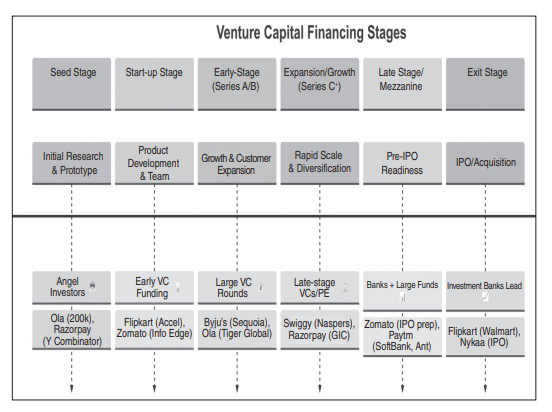
Venture capital financing typically progresses through sequential stages; each aligned with the growth and funding requirements of a start-up. Investment banks often engage at later stages to structure deals, raise larger funding rounds, or prepare companies for IPOs and strategic exits. Figure 6.2 explains the various stages of VC financing.

6.1 Seed Stage Financing

This stage supports the initial research, concept development, and prototype creation of a start-up idea. Funding is generally small and used for product feasibility studies, business model validation, and early operations wherein investor’s role includes high-risk capital providers such as angel investors, seed funds, or early-stage VCs. For example – Ola Cabs received its first seed funding of around USD 200,000 from angel investor Rehan Yar Khan to test its aggregator model; Razorpay was backed in its seed stage by Y Combinator to build its digital payments platform.
Stages of Venture Capital Financing

Stages of Venture Capital Financing

6.2 Start-up Stage Financing

This stage funds product development, hiring of the initial management team, marketing efforts, and scaling from prototype to market-ready product wherein investor’s role includes early institutional funding by VCs to start-ups with some proof of concept but no significant revenue. For example – Flipkart, after initial seed capital, raised early-stage VC funding from Accel India in 2009 to expand its online retail operations; Zomato secured early funding from Info Edge to strengthen its platform and marketing activities.

6.3 Early-Stage Financing (Series A and Series B)

This stage accelerates growth, expands the customer base, and optimises operations once the product has gained initial traction. Funds are used for scaling, technology upgrades, and geographic expansion. Larger VC funds and institutional investors come in at this stage with bigger cheques. For example – Byju’s raised a USD 25 million Series B round from Sequoia Capital to expand its edtech platform; Ola received USD 5 million in Series A from Tiger Global to grow its ride-hailing services beyond Bangalore.

6.4 Expansion/Growth Stage Financing (Series C and Beyond)

This stage supports rapid business expansion, diversification of product lines, entry into international markets, and large-scale marketing. Companies at this stage demonstrate strong revenue growth though profitability may still be limited. Late-stage VC funds, private equity firms, and corporate venture arms typically participate here. Investment banks often act as advisors for structuring these larger rounds. For example – Swiggy raised USD 210 million in a Series G round led by Naspers and DST Global to strengthen its food delivery network across India; Razorpay received late-stage funding from GIC and Sequoia to expand into new fintech solutions.

6.5 Late Stage/Mezzanine Financing (Pre-IPO Stage)

This stage prepares the company for IPO, merger, or acquisition by enhancing balance sheets, achieving profitability, and expanding further. Funds may be used for restructuring, acquisitions, or large-scale infrastructure. Investment banks play a critical role in syndicating private placements, arranging mezzanine debt, and advising on IPO readiness. For example – Zomato, before its IPO, raised late-stage funding from Tiger Global and Ant Financial. Investment banks like Morgan Stanley and Kotak Mahindra Capital helped structure its IPO in 2021; Paytm raised billions in pre-IPO rounds from investors such as Ant Group and SoftBank, with banks advising on its USD 2.5 billion IPO.

6.6 Exit Stage (IPO/Acquisition/Buyouts)

This stage provides returns to venture capitalists and investors, while enabling the company to access public markets or strategic buyers. Investment banks lead IPOs, mergers, and acquisitions, ensuring compliance, valuation, and capital raising. For example – Flipkart’s exit came in 2018 when Walmart acquired a 77% stake for USD 16 billion, one of the largest exits in India’s VC history. Investment banks advised both parties in structuring the deal; Nykaa launched a successful IPO in 2021, backed by investors like TPG and Fidelity, with the issue managed by ICICI Securities, Kotak Mahindra Capital, and Morgan Stanley.

7. Types of Venture Capital

While the stages of venture capital financing describe the chronological progression of a start-up’s funding journey, the types of venture capital categorise funding based on purpose, nature, and risk profile. Investment banks and venture capital funds often categorise these stages to structure deals effectively.

The post Venture Capital in India – Meaning | Features | Stages | Types appeared first on Taxmann Blog.

source