

Categories
Blog Updates

GST Registration Restored After Cancellation Withdrawn | HC

GST registration restoration

Case Details: P.N. Impex vs. State of Maharashtra - [2026] 185 taxmann.com 772 (Bombay)

Judiciary and Counsel Details

  • G. S. Kulkarni & Aarti Sathe, JJ.
  • Sujit SahooMs Reeta Sharma for the Petitioner.
  • Ms Shruti D. Vyas, Addl. G.P. & Aditya R. Deolekar, AGP for the Respondent.

Facts of the Case

The petitioner challenged the cancellation of its GST registration, contending that the Show Cause Notice (SCN), order-in-original (OIO) and cancellation order were non-speaking, lacked reasons, operated retrospectively. These were in violation of principles of natural justice, thereby impairing its effective opportunity to respond. It submitted that due to such procedural defects, its ability to continue business operations and access the GST portal stood adversely affected and therefore sought quashing of the cancellation order along with restoration of registration and consequential reliefs. During the proceedings, the petitioner reiterated its reliance on procedural fairness requirements under Section 29 read with Section 30 of the CGST Act. The matter was accordingly placed before the High Court.

High Court Held

The High Court held that, in the context of Section 29 and Section 30 of the CGST Act, once the jurisdictional officer withdrew the impugned cancellation order after verifying the legal position, the very basis of the dispute ceased to survive. It further held that Section 29 empowers cancellation of registration only in accordance with due process, and Section 30 contemplates restoration/ revocation subject to prescribed conditions, which stood effectively satisfied in view of withdrawal of the cancellation. The Court observed that continuation of the cancellation would be unjustified when the authorities themselves had accepted the legal infirmities and corrected the position during proceedings. It accordingly directed restoration of GST registration with consequential action, including issuance of an email communication to the petitioner, in a time-bound manner to operationalise the registration under the statutory framework.

List of Cases Referred to

The post GST Registration Restored After Cancellation Withdrawn | HC appeared first on Taxmann Blog.

source

Categories
Blog Updates

Section 271DA Penalty Invalid Without Proof of Section 269ST Violation | ITAT

Section 269ST penalty

Case Details: MSN Laboratories (P.) Ltd. vs. Additional CIT [2026] 185 taxmann.com 655 (Hyderabad-Trib.)

Judiciary and Counsel Details

  • Vijay Pal Rao, Vice President & Manjunatha G., Accountant Member
  • M.V. Prasad, CA for the Appellant.
  • Dr. Sachin Kumar, Sr. AR for the Respondent.

Facts of the Case

A search under section 132 was conducted in the MSN Group. During the search, the AO found an Excel sheet in the possession of the assessee’s cashier. The said Excel sheet contained date-wise details of sales of spent solvents and scraps. In this regard, the AO contended that the assessee received cash of Rs. 2 lakhs or more in a single transaction. Thus, the AO levied a penalty under section 271DA for the violation of section 269ST.

Aggrieved by the order, the assessee filed an appeal to the CIT(A). The CIT(A) upheld the penalty order. The assessee filed an appeal to the Hyderabad Tribunal.

ITAT Held

The Tribunal held that the Excel sheet did not show any details of each sale made to each buyer on said date. Further, the cash proceeds from the sales of spent solvents recorded in the Excel sheet were not received immediately. Except for the entry appearing on a particular date in excess of Rs. 2 lakhs or more, no tangible and cogent material on record to infer the violation of provisions of section 269ST in the case of the assessee. It is a settled law that the burden of establishing the occurrence of default by the assessee under the relevant provision, which makes the assessee liable for a penalty, is on the Revenue.

In the present case, since the AO has alleged a violation of section 269ST, the onus lies on the Revenue to establish the violation. From the material considered for the levy of penalty under section 271DA, no such evidence is forthcoming from the seized material. No evidence has been brought on record by the AO. Although the JCIT observed that it is for the assessee to discharge the burden by furnishing relevant evidence and proving that the cash received is less than the amount specified under section 269ST, once the AO alleges a violation, it is for the AO to prove the allegation with relevant evidence.

In the present case, admittedly, there is no evidence, such as sales bills or cash receipts, for the sale of unaccounted spent solvents and scraps. The only evidence found is the Excel sheet maintained by the Cashier for the entire group, which contains consolidated details for five companies and various plants/units. Only based on consolidated entries in the Excel sheet can it be alleged that the assessee violated Section 269ST and that a penalty under Section 271DA was imposed.

Therefore, the AO has not conclusively proved the violation of section 269ST to levy a penalty under section 271DA, and the penalty is not sustainable on the merits in the facts and in law.

List of Cases Reviewed

List of Cases Referred to

The post Section 271DA Penalty Invalid Without Proof of Section 269ST Violation | ITAT appeared first on Taxmann Blog.

source

Categories
Blog Updates

[Opinion] Audit Lapses and Professional Misconduct Under CA Act

audit professional misconduct

Editorial Team – [2026] 185 taxmann.com 838 (Article)

1. Introduction

The role of a statutory auditor is fundamental to maintaining the credibility of financial statements and ensuring compliance with legal and regulatory requirements. Auditors are expected to exercise due diligence, apply professional skepticism, and report any material misstatements. However, lapses in professional judgment, inadequate verification of underlying documentation, and disregard of statutory provisions or regulatory guidelines can lead to serious consequences, including findings of professional misconduct. The following discussion examines key regulatory provisions governing professional conduct, the disciplinary consequences arising from non-compliance, and practical case scenarios that illustrate how failures in due diligence, reporting, and adherence to professional standards can result in action under the Chartered Accountants Act, 1949.

2. Relevant Provisions

The following statutory and professional provisions play a crucial role in governing the duties and responsibilities of a Chartered Accountant in practice:

2.1 Chartered Accountants Act, 1949

The Act lays down the framework for regulating the profession of Chartered Accountancy in India and prescribes standards of professional conduct.

(a) Clause (6), Part I, Second Schedule

This clause provides that a Chartered Accountant shall be deemed guilty of professional misconduct if he fails to report a material misstatement known to him in a financial statement with which he is concerned in a professional capacity.

It emphasizes the auditor’s obligation to ensure that financial statements present a true and fair view and that any significant misrepresentation, whether arising from fraud or error, must be properly disclosed in the audit report.

(b) Clause (7), Part I, Second Schedule

This clause addresses failure to exercise due diligence or gross negligence in the performance of professional duties. It requires auditors to apply reasonable care, skill, and professional skepticism while performing audit procedures, including verification of transactions, examination of supporting documents, and ensuring compliance with applicable laws. Any lapse in these duties, even without intent, may attract liability under this provision.

2.2 Companies Act, 2013

This Act governs corporate functioning and compliance requirements for companies in India.

(a) Section 62 – Further Issue of Share Capital

Section 62 governs the process by which a company issues additional share capital. It mandates that:

  • Shares must first be offered to existing shareholders (rights issue) in proportion to their existing holdings.
  • Such offer must be made through a notice specifying the number of shares offered and the time period for acceptance.
  • Any allotment of shares requires clear consent or acceptance from the concerned shareholder.

Non-compliance with this provision renders the allotment invalid and may lead to legal consequences. The auditor is expected to verify that such procedures have been duly followed and supported by proper documentation.

Click Here To Read The Full Article

The post [Opinion] Audit Lapses and Professional Misconduct Under CA Act appeared first on Taxmann Blog.

source

Categories
Blog Updates

Member Subscriptions and Seminars Taxable as Business | AAR

GST association members supply

Case Details: The Coimbatore Branch of Indian Medical Association, In re - [2026] 185 taxmann.com 479 (AAR-TAMILNADU)

Judiciary and Counsel Details

  • C. Thiyagarajan & B. Suseel Kumar, Member

Facts of the Case

The applicant sought an advance ruling on whether its activities of collecting subscription from members, conducting seminars, workshops, and providing related facilities would constitute ‘business’ and ‘supply’ under GST. It was submitted that although its primary objective included conducting health camps for economically weaker sections of society and organising educational programmes for medical professionals, such activities were carried out for mutual benefit and professional development, and therefore ought not to be treated as taxable supplies. It further contended that the principle of mutuality applied to member-related transactions and accordingly excluded such activities from GST levy. The matter was accordingly placed before the Authority for Advance Ruling (AAR).

AAR Held

The AAR held that under the Section 2(17)(e) of the CGST Act, the provision of facilities or benefits by an association to its members for subscription or other consideration constitutes ‘business’ and therefore the applicant’s activities fall within its ambit. It further held that under Section 7(1)(aa) of the CGST Act, read with its explanation deeming a body and its members as distinct persons notwithstanding any other law or judicial principle, transactions between an association and its members constitute ‘supply’ under GST. The Authority observed that collection of subscription and organisation of seminars and workshops for members clearly involved consideration and fell within the statutory definition of supply. It accordingly ruled that such activities are taxable under GST.

List of Cases Referred to

The post Member Subscriptions and Seminars Taxable as Business | AAR appeared first on Taxmann Blog.

source

Categories
Blog Updates

[World Labour Law News] U.S. Proposes Unified Joint Employer Test Across FLSA | FMLA | MSPA

US joint employer test proposal

Editorial Team – [2026] 185 taxmann.com 848 (Article)

World Labour Law News provides a weekly snapshot of Labour law developments from around the globe. Here’s a glimpse of the key Labour law update this week.

1. Labour Law

1.1 U.S. Proposes Unified Joint Employer Test Across FLSA, FMLA, MSPA with Clear Vertical and Horizontal Standards

On April 22, 2026, the U.S. Department of Labor announced a Notice of Proposed Rulemaking (NPRM) to revise its analysis for assessing joint employer status under three federal wage and hour laws. Specifically, the NPRM proposes to:

(1) to implement regulatory guidance for determining joint employer status under the Fair Labor Standards Act (FLSA) at 29 CFR part 791; and

(2) amend provisions in existing regulations implementing the Family and Medical Leave Act (FMLA) and Migrant and Seasonal Agricultural Worker Protection Act (MSPA) so that the proposed FLSA analysis would be used to determine joint employer status under those laws too.

In particular, the NPRM’s proposed analysis would:

  • Set forth distinct standards for determining joint employer status in “vertical” and “horizontal” scenarios—a distinction that courts and the Department have long drawn.
  • Advise that horizontal joint employment exists when separate employers are sufficiently associated with respect to the employment of the same employee, but that business relationships which have little to do with the employment of specific employees—such as sharing a vendor or being franchisees of the same franchisor—are alone insufficient to establish joint employment.
  • Adopt a four-factor analysis for use in every case of potential vertical joint employment, examining whether the potential joint employer:
    1. hires or fires the employee;
    2. supervises and controls the employee’s work schedule or conditions of employment to a substantial degree;
    3. determines the employee’s rate and method of payment; and
    4. maintains the employee’s employment records.
  • Explain that additional factors may be relevant in assessing vertical joint employment, but that a unanimous finding on the four factors in either direction would establish a “substantial likelihood” regarding whether an individual or entity is a joint employer with another.

Source – Notice

1.2 The Government of Canada Invests in Programs that have a Proven Track Record of Delivering Positive Employment Outcomes for Young People

On April 13, 2026, On April 13, 2026, the Government of Canada highlighted expanded youth employment and skills programs, including student aid, work placements and apprenticeship support.

Backgrounder

1. Managing the cost of studying and training:

The Canada Student Financial Assistance Program

The Canada Student Financial Assistance Program (CSFA Program) provides Canada Student Grants and Loans to help students pay for their post-secondary education. It also offers repayment assistance to borrowers with financial difficulty.

Through the CSFA Program, the Government of Canada funds about 60% of a full-time student’s financial need. The province or territory covers the remaining 40%.

The Program works in partnership with provinces and territories to deliver student aid. Funding is available to full- and part-time students that:

  • are from low- and middle-income families
  • have dependants
  • have disabilities

Apprentices can also get help through Canada apprentice loans and apprenticeship grants.

To help students manage costs, ESDC extended temporary increases to Canada Student Grants and Loans for the 2026-27 school year. Approximately 571,000 Canadian students are expected to benefit from the 40% increase to non-repayable grants and 422,000 students could benefit from the weekly loan limit increase. Additionally, the Canada Student Loan Forgiveness benefit is now available for family doctors, nurses, early childhood educators, dentists, dental hygienists, pharmacists, midwives, teachers, social workers, personal support workers, physiotherapists, and psychologists in over 200 new rural and remote communities.

Source – News

Click Here To Read The Full Article

The post [World Labour Law News] U.S. Proposes Unified Joint Employer Test Across FLSA | FMLA | MSPA appeared first on Taxmann Blog.

source

Categories
Blog Updates

SC Bars Use of IBC as Recovery Tool by Decree Holders

IBC misuse decree holder

Case Details: Anjani Technoplast Ltd. vs. Shubh Gautam - [2026] 185 taxmann.com 816 (SC)

Judiciary and Counsel Details

  • Pamidighantam Sri Narasimha & Alok Aradhe, JJ.
  • Dama S Naidu, Sr. Adv., Pankaj PandeyGirish TripathiDigvijay PrasadAshish YadavMs Ranjeeta Rohtagi, Advs. & Ms Megha Karnwal, Aor for the Appellant.
  • Kapil SibalS. Niranjan Reddy, Sr. Advs., Ms Shloka Narayanan, Aor, Gaurav SinghMs RajeshwariMs Shubhani D Krishan, Advs. for the Respondent.

Facts of the Case

In the instant case, the respondent, a money lender, advanced loans of about Rs. 2.50 crore (12.75% p.a.) and Rs. 2 crore (3% monthly) in 2010. After cheque dishonour and a 2013 compromise, the appellant paid about Rs. 3.53 crore by July 2014. A 2016 summary suit claimed Rs. 4.38 crore; a second compromise fixed Rs. 2.39 crore as full settlement. On 11.01.2018, the Delhi High Court decreed Rs. 4.38 crore with 24% interest from 01.02.2016. Appeals failed up to the Supreme Court in 2021.

In December 2021, the respondent filed a Section 7 IBC plea instead of execution. The NCLT (June 2022) dismissed it, holding a decree holder is not automatically a financial creditor and IBC cannot be used for recovery. The NCLAT (November 2022) reversed this, allowing admission on the basis of time value of money.

Meanwhile, the Delhi High Court directed recomputation of dues and deposit of Rs. 3 crore (paid in November 2022). Tax proceedings and ITAT records showed lower outstanding figures, creating inconsistencies. On appeal to the Supreme Court, the appellant later deposited Rs. 60.99 lakh before the Supreme Court in October 2024.

Supreme Court Held

The Supreme Court observed that a decree for money in favour of a financial creditor would give rise to a fresh cause of action for initiating proceedings under Section 7 of IBC. However, that principle does not operate in a vacuum and does not mean that every decree holder who also happens to be a financial creditor is entitled, as a matter of right, to invoke insolvency process in preference to execution.

Accordingly, the application of this principle must be tested on the facts of each case. The question of whether, in each case, invocation of IBC amounts to misuse of process or use of the Code as a recovery mechanism remains to be examined on facts. Where the respondent, holding a final money decree and having full machinery of civil execution at his disposal, chose instead to invoke insolvency jurisdiction, such conduct was precisely what the Supreme Court in GLAS Trust Company LLC v. BYJU Raveendran [2024] 167 taxmann.com 619/[2025] 187 SCL 14 (SC)/(2025) 3 SCC 625 had characterised as an improper use of IBC, using insolvency as a substitute for debt enforcement and as a means of coercing the corporate debtor into payment.

The Supreme Court held that where the quantum of “debt” itself, as contemplated under the Code, was seriously disputed, initiation of CIRP was nothing more than use of IBC as a recovery mechanism and was an abuse of process. Insolvency process is a remedy with far-reaching consequences and must be reserved for cases of genuine insolvency or financial distress, not for enforcement of money decrees.

List of Cases Reviewed

List of Cases Referred to

The post SC Bars Use of IBC as Recovery Tool by Decree Holders appeared first on Taxmann Blog.

source

Categories
Blog Updates

[Opinion] Computing the Block Period u/s 153C | Search Date vs Receipt Date

Section 153C block period

Sumaksh Mahajan – [2026] 185 taxmann.com 834 (Article)

An Examination of Competing Interpretations and the Emerging Judicial Position

Sections 153A and 153C of the Income Tax Act, 1961 ceased to apply to searches conducted on or after 1 April 2021. Their continuing relevance, however, is not in doubt. A substantial volume of search assessments from the pre-2021 period remains pending before CIT(A)s, ITA Tribunals, and the High Courts. Within this body of litigation, one interpretive question surfaces with considerable frequency: for a person who has received a notice under Section 153C—the ‘other person,’ who was not searched but whose material was recovered during a search of a third party—from which date should the block period of six assessment years be computed? The Revenue’s position is that the date of search governs. The counter-position, which has found support in a consistent line of judicial decisions, is that the First Proviso to Section 153C creates a deeming fiction that displaces the date of search with the date on which the seized material was received by the jurisdictional Assessing Officer. This article sets out the statutory framework, examines the competing arguments, and surveys the current judicial position.

I. The Statutory Framework

Section 153A, introduced by the Finance Act, 2003, governs assessments of searched persons. Upon a search under Section 132 or a requisition under Section 132A, the Assessing Officer is required to issue notice for the six assessment years immediately preceding the year of search. The notice is mandatory—no precondition of satisfaction, no room for discretion. Abatement of pending assessments for those years follows automatically on the date of search.

Section 153C addresses a different scenario: where material seized from a searched person is found to belong to a third party—the ‘other person.’ That person’s assessment is conducted in accordance with the procedure under Section 153A. However, two conditions must be satisfied before any notice can issue:

(i) the AO of the searched person must record satisfaction that the seized material belongs to the ‘other person,’ and

(ii) the jurisdictional AO of the ‘other person’ must separately record satisfaction that the material has a bearing on the determination of their income.

The provision at the heart of this article is the First Proviso to Section 153C(1), which reads, in material part:

…for this purpose, references to the date of initiation of the search under section 132 or making of requisition under section 132A in section 153A shall be deemed to be references to the date of receiving the books of account, other documents or assets by the Assessing Officer having jurisdiction over such other person.—First Proviso to Section 153C(1)

On a textual reading, the First Proviso creates a deeming fiction: the date of search is substituted, for the purposes of the ‘other person’s’ proceedings, with the date of receipt of seized material by the jurisdictional AO. The six-year block runs backward from the assessment year relevant to the year of receipt—not the year of search.

II. Structural Distinction Between Sections 153A and 153C

Before examining the competing interpretations, it is useful to set out the key structural differences between the two provisions. These differences underlie the interpretive controversy and are frequently not pressed with sufficient clarity before lower authorities.

Parameter
Distinction
Trigger
Section 153A  A search u/s 132 or requisition u/s 132A is the sole trigger. No further condition precedent. Notice is mandatory—the AO ‘shall’ issue it.
Section 153C Double-satisfaction required before any notice can issue:
(i) the AO of the searched person must record satisfaction that seized material belongs to the ‘other person’; and
(ii) the jurisdictional AO of the ‘other person’ must record satisfaction that the material bears on their income.
Block Period Anchor
Section 153A Six AYs reckoned backward from the AY relevant to the previous year in which the search was conducted.
Section 153C Per the First Proviso deeming fiction, the reference to the date of search in Section 153A is deemed to be the date of receipt of seized material/books by the jurisdictional AO of the ‘other person.’
Abatement of Pending Assessments
Section 153A Automatic and unconditional on the date of search—a preordained consequence of the search.
Section 153C Conditional—arises only after the jurisdictional AO forms the requisite satisfaction and proceeds under Section 153C.
Legislative Design
Section 153A Mandatory, non-discretionary, and search-driven. No room for the AO to form or withhold an opinion.
Section 153C Conditional, opinion-driven, and deliberately more exacting—consistent with the fact that the ‘other person’ was not the subject of the search.
Click Here To Read The Full Article

The post [Opinion] Computing the Block Period u/s 153C | Search Date vs Receipt Date appeared first on Taxmann Blog.

source

Categories
Blog Updates

No Claim Against Principal Employer Without Employment Proof | HC

principal employer liability

Case Details: Paramjeet Singh vs. BSES Rajdhani Power Ltd. [2026] 185 taxmann.com 276 (Delhi)[30-03-2026]

Judiciary and Counsel Details

  • Manoj Kumar Ohri, J.
  • Karan LuthraShiven Asthana, Advs. for the Petitioner.
  • Sandeep Prabhakar, Sr. Adv. & Vikas Mehta, Adv. for the Respondent.

Facts of the Case

In the instant case, the workman, Paramjeet Singh, claimed that he was employed as a driver from 14.12.2003 to 31.05.2012 and that his services were illegally terminated on 01.06.2012 after he demanded statutory benefits. He filed a claim against both the principal employer (BSES Rajdhani Power Ltd.) and the contractor. He relied on two identity cards issued by the contractor and a vehicle log slip to support his claim. However, BSES denied any employer–employee relationship with him, while the contractor admitted that he was its employee but stated that he had left the job on 19.05.2012 and had not completed 240 days of continuous service in the preceding year.

The Labour Court examined the facts and found that Paramjeet Singh failed to prove continuous service of 240 days, as required under Section 25F of the Industrial Disputes Act, 1947. The identity cards produced were not sufficient evidence, and there was a clear break in service, he stopped working after 30.04.2011 and rejoined only on 02.11.2011 before finally working till 19.05.2012. Importantly, he did not file any response to challenge the contractor’s version that he had voluntarily left the job. Based on these findings, the Labour Court dismissed his claim.

High Court Held

On appeal, the High Court of Delhi upheld the Labour Court’s decision. The Court noted that Paramjeet Singh had claimed to be an employee of BSES. Still, there was no evidence to establish such a relationship, especially since the contractor had admitted employment. It further held that in the absence of any allegation that the contract between BSES and the contractor was illegal, the workman could not claim to be an employee of the principal employer. Additionally, since he sought no relief against the contractor, there was no basis to interfere with the Labour Court’s award. Accordingly, the petition was dismissed.

List of Cases Referred to

The post No Claim Against Principal Employer Without Employment Proof | HC appeared first on Taxmann Blog.

source

Categories
Blog Updates

ITC Claim for Tax Year 2018-19 Allowed Under Section 16(5) Extension | HC

Section 16(5) ITC extension

Case Details: Saurabh Agarwalla vs. Union of India [2026] 185 taxmann.com 739 (Gauhati)

Judiciary and Counsel Details

  • Anjan Moni Kalita, J.
  • R.S. MishraMs B. SarmaMs M. Dey, Advs. for the Petitioner.

Facts of the Case

The petitioner, a registered person under the CGST and Assam GST Acts, had availed input tax credit (ITC) for FY 2018–19, which was denied by the department on the ground that it was availed beyond the time limit prescribed under Section 16(4). A show cause notice was issued, and thereafter an Order-in-Original dated 07.02.2024 was passed confirming demand along with interest and penalty. The petitioner challenged the order before the High Court, contending that subsequent insertion of Section 16(5) and 16(6) retrospectively extended the time limit for availing ITC up to 30 November 2021 for the relevant financial years, and thus the denial of ITC was no longer sustainable.

High Court Held

The High Court held that in view of the retrospective amendment inserting Section 16(5), the petitioner was entitled to avail ITC for the relevant period notwithstanding the limitation under Section 16(4), as the extended timeline directly covered the petitioner’s case; consequently, the basis of denial ceased to exist, and the Order-in-Original confirming demand, interest, and penalty was set aside, subject to payment of excess utilized amount and applicable interest within the stipulated time.

The post ITC Claim for Tax Year 2018-19 Allowed Under Section 16(5) Extension | HC appeared first on Taxmann Blog.

source

Categories
Blog Updates

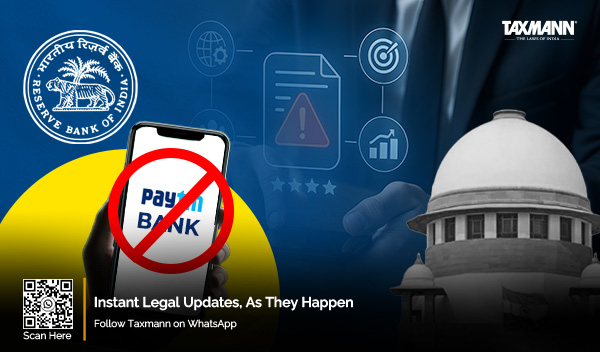
RBI Cancels Paytm Payments Bank Licence Over Compliance Failures

Paytm Payments Bank licence cancellation

The Reserve Bank of India (RBI) has cancelled the banking licence of Paytm Payments Bank, effective April 24, 2026, bringing an end to all its regulated banking operations.

1. Cessation of Banking Operations

Following the cancellation:

  • The bank is no longer permitted to:
    1. Accept deposits
    2. Undertake fund transfers
    3. Provide any regulated banking services
  • The process of winding up has been initiated

2. Regulatory Reasons for Cancellation

The RBI’s action is based on:

  • Serious lapses in governance standards
  • Persistent non-compliance with regulatory directions
  • Failure to adhere to licence conditions

3. Prior Supervisory Actions

Before cancellation, RBI had:

  • Imposed restrictions on operations
  • Limited the bank’s activities to:
    1. Contain risks
    2. Protect customer interests

Despite these measures:

  • The bank was unable to rectify regulatory deficiencies

4. Protection of Depositors

  • RBI has clarified that the bank has adequate funds to repay depositors
  • Customers will:
    1. Receive their funds through the prescribed winding-up process
    2. Be safeguarded during the transition

5. Regulatory Significance

This action underscores RBI’s:

  • Commitment to strict regulatory enforcement
  • Focus on governance and compliance standards
  • Priority towards protecting depositors and financial stability

6. Conclusion

The cancellation marks a decisive regulatory step, ensuring that non-compliance and governance failures are addressed firmly, while maintaining confidence in the banking system through depositor protection measures.

Click Here To Read The Full Press Release

The post RBI Cancels Paytm Payments Bank Licence Over Compliance Failures appeared first on Taxmann Blog.

source