
Categories
Blog Updates

HC Condoned Delay in GST Appeal for ITC Dispute

GST Appeal for ITC Dispute

Case Details: Vishal Durgadas Jaiwant vs. Joint Commissioner of Commercial Taxes (Appeals) [2026] 183 taxmann.com 665 (Karnataka)

Judiciary and Counsel Details

  • Mrs K.S. Hemalekha, J.
  • S.G. Solargoppa, Adv. for the Petitioner.
  • Praveen K. Uppar, AGA for the Respondent.

Facts of the Case

The petitioner challenged the rejection of his appeal against the denial of Input Tax Credit (ITC) arising from a mismatch caused by the supplier’s failure to upload the relevant invoice in GSTR-1. It was submitted that ITC had been availed based on the supplier’s invoice. He contended that, due to a bona fide belief that the supplier would rectify the error and a lack of awareness and assistance regarding the limitation period, the appeal could not be filed within time. The petitioner, therefore, sought condonation of the delay and adjudication of the appeal on the merits. The matter was accordingly placed before the High Court.

High Court Held

The High Court held that the explanation furnished by the petitioner disclosed a bona fide belief and reasonable cause for the delay. The Court observed that the dispute arose from an assessment under Section 73 of the CGST Act and that the appeals filed under Section 107 of the CGST Act and the Karnataka GST Act required consideration on the merits. It further noted that instructions issued under Section 168 were relevant in cases of ITC mismatch due to supplier non-reporting. Accordingly, the Court set aside the order rejecting the appeal as time-barred and directed that the appeal be treated as filed within time and decided on the merits.

List of Cases Referred to

The post HC Condoned Delay in GST Appeal for ITC Dispute appeared first on Taxmann Blog.

source

Categories
Blog Updates

[Global Financial Insights] IASB Update – February 2026 | Key Highlights and More

IASB February 2026 update

Editorial Team – [2026] 184 taxmann.com 56 (Article)

Global Financial Insights is a weekly feature for the Accounts and Audit Module subscribers of Taxmann.com. It provides you with the latest updates on financial reporting and auditing practices from across the globe. Here is this week’s financial update:

1. IASB Update – February 2026 | Key Highlights

The International Accounting Standards Board held its meetings on 24–25 February 2026 to discuss various research, standard-setting and maintenance projects. Key highlights of the meetings are summarised below:

(a) Financial Instruments with Characteristics of Equity

The IASB met on 24 February 2026 to continue redeliberating the Exposure Draft on Financial Instruments with Characteristics of Equity, focusing on proposed amendments to IAS 32 related to the classification of derivatives on own equity when applying the fixed-for-fixed condition. The Board tentatively agreed to proceed with the proposed requirements, subject to minor drafting improvements and targeted refinements. These clarifications include defining a derivative as meeting the fixed-for-fixed condition if there is a fixed amount of consideration and either a fixed number of own equity instruments or a fixed exchange ratio, and confirming that derivatives between group entities can meet the condition in consolidated financial statements under specified functional currencies. Terminology was updated: “preservation adjustments” are now “adjustments that compensate the future holders of the equity instruments,” and “passage-of-time adjustments” are now “adjustments that are solely a function of time,” with further guidance on predetermined adjustments and share-for-share exchanges. All 13 IASB members agreed with these decisions.

The Board also received an update on the project plan but made no further decisions. The IASB will continue to redeliberate the classification topics in the Exposure Draft in upcoming meetings.

(b) Post-implementation Review of IFRS 16, Leases

The IASB discussed additional feedback received on its request for information for the Post-implementation Review of IFRS 16, including matters relating to transition requirements and academic research. No decisions were taken. The Board will continue analysing feedback before determining whether further actions are required.

(c) Amortised Cost Measurement – IFRS 9

The IASB tentatively decided to clarify that a modification of a financial instrument constitutes a change in contractual terms affecting the nature, timing, amount or uncertainty of cash flows under IFRS 9. It also decided to clarify that a substantial modification of a financial asset results in derecognition of the original asset and recognition of a new asset, assessed using a principles-based approach. All 13 IASB members agreed with these decisions, and the Board will continue deliberating the remaining proposals in future meetings.

(d) Equity Method

The IASB met on 25 February 2026 to continue reviewing the proposals in the Exposure Draft on the Equity Method of Accounting—IAS 28 Investments in Associates and Joint Ventures. The Board tentatively decided to retain the existing guidance on impairment indicators, clarifying that a single event may not indicate impairment and that investors should consider all observable information when assessing whether an investment in an associate has lost value. They also agreed to update the language in IAS 28, replacing “decline in fair value … below its cost” with “decline in fair value … to less than its carrying amount,” removing references to a “significant or prolonged” decline, and confirming that investors should use observable price information, including market prices, when determining impairment, especially for publicly traded associates.

Regarding other matters, the IASB decided not to move the impairment requirements from IAS 28 to IAS 36 and will not address two application issues related to reversing impairment losses at this stage. All 13 IASB members agreed with these decisions, and the Board will continue deliberating the remaining proposals in future meetings.

(e) Post-implementation Review of IFRS 9 – Hedge Accounting

The IASB discussed the objective, activities and timeline for the first phase of the post-implementation review of hedge accounting requirements under IFRS 9. No decisions were taken. The Board plans to engage with consultative groups and other stakeholders to inform a request for information, which it expects to publish in the second half of 2026.

(f) Provisions – Targeted Improvements

The IASB had earlier issued an Exposure Draft titled “Provisions—Targeted Improvements”, proposing targeted amendments to the recognition criteria for provisions under IAS 37 Provisions, Contingent Liabilities and Contingent Assets and inviting stakeholder feedback.

At its meeting on 24 February 2026, the IASB redeliberated the feedback received on the Exposure Draft, focusing on aspects of the present obligation recognition criterion, particularly the past-event condition and the proposed transfer condition.

In relation to levies, the Board tentatively decided to supplement the proposed past-event condition with additional application requirements. These would establish the principle that the economic benefit or activity satisfying the past-event condition is the activity the government seeks to levy, supported by a constraining presumption that such activity would generally be one specified in the levy legislation for the levy to become payable. The IASB also discussed whether this presumption should be rebuttable in certain circumstances, although no decision was taken on this matter.

The IASB also tentatively decided to retain the proposal to introduce an explicit ‘transfer condition’ in the recognition criterion. The Board agreed to further clarify the distinction between an obligation to transfer an economic resource and an obligation to exchange economic resources, noting that an exchange involves both a transfer and a corresponding right to receive another economic resource, which may result in the recognition of either an asset or an expense. Additional guidance and examples will be expanded to explain how the transfer condition applies to asset decommissioning and environmental rehabilitation obligations and how it interacts with measurement requirements in IAS 37.

Further, the Board agreed to clarify the implications of the transfer condition for levies by defining ‘levy’ as a non-reciprocal charge and specifying that obligations for levies would, by definition, meet the transfer condition.

The IASB will continue redeliberating the proposals in the Exposure Draft in subsequent meetings.

Source – International Financial Reporting Standard

Click Here To Read The Full Article

The post [Global Financial Insights] IASB Update – February 2026 | Key Highlights and More appeared first on Taxmann Blog.

source

Categories
Blog Updates

Fundamentals of Industry Analysis – Cyclicality | Trends

Fundamentals of Industry Analysis

Fundamentals of industry analysis refer to the systematic evaluation of an industry’s structure, dynamics, growth potential, and competitive environment to assess the prospects of companies operating within that industry. It involves examining factors such as industry definition, market size, cyclicality, demand drivers, secular trends, competitive intensity, regulatory environment, and the industry life cycle. Through industry analysis, analysts can understand how economic conditions, technological changes, and market forces influence the performance and profitability of businesses within the industry. This analysis helps investors and researchers identify growth opportunities, competitive advantages, and potential risks, thereby supporting more informed investment and strategic decisions.

Table of Contents

  1. Role of Industry Analysis in Fundamental Analysis
  2. Defining the Industry
  3. Understanding Industry Cyclicality
  4. Market Sizing and Trend Analysis
  5. Secular Trends, Value Migration and Business Life Cycle
  6. Understanding the Industry Landscape
Check out NISM X Taxmann's Research Analyst which is a comprehensive, practice-oriented handbook on equity research and investment analysis, designed as a complete desk reference for conducting professional research in regulated capital markets. It seamlessly integrates securities market fundamentals, research methodologies, economic and industry analysis, company evaluation, valuation, risk assessment, and research report writing into a single, coherent framework. The book traces the entire equity research lifecycle—from market understanding to valuation and compliant research output—while emphasising disciplined analytical thinking, sound professional judgment, and ethical conduct. Published by Taxmann, it is an essential resource for research professionals, analysts, students, and educators seeking a rigorous and practical approach to high-quality equity research.

1. Role of Industry Analysis in Fundamental Analysis

Economic analysis helps us understand whether economy, in general, is likely to grow in the foreseeable future or decline. Industry analysis helps in understanding how each industry would be impacted under the current economic conditions.

In Industry analysis, analysts also try to understand how the various players related to a particular industry or business sector are likely to react and how that may affect the prospect of the industry. The words Industry and Business Sector or Economic Sector are sometimes a source of confusion due to their lose usage and the multitude of definitional standards across the globe. Industry is a grouping of firms, which offer the same or similar products or service to serve the same customer need (example, Auto industry, Insurance industry, Steel industry, Telecom industry, Entertainment industry). Business Sector is a broad category comprising similar and related industries (example, Financial Services Sector encompassing Insurance, Banking, Credit Rating, Investment Banking; Industrial metals sector comprising Steel, Copper, and Aluminum industries). Economic sector represents the segments of an economy which contribute to the total national income or national product, like agriculture, manufacturing, public utilities, and services. For the research analysts the following paragraphs would bring in more clarity.

The various questions that must be addressed in industry analysis include the following:

  1. What is the industry in which the company operates?
  2. How much does it get impacted on account of cyclical trends in the economy?
  3. What is the potential industry size?
  4. How has the industry been performing in the past and what were the drivers behind the performance?
  5. What is the level of competition in the industry? How does it affect the pricing power of the various players?
  6. What are the various secular trends that affect the industry, and are they causing any value migration?
  7. Are there any regulatory headwinds or tail winds affecting the industry?

NISM X Taxmann | Research Analyst

2. Defining the Industry

The very first step in an industry analysis is to define the industry in which the company operates. Industry definition is not always an easy task. While there are several standard industry classification systems, such as National Industry Classification (NIC) system in India, the Global Industry Classification Standard (GICS). or North American Industry Classification System (NAICS) in US, they may not necessarily capture the substance of the industry.

For instance, NIC has a single classification for manufacture of passenger cars. Thus, every car manufacturer including entry level compact car manufacturers and high-end luxury car manufacturers fall under the same industry classification. However, since the dynamics of the luxury car manufacturer is very different from entry level passenger car segment, analysts may view them as different industries. The challenge especially increases when a company competes in many industries to earn its income.

Let us take the example of PVR Limited. On one hand, PVR Cinemas competes with satellite channels and Over the Top (OTT) platforms, such as Netflix and Hotstar, to attract audience. On the other hand, the cinema industry also competes with live theatres, live performances, and sporting leagues.

Thus, if an analyst applies a narrow industry definition and classifies the company as part of cinema exhibitors, it creates a risk of overlooking other competitors. But if one were to give broader definition, then challenge is to identify whether to classify the company as part of entertainment media industry or should it be classified as part of Out of Home (OOH) entertainment industry. This may force the analyst to classify it as part of a much broader media and entertainment industry. But that would create another challenge as each segment within this broader group have their own idiosyncrasies and not strictly comparable. This understanding is extremely crucial, especially when the analysts embark on the journey of comparison of financials, finds our peer firms, and then undertakes valuations.

Camera manufacturing is another example that shows the challenges in defining an industry. Couple of decades ago, cameras were a standalone product. However, with the emergence of mobile phones with built-in cameras, a lot of entry level digital cameras started losing their sales to these phones. Today, with emergence of high technology mobile phones, even mid-tier cameras are facing competition from mobile phones. If cameras are defined as a standalone industry, then an analyst may end up ignoring this huge competition from mobile phones.

An analyst should carefully consider the various factors that drive the business and should classify it as part of the industry group which have such common driving factors. Thus, if an analyst believes that PVR Limited’s business is driven by people’s propensity to spend time outside their home, it may be appropriate to classify it as part of out of home entertainment industry. On the other hand, if the business is largely driven by people’s propensity to consume movie content, then it may be appropriate to classify it as part of entertainment media.

GICS which is widely used in financial sector for global investors on the other hand is a four-tiered, hierarchical industry classification system where the four tiers are – Sectors, Industry Groups, Industries and Sub-Industries divided into 11 sectors, 25 industry groups,74 industries and 163 sub-industries. An example for grouping for Energy sector is shown below for illustration purposes:
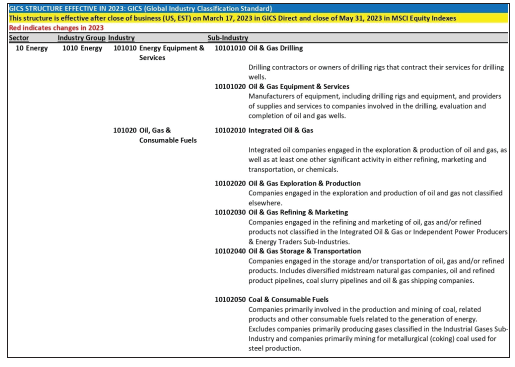
Grouping for Energy Sector Illustration

Source – MSCI, March 2023

3. Understanding Industry Cyclicality

Economic cycles affect all businesses. However, they affect some businesses more than others. Based on the cyclical nature, industries can be classified into three categories:

Defensive Industries – These are industries that create products and services that have low-income elasticity i.e., a fall or rise in income does not affect the demand significantly. Therefore, these industries experience minimal impact on account of economic cycles. Rather, their business prospects are affected only by secular trends. Food, agricultural inputs, and healthcare are some of the industries that have exhibited these traits in the past.

Semi-cyclical Industries – These industries experience growth in sales during the expansionary phase and decline during recessionary phase. However, these industries do have some base level demand which help the industry to have reasonably healthy sales in recessionary conditions also. Consumer durables industry has exhibited these traits.

Deep Cyclical Industries – These industries witness extreme cyclicality in their revenues as they are largely driven by economic cycle and/or commodity cycles. Capital goods industry or Steel exhibits such behavior. During recessionary conditions, their sales drop significantly as most companies put their capacity expansion plans on hold. However, these industries experience massive growth at the first signs of economic recovery as pent-up demand result in higher orders.

4. Market Sizing and Trend Analysis

Industries that are underpenetrated have high growth potential as there is more headroom for growth. However, as industries mature, the new growth avenues decline and the overall growth rates, thus, come down. Therefore, while studying industry, it is important to analyse the potential size of the market and current size of the market.

However, measuring the current market size is difficult especially if there are many unorganised players or private companies whose information is not available in public domain. Further, quantifying the potential size of the market also involves making lot of assumptions, which can go wrong.

Therefore, studying the past trends can supplement our analysis and help us understand how the industry has been growing and what are the factors that are affecting growth. Such studies also help us understand the underlying secular trends.

Market sizing can be done through either top-down approach or bottom-up approach. In a top-down approach, we measure the size of the market or industry starting from macro-economic factors and arrive up to the industry level. In bottom-up approach, we quantify the market by looking at individual companies and aggregating their data to arrive at the industry size.

For example, if we were to quantify the total industry size for a particular therapy, we can use the top-down approach as follows:

(i) identify how many patients underwent the therapy

(ii) ascertain average expenditure per patient

(iii) take the product of (i) and (ii) to arrive at the revenue.

From a bottom-up perspective, we can look at revenue of all the hospitals that provide this therapy and identify how much (or what proportion) of their revenue was earned from this therapy. We can then aggregate it to arrive at industry size.

As mentioned above, market sizing may involve making certain assumptions, as all the required information may not be available.

5. Secular Trends, Value Migration and Business Life Cycle

As discussed earlier, secular trends are long term trends that cause displacement in production or consumption of goods and services. There are various factors that drive secular trends:

(i) Technological Advancement – New technology can cause disruption in many ways. It can bring in new methodology in production of goods. It can provide alternative to an existing product or can create new consumption pattern. The following are some of the examples of secular trends caused by technology:

(a) Horizontal drilling technology enabled exploration of shale gas. This resulted in significant decline in long term average price of hydrocarbons.

(b) Digital cameras made film rolls obsolete; mobile cameras made entry level digital cameras obsolete.

(c) Improvement in battery technology is enabling increased use of electric vehicles compared to fossil fuel driven vehicles.

(ii) Change in Income Levels – As an economy grows, the disposable income of population is likely to increase. This can cause change in category of goods and services being consumed. People start consuming premium products compared to cheaper alternatives.

(iii) Demographic Changes – The composition of a country’s population in terms of age, gender and ethnicity may undergo change over a period. This may cause changes in the consumption pattern within the country. For example, ageing population in Japan has resulted in decrease in per capita consumption of beer.

(iv) Change in Culture, and Tastes and Preferences – Cultural changes are a constant. Most often, they are gradual. However, sometimes changes can also be sudden driven by revolution, insurgencies, or a societal response to a pandemic. These changes can cause a change in consumption pattern of goods and services. For example, increasing influence of western culture in Asian societies created higher demand for western clothing.

(v) Changes in Regulation or Government Policy – Change in regulations, or government actions may also create secular trends in industry. For instance, implementation of GST created certain efficiencies in the logistic industry. It in turn reduced the demand for purchase of new commercial vehicles.

In addition to the above, many other factors may also serve as a catalyst for a secular trend.

When a new secular trend emerges, it causes value migration between industries or between players. And often it also creates an inflection point in the business cycle of one or more affected industries.

5.1 Value Migration

In simple terms, value migration happens when a phenomenon creates long term advantage for one or more entities at the cost of other entities. Thus, the entity that gains witnesses an increase in its shareholder value, while the other entity loses. The entity that adopts the latest technology, or captures the changing needs of the customer preferences, or creates a disrupting innovation benefit and its laggard competitors loose.

Such a shift can happen across geographies, across industries, across the value chain and to a lesser extent between competitors within the industry.

Geographic Migration – Geographic migration of value happens when a secular trend helps a country or geography as compared to other. For instance, horizontal drilling and shale gas discovery shifted value to US based oil exploration at the cost of other oil producing countries as US had large amount of shale gas reserve and were able to extract them at a lower cost compared to other oil producing nation. Similarly, globalization helped low-cost manufacturer such as China to rapidly grow its economy as compared to many other high cost destinations.

Cross Industry Migration – Cross industry migration happens when one industry gains at the cost of another. For example, advent of digital cameras resulted in massive decline of film rolls industry and saw big companies like Kodak having to shut down.

Migration Across Value Chain – Some phenomenon can result in industries at the down end of value chain gain at the cost of those at the upper end or vice versa. For example, high competition intensity in the Indian telecommunication space resulted in significant fall in price of mobile services, which in turn led to significant decline in shareholder value for telecom companies. However, this resulted in increased consumption of digital products and thus more traction for digital content providers.

Migration Across Companies in the Same Industry – Certain disruption may create new competitive advantage for one company or may remove a competitive advantage enjoyed by an existing player. This may result is value migrating from one company to another. For example, before advent of 2G technology, Research in Motion (Blackberry) enjoyed significant competitive advantage among corporate mobile users. Its mobile devices were the most efficient in accessing emails and other internet services. However, with the advent of 2G Technology many new smartphone manufacturers emerged. They were able to provide similar service. This eventually led to decline in shareholder value for Blackberry while its competitors such as Apple saw the value increasing.

Understanding value migration can help analysts identify suitable investment opportunities ahead of time and to exit from the loosing businesses.

5.2 Business Life Cycle

Business life cycle refers to the various stages through which a business transitions through its journey from its emergence till its eventual decline.
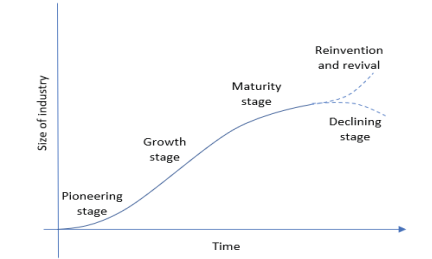
Business Life Cycle

Every industry typically goes through the following phases:

(a) Pioneering Stage – The industry is just taking shape. It is not widely adopted. The concept is still being proven or just been proven.

(b) Growth Stage – The concept is found viable and many customers start adopting the new product. As more and more customers adopt the product, the industry witness steep growth.

(c) Matured Stage – The industry has existed for long and most customers who can use the product are already using it. Number of new (potential) customers are relatively less.

(d) Declining Stage – Change in customer preference or a new technology replaces the industry’s product with a new product. At this juncture, the industry starts losing out to the alternatives.

(e) Reinvention and Revival – Although it is very rare, it is possible that the goods or services produced by the industry finds a new use in a different application and starts a new cycle all over again.

In the Indian context, call taxis can be looked at one example of an industry that has gone through all the phases over a period.

Call taxis in India started taking shape during the end of 20th century and early parts of 21st century. Aided by increased penetration of telephones and growing consumer income, call taxi services witnessed tremendous growth over the next decade. However, with the advent of app-based taxi aggregators, the industry declined significantly in size.

Every industry goes through the cycle and in turn causes significant displacement in the economy. The labor force working in one industry will have to reskill themselves and move to a new industry or find themselves out of workforce. Similarly, capacity will need to be redirected to a different use.

Although secular trends can be traced to business lifecycles, there are other disruptors that can affect the secular trend. For example, horizontal drilling technology enabled exploration of shale gas which brought a long-term decline in crude oil prices without causing any displacement of the goods being consumed.

Analysing and understanding secular trends help the analyst understand the long-term trajectory of the business.

However, in order to understand the medium term and short-term trends, analyst will have to focus on cyclical trends.

6. Understanding the Industry Landscape

Industry landscaping involves studying all the players in the industry and their interaction with each other. This includes understanding competitors, customers, suppliers, regulators, and emerging technologies. It also involves studying the differentiating factors between various competitors and customer’s preference.

Such a study will help the analyst understand how the industry may react to external market events. For example, in industries with low competition intensity, companies are likely to be able to transfer any increase in input cost to their customers. Thus, their profit margin is likely to remain intact. On the other hand, if the competition intensity is high, it may create pricing pressure which will likely reduce the profits.

Industry landscaping needs to be very comprehensive. While analysts can use their own frameworks, there are certain established frameworks that can help understand the industry landscape. These include the following:

(i) Michael Porter’s Five Force Model

(ii) PESTLE Analysis

(iii) BCG Matrix

(iv) SCP Analysis

The post Fundamentals of Industry Analysis – Cyclicality | Trends appeared first on Taxmann Blog.

source

Categories
Blog Updates

Lease Term Reassessment Under Ind AS 116 and Its Impact

Ind AS 116 Lease Term Reassessment

1. Facts

Navratan Retail Limited, hereinafter referred to as “the lessee”, enters into a lease agreement for a retail shop located in a prime commercial mall. The lease agreement provides for a non-cancellable lease term of five years, together with an option available to the lessee to renew the lease for an additional five years at the same rental terms.

The annual lease rental is Rs. 10,00,000, payable at the end of each year. At the commencement date, the lessee incurs direct cost Rs. 30,00,000, primarily towards interior fit-outs and store customisation. Management expects these improvements to generate economic benefits over a period of ten years. Considering the strategic importance of the location, customer visibility, and the recovery period of the leasehold improvements, the lessee concludes at commencement that it is reasonably certain to exercise the renewal option.

Accordingly, the lease term is determined as ten years, and using an incremental borrowing rate of 8%, the lessee recognises a lease liability and corresponding right-of-use asset based on lease payments over the ten-year period. The present value factor for ten annual payments at 8% is approximately 6.71, resulting in an initial lease liability of approximately Rs. 2,68,40,000 (Rs. 40,00,000 × 6.71).

During the third year of operations, adverse economic conditions significantly affected retail demand, and sales generated from the store declined by nearly 40% compared with initial projections. Although operations continue, management becomes uncertain about the long-term viability of the outlet.

The management of the Navratan Retail Limited is in a dilemma as to whether the lease term should be reassessed immediately due to deteriorating performance, or only when a definitive decision regarding renewal is taken.

2. Relevant Provision

Ind AS 116 – Leases

Para 20 of Ind AS 116

A lessee shall reassess whether it is reasonably certain to exercise an extension option, or not to exercise a termination option, upon the occurrence of either a significant event or a significant change in circumstances that:

(a) is within the control of the lessee; and

(b) affects whether the lessee is reasonably certain to exercise an option not previously included in its determination of the lease term, or not to exercise an option previously included in its determination of the lease term

Para 24 of Ind AS 116

The cost of the right-of-use asset shall comprise:

……..

(c) any initial direct cost incurred by the lessee

Para B41 of Ind AS 116

Paragraph 20 specifies that, after the commencement date, a lesseereassesses the lease term upon the occurrence of a significant event or a significant change in circumstances that is within the control of the lessee and affects whether the lessee is reasonably certain to exercise an option not previously included in its determination of the lease term, or not to exercise an option previously included in its determination of the lease term. Examples of significant events or changes in circumstances include:

(a) significant leasehold improvements not anticipated at the commencement date that are expected to have significant economic benefit for the lessee when the option to extend or terminate the lease, or to purchase the underlying asset, becomes exercisable;

(b) a significant modification to, or customisation of, the underlying asset that was not anticipated at the commencement date;

(c) the inception of a sublease of the underlying asset for a period beyond the end of the previously determined lease term; and

(d) a business decision of the lessee that is directly relevant to exercising, or not exercising, an option

Click Here To Read The Full Story

The post Lease Term Reassessment Under Ind AS 116 and Its Impact appeared first on Taxmann Blog.

source
Categories
Blog Updates

SEBI Issues Frequently Asked Questions on ‘Credit Rating Agencies’

SEBI FAQs on Credit Rating Agencies

FAQs; Dated: 02.03.2026

The Securities and Exchange Board of India (SEBI) has released a set of Frequently Asked Questions (FAQs) on Credit Rating Agencies (CRAs) to enhance investor awareness and provide clarity on the functioning and regulation of credit rating activities in India.

1. What is a Credit Rating Agency (CRA)?

A Credit Rating Agency (CRA) is an entity that evaluates and assigns ratings to debt instruments or entities based on their creditworthiness and ability to meet financial obligations. These ratings help investors assess the risk associated with investing in such instruments.

2. Measures Taken by SEBI to Strengthen Credit Rating

SEBI has implemented several measures to strengthen the credit rating framework, including:

  • Enhancing disclosure and transparency requirements for CRAs
  • Strengthening governance and accountability mechanisms
  • Prescribing norms to manage conflicts of interest
  • Improving surveillance and review mechanisms for ratings
  • Ensuring greater reliability and integrity of the rating process

These steps aim to enhance investor confidence in credit ratings.

3. Difference Between a CRA and a Credit Bureau

A Credit Rating Agency assesses the creditworthiness of debt instruments or issuers, primarily for the benefit of investors in the securities market.

In contrast, a credit bureau maintains and provides credit history and credit scores of individuals or businesses, typically used by banks and financial institutions for lending decisions.

4. Regulatory Authority for CRAs

Credit Rating Agencies in India are regulated by SEBI, which prescribes the regulatory framework governing their registration, operations, disclosures, and compliance requirements.

5. Factors Considered While Assigning a Credit Rating

CRAs generally consider several factors while determining a credit rating, including:

  • Financial performance and stability of the issuer
  • Debt repayment capacity
  • Industry outlook and market position
  • Management quality and governance standards
  • Economic and regulatory environment

These factors collectively help assess the probability of timely repayment of obligations.

6. How Credit Ratings Are Denoted

Credit ratings are typically expressed through alphabetic symbols, often accompanied by modifiers such as “+” or “–”. These symbols indicate different levels of credit risk, ranging from high safety and low default risk to higher levels of credit risk.

7. Is Credit Rating a One-Time Exercise?

Credit rating is not a one-time exercise. Once assigned, ratings are subject to continuous monitoring and periodic review by the CRA.

If there are significant changes in the issuer’s financial condition or market environment, the rating may be upgraded, downgraded, or reaffirmed accordingly.

8. Objective of the FAQs

The FAQs aim to improve public understanding of the role and functioning of Credit Rating Agencies, promote informed investment decisions, and strengthen transparency in the credit rating ecosystem.

Click Here To Read The Full Update

The post SEBI Issues Frequently Asked Questions on ‘Credit Rating Agencies’ appeared first on Taxmann Blog.

source
Categories
Blog Updates

AO Cannot Reopen Scrutiny After Passing Order on Modified Return u/s 170A | HC

notice under section 143(2)

Case Details: Bajaj Electricals Ltd. vs. Assistant Commissioner of Income-tax - [2026] 183 taxmann.com 637 (Bombay)

Judiciary and Counsel Details

  • B. P. Colabawalla & Firdosh P. Pooniwalla, JJ.
  • Nitesh JoshiJeet Kamdar for the Petitioner.
  • Abhishek R. Mishra for the Respondent.

Facts of the Case

The petitioner filed its original return of income for the relevant assessment year. Subsequently, a revised return of income was filed, and the assessment proceedings were initiated by the issue of notice under Section 143(2). Later, a modified return of income was filed pursuant to Section 170A. During the assessment proceedings, an assessment order was passed.

However, the Assessing Officer (AO) took the income as per the revised return of income, not as per the modified return of income. The assessee filed a rectification application for the same. In addition, the AO issued a notice under section 143(2) seeking to assess the modified return of income filed by the assessee.

The assessee filed a writ petition to the Bombay High Court against the notice issued by the AO under section 143(2).

High Court Held

The High Court held that Section 170A(2)(b) makes a distinction between two scenarios. One is where the assessment is completed on the date of furnishing the modified return of income, and the other is where the assessment is pending on the date of furnishing such return of income.

Where the assessment proceedings are pending on the date of furnishing of the modified return of income, the AO has to pass an order assessing or reassessing the total income of the relevant assessment year in accordance with the order of the business reorganisation and taking into account the modified return so furnished.

In the instant case, the assessment proceedings were pending when the modified return of income was filed. The AO was under an obligation to assess the total income of the relevant assessment year in accordance with the order of the business reorganisation, and taking into account the modified return so furnished. In fact, the AO carried out that exercise, examining the aspects arising from the modified return of income.

Since the modified return of income has already been subjected to scrutiny and an assessment order passed thereon, the issuance of the impugned notices with a view to again scrutinising the said modified return of income is contrary to the express provisions of Section 170A(2)(b) of the IT Act.

The post AO Cannot Reopen Scrutiny After Passing Order on Modified Return u/s 170A | HC appeared first on Taxmann Blog.

source

Categories
Blog Updates

ASIC Extends Short-Selling Relief for Precious Metal ETP Market Makers

ASIC Short-Selling Relief for Market Makers

Editorial Team [2026] 184 taxmann.com 27 (Article)

World Corporate Law News provides a weekly snapshot of corporate law developments from around the globe. Here’s a glimpse of the key corporate law update this week.

1. Securities Law

1.1 ASIC Extends Short-Selling Relief for Market Makers in Precious Metal-Backed Exchange-Traded Products

On February 27, 2026, the Australian Securities and Investments Commission (ASIC) extended conditional short-selling relief for appointed market makers to support market liquidity in exchange-traded options (ETOs) listed over Global X Physical Gold Structured and specified structured products referencing precious metals.

The relief extends the existing market maker short-selling relief for similar exchange-traded products where settlement failure risk is low.

With effect from February 3, 2026, the ASIC Corporations (Amendment) Instrument 2026/24 amends the ASIC Corporations (Short Selling) Instrument 2018/745 to:

(a) Allow market makers of specified structured products that reference precious metals to short sell these products during the course of market making on the same conditions that currently apply to ETF market makers.

(b) Include Global X Physical Gold Structured as an approved product that an appointed ETO market maker can short sell to hedge risks arising from making a market in the listed option.

(c) Extend the covered short sale transaction reporting relief for ETF market makers also to include market makers of specified structured products and

(d) Reflect current naming conventions for exchange-traded products and use market-neutral language.

Markets that intend to rely on the conditional exemption should review the amended instrument to understand how it applies to their market-making activities.

Source – Official Guidance

Click Here To Read The Full Article

The post ASIC Extends Short-Selling Relief for Precious Metal ETP Market Makers appeared first on Taxmann Blog.

source

Categories
Blog Updates

Beedi Rollers Engaged Through Intermediary Held Employees Eligible for PF | HC

Beedi Rollers via Intermediary

Case Details: Seyadu Beedi Company vs. Regional Provident Fund Commissioner - [2026] 183 taxmann.com 731 (HC-Madras)

Judiciary and Counsel Details

  • K. Surender, J.
  • I. Robert Chandra Kumar, Standing Counsel for the Respondent.

Facts of the Case

In the instant case, the petitioner was a beedi manufacturing company. It procured unbranded beedis from M/s. Rajan Traders affixed its brand and sold them. The petitioner was covered under the Employees’ Provident Funds and Miscellaneous Provisions (EPF) Act.

A complaint by the District Beedi Employees Union alleged that provident fund benefits were not extended to about 800 beedi rollers engaged through M/s. Rajan Traders.

Pursuant to the complaint, the Regional Provident Fund Commissioner conducted an enquiry under Para 26B of the EPF Scheme, read with Section 7A of the Act and held that beedi rollers supplying beedis to M/s. Rajan Traders were employees of the petitioner and had to be enrolled as PF members.

The petitioner challenged the said order before the Appellate Tribunal, which set aside the Regional Provident Fund Commissioner’s order. The Regional Provident Fund Authority and the Beedi Workers Union filed writ petitions challenging the Appellate Tribunal’s order; the High Court dismissed those writ petitions, thereby confirming the Appellate Tribunal’s order.

In writ appeals, the Division Bench held that the Appellate Tribunal lacked jurisdiction to entertain an appeal against an order passed under Para 26B read with Section 7A of the Act. Thereafter, the petitioner filed the instant writ petition.

It was noted that, since the beedi rollers were producing beedis and rendering services to the petitioner company through M/s. Rajan Traders, the presence of M/s. Rajan Traders, as an intermediary, did not alter the relationship between the beedi workers and the petitioner company.

Further, it was noted that sustenance of the beedi rollers was wholly dependent on the petitioner company, and the arrangement adopted by the petitioner company was to project the absence of nexus between the beedi rollers and the Petitioner Company.

High Court Held

The High Court observed that the Regional Provident Fund Commissioner had given adequate and convincing reasons to establish that beedi rollers were, in fact, employees of the petitioner company.

The High Court held that though the petitioner company adopted a dubious method in engaging the services of beedi rollers, on a scrutiny and reasoning given in the order dated 01.07.2003, it could not be held that beedi rollers were not employees of the petitioner company or that they were not entitled to provident fund benefits.

Accordingly, the order dated 01.07.2003 passed under Para 26B of the EPF Scheme, read with Section 7A of the Act, and the consequential order dated 17.08.2004 was liable to be sustained.

List of Cases Referred to

  • Regional Provident Fund Commissioner v. Seyadu Beedi Company [W.A. (MD) No.1089 of 2018, dated 11-9-2025] (para 8).

The post Beedi Rollers Engaged Through Intermediary Held Employees Eligible for PF | HC appeared first on Taxmann Blog.

source

Categories
Blog Updates

IFSCA Specifies Fee Structure for IFSC Entities

IFSCA Fee Structure

Circular no. IFSCA-DTFA/1/2026; Dated: 02.03.2026

The International Financial Services Centres Authority (IFSCA) has specified the fee structure applicable to entities undertaking or intending to undertake permissible activities in the International Financial Services Centre (IFSC). The framework also covers fees payable by persons seeking clarification under the Informal Guidance Scheme.

1. Application Fees for Licences, Registrations and Authorisations

Every application submitted to IFSCA for obtaining a licence, registration, recognition or authorisation will be treated as a separate application. Accordingly:

  • Each application will attract separate specified application fees.
  • The applicable fee must be remitted to the Authority’s designated bank account.

This ensures that each regulatory request is processed independently.

2. Payment of Fees After Provisional or In-Principle Approval

Where the Authority communicates a decision to grant provisional approval or in-principle approval, the applicant must:

  • Pay the applicable licence, registration, recognition or authorisation fee within 15 days from the date of intimation.
  • The payment must be completed before the final grant of the licence, registration, recognition or authorisation.

3. Non-Refund of Fees After Approval Stage

If the Authority subsequently decides not to grant the licence, registration, recognition or authorisation after issuing provisional or in-principle approval, the fees already paid by the applicant will not be refunded.

This provision ensures administrative finality and covers the costs incurred during the evaluation process.

4. Consequences of Non-Payment of Fees

If the applicant fails to pay the requisite fee within the specified timeline, it will be presumed that the applicant does not wish to proceed with the licence, registration, recognition or authorisation.

In such cases, the Authority may, at its discretion:

  • Discontinue the approval process, and
  • Close the application.

5. Conditional Recurring Fees

Once an entity obtains a licence, registration, recognition or authorisation, it will be required to pay conditional recurring fees, which may be based on parameters such as turnover or other prescribed criteria.

These recurring fees must be paid in two instalments as per the prescribed framework.

6. Penalty for Delay in Submission of Regulatory Reports

Where a regulated entity fails to submit complete periodic regulatory or supervisory reports or returns within the specified timeline, it must pay:

  • USD 100 for each instance of delay,
  • For every month or part thereof during which the report or return remains unsubmitted.

This provision encourages timely regulatory reporting and compliance.

7. Fees Under the Informal Guidance Scheme

Applicants seeking clarification under the IFSCA Informal Guidance Scheme must pay a fee of USD 1,000 per application.

If the Authority determines that the application is not maintainable under the scheme:

  • USD 250 (25% of the fee) will be retained as a processing fee, and
  • USD 750 (75% of the fee) will be refunded to the applicant.

8. Objective of the Fee Framework

The fee structure aims to:

  • Ensure transparency and consistency in regulatory charges
  • Streamline the licensing and approval process in IFSC
  • Promote timely compliance with regulatory reporting requirements
  • Provide a structured mechanism for obtaining regulatory guidance

The framework supports efficient regulatory administration while facilitating the growth and governance of entities operating in IFSC.

Click Here To Read The Full Circular

The post IFSCA Specifies Fee Structure for IFSC Entities appeared first on Taxmann Blog.

source

Categories
Blog Updates

HC Warns Authorities Against Blind Reliance on AI-Generated Judgments

AI-generated judgments

Case Details: Marhabba Overseas (P.) Ltd. vs. Union of India - [2026] 183 taxmann.com 743 (Gujarat)

Judiciary and Counsel Details

  • A.S. Supehia & Pranav Trivedi, JJ.
  • S N Soparkar, Sr. Adv., Parth H BhattMs Khyati A ChughSudeep Biswas for the Petitioner.
  • Ankit ShahPradip D Bhate for the Respondent.

Facts of the Case

The petitioner challenged the show cause notice (SCN) and the impugned order issued by the Commissioner. During the hearing, the petitioner submitted that the Commissioner had rejected four core defences cited, which were either non-existent or unrelated to the issues raised in the defence statement. It was contended that the reasoning and findings recorded by the Commissioner were flawed and deceptive, as they appeared to be based on AI-generated citations without reading the actual judgments. It sought that guidelines be prescribed for quasi-judicial authorities to prevent reliance on non-existent or irrelevant AI-generated judgements. The matter was accordingly placed before the High Court.

High Court Held

The High Court held that the reliance placed by the Commissioner on the aforementioned judgements was incorrect, as the cited authorities were either non-existent. It was observed that the findings recorded by the Commissioner under Section 75 of the CGST Act, and the Gujarat GST Act, were flawed due to unverified reliance on AI-generated case law. It was held that quasi-judicial authorities must ensure that the judgements and citations they refer to are factually accurate, directly applicable, and verified before incorporation in orders. The Court directed that appropriate guidelines be prescribed to prevent reliance on AI-generated or irrelevant judgement.

List of Cases Referred to

The post HC Warns Authorities Against Blind Reliance on AI-Generated Judgments appeared first on Taxmann Blog.

source