
Categories
Blog Updates

RBI Issues Rupee Interest Rate Derivatives Directions 2025

Rupee Interest Rate Derivatives Directions

PR No. 2025-2026/1661; Dated: 08.12.2025

1. Regulatory Overview

The Reserve Bank of India (RBI) has issued the ‘Rupee Interest Rate Derivatives (IRD) Directions, 2025’, providing a consolidated and updated regulatory framework governing Rupee IRD markets in India. The Master Direction modernises the earlier regime to reflect evolving market structures, product innovation, and wider risk-hedging needs across the financial system.

These Directions reinforce the supervisory architecture for banks, financial institutions, market intermediaries, corporates, and non-resident participants engaged in Rupee IRD transactions.

2. Purpose of the Updated Framework

The revised Directions aim to:

  • Strengthen market integrity, transparency, and governance
  • Support risk management requirements for financial institutions, corporates, and investors
  • Align regulatory norms with global IRD market practices
  • Promote orderly, efficient, and well-supervised development of Rupee interest rate derivatives

The Directions are intended to facilitate hedging, improve liquidity, enhance price discovery, and reduce systemic risk through better oversight and market discipline.

3. Scope of Coverage

The Directions govern Rupee IRD transactions undertaken:

  • In the Over-the-Counter (OTC) market, and
  • On recognised stock exchanges in India

This dual-framework approach provides regulatory uniformity across both bilateral and exchange-traded derivative segments.

4. Key Regulatory Provisions

The Master Direction lays down requirements in the following broad areas:

4.1 Eligible Participants

Rules governing:

  • Banks, financial institutions, primary dealers, corporates, NBFCs, and other entities permitted to participate in Rupee IRD markets
  • Conditions for participation and product usage

4.2 Transactions with Non-Residents

  • Norms for non-resident entities entering Rupee IRD transactions for hedging, investment, or market-making
  • Conditions applicable to cross-border counterparties and settlement mechanisms

4.3 OTC Market Guidelines

  • Standardised terms, documentation, conduct, and risk-management rules for bilateral trades
  • Requirements on valuation, margining, settlement, and product usage

4.4 Reporting Requirements

  • Mandatory transaction reporting to trade repositories
  • Enhanced visibility and supervisory analytics for RBI to monitor systemic risk
  • Timelines and formats for reporting of bilateral and exchange-cleared trades

4.5 Information and Compliance Obligations

  • Participants must furnish information sought by RBI for supervisory or market-monitoring purposes
  • Maintenance of records, internal controls, and audit readiness

5. Effective Date

The Directions will come into force from March 01, 2026.

From this date onward:

  • All new Rupee IRD transactions must comply with the updated Directions
  • Market participants must align systems, documentation, reporting pipelines, and compliance frameworks with the revised norms

6. Regulatory Intent and Market Impact

The Directions are expected to:

  • Enhance market transparency, supervisory insight, and investor confidence
  • Improve risk-hedging access for banks, NBFCs, corporate treasuries, and institutional players
  • Deepen liquidity and broaden product usage in interest rate derivatives
  • Support the stable development of fixed-income markets and financial stability
Click Here To Read The Full Press Release

The post RBI Issues Rupee Interest Rate Derivatives Directions 2025 appeared first on Taxmann Blog.

source

Categories
Blog Updates

IFSCA Strengthens Governance for Related-Party Lending by IBUs

IFSCA credit norms for IBUs

Circular No. e-file No. 110/IFSCA/Banking Regulation/2020-21; Dated: 08.12.2025

1. Regulatory Overview

The International Financial Services Centres Authority (IFSCA) has issued amendments to Module 16 of the IFSCA Banking Handbook, which governs the framework for provision of credit by IFSC Banking Units (IBUs). The amendments clarify the applicability of certain lending restrictions and strengthen governance standards relating to related-party lending and conflict-free decision-making.

2. Non-Applicability of Section 20(1) Restrictions to Foreign Bank IBUs

Section 20(1) of the Banking Regulation Act, 1949, imposes restrictions on banks in India in respect of granting loans or advances to:

  • any of its directors,
  • firms or companies in which a director is interested, or
  • certain related entities.

2.1 Clarification by IFSCA

The IFSCA has clarified that these restrictions will not apply to foreign bank IBUs operating in GIFT IFSC.

This exemption recognises:

  • the international nature of foreign bank operations in GIFT IFSC,
  • the broader regulatory architecture governing foreign banks, and
  • the need to maintain parity with global wholesale banking practices within IFSC.

3. Policy Requirements for Related-Party Lending

Despite the above exemption, IBUs must adhere to enhanced governance and conflict-mitigation requirements, especially when extending loans or advances to:

  • a director of the Parent Bank, or
  • any related party of the Parent Bank

3.1 Mandatory Internal Policy

IBUs are required to:

  • formulate a policy on loans and advances, covering approval norms, due diligence, credit appraisal, documentation, exposure conditions, and risk controls
  • ensure that credit decisions are free from conflicts of interest, particularly in cases involving directors, parent-entity relationships, or connected lending arrangements

This reinforces sound internal checks, prudential oversight, and independent decision processes, even where statutory prohibitions are relaxed.

4. Governance Expectations

The amendments emphasise that:

  • IBUs must maintain transparent approval processes
  • Any lending decision involving directors or related parties must be subject to:
    1. independent review,
    2. board-level or committee-level supervision, and
    3. robust record-keeping and documentation

The intent is to prevent undue influence, preferential terms, or misaligned credit decisions, while still permitting legitimate wholesale lending market activities within IFSC.

5. Regulatory Intent

IFSCA’s amendments seek to:

  • align IFSC credit operations with international banking norms for wholesale financial centres
  • reinforce prudential safeguards where statutory exemptions apply
  • ensure risk-based governance, conflict-free decision-making, and policy-driven internal controls
  • promote a stable credit ecosystem within GIFT IFSC without constraining legitimate cross-border financing arrangements

6. Compliance Considerations for IBUs

IBUs must:

  • draft or update their internal lending policy, with explicit provisions for related-party and director-linked exposures
  • maintain clear conflict-mitigation procedures, including abstention, independent approval, and controlled documentation
  • review credit committee frameworks to ensure independence and traceability
  • monitor exposures to parent-entity directors and affiliates to prevent reputational or supervisory concerns

Non-compliance may invite enhanced supervisory review, inspection findings, or operating restrictions.

Click Here To Read The Full Circular

The post IFSCA Strengthens Governance for Related-Party Lending by IBUs appeared first on Taxmann Blog.

source

Categories
Blog Updates

SEBI Mandates Accessibility Readiness Reporting for Digital Platforms

SEBI digital accessibility reporting

CIRCULAR HO/13/19/13(2)2025-ITD-1_VIAP/I/187/2025; Dated: 08.12.2025

1. Background

SEBI has issued a clarification on its earlier circular relating to digital accessibility compliance by all regulated entities (REs). The clarification addresses queries raised by intermediaries and market infrastructure institutions and outlines a more practical, phased approach to readiness assessment and reporting.

Digital accessibility norms are intended to ensure that investors—especially those with disabilities—can access, navigate, and use digital platforms and investor-facing systems without barriers.

2. Investor’s Right to Digital Accessibility

SEBI has mandated that “Investor’s Right to Digital Accessibility” be integrated as a component of all Investor Charters issued by regulated entities.

This requirement:

  • Recognises digital accessibility as a core investor protection right
  • Reinforces SEBI’s commitment to inclusive access across securities market platforms
  • Ensures that investors are aware of their entitlement to accessible digital services and grievance escalation avenues

3. Revised Compliance Timelines

Instead of appointing an auditor by December 14, 2025, REs are now required to:

  • Submit the readiness and compliance status of each digital platform by March 31, 2026
  • Use the standardised format prescribed by SEBI for platform-level reporting

This revision provides regulated entities with additional time to evaluate current accessibility gaps, upgrade systems, and prepare structured compliance information.

4. Digital Platform Coverage

The reporting requirement applies to:

  • Mobile applications
  • Web portals and investor interfaces
  • Onboarding platforms
  • Transaction, account management, or market access platforms
  • Any digital touchpoint used by investors or clients

Each digital platform must be evaluated separately for its accessibility status.

5. Grievance Redressal Via SCORES

Regulated entities must:

  • Track, acknowledge, and resolve accessibility-related complaints through the SCORES grievance redressal system
  • Ensure that accessibility concerns receive the same priority and complaint closure requirements as other investor grievances

This ensures standardised grievance transparency and supervisory monitoring.

6. Audit and Assurance Requirements

Although the immediate auditor appointment requirement has been deferred, SEBI has clarified that:

  • REs must conduct regular accessibility audits
  • Audits must be performed by qualified and certified accessibility professionals
  • Audit outcomes must be used for ongoing remediation and platform enhancement

The expectation is for periodic technical review, using recognised accessibility standards (e.g., WCAG), rather than ad hoc or one-time assessment.

7. Compliance Intent

SEBI’s regulatory intent behind the clarification is to:

  • Promote digital inclusion and accessibility equity
  • Provide REs with practical and phased compliance timelines
  • Ensure structured self-assessment and reporting rather than compliance only via auditor certification
  • Embed accessibility into core consumer protection and market transparency frameworks

8. Key Compliance Actions for REs

Regulated entities should now:

  • Map all digital platforms and assess current accessibility readiness
  • Use the prescribed SEBI format for reporting readiness by March 31, 2026
  • Ensure integration of accessibility rights into Investor Charters
  • Strengthen internal SOPs, product design, technology standards, and remediation timelines
  • Put formal mechanisms in place to handle accessibility complaints through SCORES
  • Schedule periodic audits with certified accessibility professionals

Failure to comply may invite regulatory review, investor complaints, supervisory measures, or digital platform usage restrictions.

Click Here To Read The Full Circular

The post SEBI Mandates Accessibility Readiness Reporting for Digital Platforms appeared first on Taxmann Blog.

source

Categories
Blog Updates

HC Quashes Prosecution for Delayed Self-Assessment Tax Payment

prosecution for delayed self-assessment tax

Case Details: Vilas Babanrao Kalokhe vs. Principal Commissioner of Income-tax (Central) - [2025] 179 taxmann.com 617 (Bombay)

Judiciary and Counsel Details

  • S.M. Modak, J.
  • Rohan DeshpandeVihit ShahAlisha Pinto, Advs. for the Petitioner.
  • Ashok KotangleVishnu ChaudhariNikitesh KotangaleNarendra BhagatMs Neha Pende, Advs. & Ms S.E. Phad, APP for the Respondent.

Facts of the Case

The assessee was engaged in the business of stone crushing and manufacturing precast cement pipes. He filed his income tax return for the assessment year 2022-23 on 05-11-2022. The Assessing Officer (AO) observed that the assessee had not paid the self-assessment tax along with the return, as required under section 140A. The tax was paid belatedly on 16-01-2023. AO initiated prosecution under section 276C(2) for a willful attempt to evade the payment of tax. The Principal Commissioner granted sanction for prosecution.

High Court Held

Aggrieved by the order, the assessee filed a writ petition with the Bombay High Court. The High Court held that there was no dispute that the assessee failed to deposit the self-assessment tax either before or along with the return. The return was submitted, but the failure was to pay tax by the due date. Section 276C is titled ‘willful attempt to evade tax etc.’. While it is true that there are two sub-sections, they operate in different fields. Both sub-sections prescribe different punishments. What is common is a ‘willful attempt by a person,’ but there remains a difference.

The difference lies in the wording of those sub-sections, which also consider different contingencies and lead to different outcomes. For instance, sub-section (1) addresses a punishable contingency such as ‘evasion of tax etc.’, but does not include the phrase ‘payment of tax’. In contrast, sub-section (2) includes the phrase ‘payment of tax etc.’. Therefore, sub-section (1) addresses evasion of tax, including submitting a return, while sub-section (2) pertains only to the ‘non-payment of tax’.

As the title of section 276C indicates, the word ‘failure’ is absent. There is a difference between ‘failure’ and ‘evasion’. Furthermore, the evasion should not only be simple evasion, but it should be willful evasion. It indicates there may be cases wherein there is a genuine case for not paying tax on or before the due date, even though the return is submitted.

The assessee has cited financial difficulties. This could be considered evasion. The department ought to have argued that these financial difficulties are not genuine but merely an excuse. The burden of proof can be shifted later. The presumption of culpability arises only when the necessary ingredients are satisfied at the outset. In this case, it cannot be inferred that the assessee committed a willful default in paying the tax along with the return, as tax was paid on 16-1-2023. Therefore, the impugned prosecution was to be quashed.

List of Cases Reviewed

List of Cases Referred to

The post HC Quashes Prosecution for Delayed Self-Assessment Tax Payment appeared first on Taxmann Blog.

source

Categories
Blog Updates

State Skill Development Authority Not Eligible for GST Exemption on Fee Share | AAR

GST exemption for state skill development

Case Details: Kerala Academy for Skills Excellence, In re - [2025] 180 taxmann.com 830 (AAR-KERALA)

Judiciary and Counsel Details

  • Jomy Jacob & Mansur M.I., Member
  • Udayan C.C., Finance Officer for the Applicant.

Facts of the Case

The applicant, a government entity designated as the State Skill Development Mission under the National Skill Development Schemes, sought an advance ruling on GST applicability. Specifically, the applicant inquired about the tax treatment of the share of fees received from its skill training partners and fees collected directly from students enrolled in its own training institutes. The applicant submitted that its training partners were not approved for the relevant schemes and that its own institutes lacked proof of approved curriculum. The matter was accordingly placed before the AAR.

AAR Held

The AAR held that the share of fees received by the applicant from its skill training partners did not qualify for exemption. Fees collected directly from students by the applicant’s own institutes were also taxable. It was further held that the source of funds, including government grants, does not restrict eligibility for input tax credit (ITC), and ITC cannot be denied solely because expenditure was incurred using grant funds, provided inputs are directly attributable to taxable outward supplies.

List of Cases Reviewed

List of Cases Referred to

The post State Skill Development Authority Not Eligible for GST Exemption on Fee Share | AAR appeared first on Taxmann Blog.

source

Categories
Blog Updates

ICAI Releases Exposure Draft of Ind AS 119 for Public Comments

Ind AS 119 Exposure Draft

Indian Accounting Standards (Ind AS) are developed in convergence with International Financial Reporting Standard (IFRS) issued by the International Accounting Standard Board (IASB). The IASB periodically updates or introduces new standards. Earlier in 2024, the IASB issued IFRS 19, Subsidiaries without Public Accountability: Disclosures, which provides a reduced disclosure framework for subsidiaries. Thus, this standard allows the eligible subsidiaries to present the financial statements with reduced disclosures. A subsidiary company qualifies to apply IFRS 19 if:

(a) it does not have public accountability, and

(b) its ultimate or any intermediate parent prepares consolidated financial statements, available for public use, that comply with IFRS.

Considering the development of IFRS 19, the Accounting Standard Board (ASB) has issued an exposure draft of Ind AS 119, Subsidiaries without Public Accountability: Disclosures. The exposure draft has been issued for public comments, with the last date of comments as 5th March 2026.

The proposed effective date of the standard is for annual reporting periods beginning on or after 1st April 2027.

Click Here To Read The Full Story

The post ICAI Releases Exposure Draft of Ind AS 119 for Public Comments appeared first on Taxmann Blog.

source

Categories
Blog Updates

Securities Trade Life Cycle – Key Steps | Front Office Operations

Securities Trade Life Cycle

The Securities Trade Life Cycle refers to the complete end-to-end process that a securities transaction (such as buying or selling shares, bonds, derivatives or other financial instruments) goes through—from the moment an order is placed until the trade is fully settled and ownership is transferred. It covers all operational, technological and regulatory steps involved across the front office, middle office and back office, ensuring that the trade is executed correctly, risks are managed, records are maintained and settlement is completed. In simple terms, it is the entire journey of a trade – Order → Execution → Confirmation → Clearing → Settlement → Reporting & Reconciliation

Table of Contents

  1. Introduction to the Securities Trade Life Cycle
  2. Front Office Operations
Check out NISM X Taxmann's Securities Operations and Risk Management which is NISM's official workbook, setting the essential knowledge benchmark for professionals involved in broking, clearing, compliance, and operational risk functions. It provides a clear understanding of how India's securities market operates—covering the regulatory framework, trade life cycle, broker operations, risk management systems, and investor protection mechanisms. The June 2025 Edition offers comprehensive, regulation-aligned coverage of products, market infrastructure, T+1 settlement, interoperability, cyber-security, and grievance redressal. With learning objectives, practical illustrations, and chapter-end assessments, the workbook provides a structured, exam-focused preparation pathway for the NISM Series VII certification.

1. Introduction to the Securities Trade Life Cycle

In financial market, “trade” means to buy and/or sell securities/financial products. To explain it further,

a trade is the conversion of an order placed on the Exchange into a pay-in and pay-out of funds and securities. Trade ends with the settlement of the order placed.

Every trade placed on the stock market has a cycle which can be broken down into pre-trade and post-trade events. Trading of securities involves multiple participants like the investors, brokers, Exchanges, Clearing agency/corporation, Clearing banks, Depository Participants, Custodians etc.

The following steps are involved in a trade’s life cycle:

  1. Placing of an Order by the investor/client/broker
  2. Risk management and routing of order through the trading platform
  3. Matching of order and its conversion into trade
  4. Confirmation of trades
  5. Clearing and Settlement of trades

The above mentioned steps in a trade’s life cycle can easily be categorized into front office, middle office and back office operations of broking firms wherein the placing of an order by the investor/client/broker, matching of order and its conversion into trade and routing of order through the trading platform are generally the front office functions; Risk management is the middle office function; Confirmation of trades and Clearing and Settlement of trades are the back office functions.

In this article we discuss these various steps involved in a trade life cycle. Figure 1 gives a pictorial representation of the typical trade life cycle for cash/equity/capital segment.
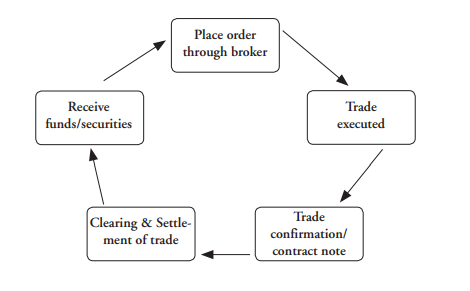
A Typical Securities Trade Life Cycle

Figure 1 – A Typical Securities Trade Life Cycle

1.1 Placing of Order

1.1.1 Trader Workstation

The trader workstation (TWS) is the terminal from which the member accesses the trading system of Exchange. From TWS member entered order into the Exchange trading system. Exchange provides own trading platforms to its member. Each trader has a unique identification by way of Trading Member ID and User ID through which they are able to log on to the system for trading or inquiry purposes.

TWS provides mainly two kinds of information which are:

Trading member’s own transaction Information:

  • Order entered
  • Order Modified
  • Outstanding Order
  • Order Log
  • Trade details

Market Information:

  • Order book
  • Securities/contract price information
  • Securities/contract trade information
  • Additional information

Exchanges have allowed members to develop their customised trading workstation as per their requirements and connect to Exchange trading system. Under this facility, the Exchanges has made available product such as Computer to Computer Link (CTCL)/Internet based trading (IBT)/Direct Market Access (DMA)/Security trading thought wireless technology facility (STWT)/Automated/Algorithm Trading (ALGO)/Smart order router (SOR) to the Trading Members. Trading member can connect to the system by various mode such as lease line, VSAT, co-location1 etc.
NISM X Taxmann's Securities Operations and Risk Management

1.1.2 Placing of Client Orders

The Broker accepts orders from the client and sends the same to the Exchange after performing the risk management checks. Clients have the option of placing their orders through various channels like internet, phone, direct market access (DMA) (for institutional clients), Securities trading using wireless technology facility (STWT)/Automated/Algorithm Trading (ALGO)/Smart order router (SOR) etc. To strengthen the regulatory provisions against un-authorized trades and to harmonise the requirements across equity & derivative market, all brokers shall execute trades of clients only after keeping evidence of the client placing such order, it could be, inter alia, in the form of:

(a) Physical record written & signed by client,

(b) Telephone recording,

(c) Email from authorised email id,

(d) Log for internet transactions,

(e) Record of SMS messages,

(f) Any other legally verifiable record.

When a dispute arises, the broker shall produce the above mentioned records for the disputed trades. However, for exceptional cases such as technical failure etc. where broker fails to produce order placing evidences, the broker shall justify with reasons for the same and depending upon merit of the case, other appropriate evidences like post trade confirmation by client, receipt/payment of funds/securities by client in respect of disputed trade, etc. shall also be considered. The Brokers are required to maintain the records for a minimum period for which the arbitration accepts investors’ complaints as notified from time to time (which is currently three years). However, in cases where dispute has been raised, such records shall be kept till final resolution of the dispute. If SEBI desires that specific records be preserved, then such records shall be kept till further intimation by SEBI.

Placing of orders through the internet/phone means the facility provided by stock brokers, whereby the client can place order(s) over the phone/internet for transactions in securities, to be executed on behalf of clients by the broker.

Here, the dealer shall refer to the Dealing Desk Executive appointed by the call centre(s) for the purpose of providing this facility.

  • For the purpose of availing of this service, the Client is required to call on the specific numbers intimated or notified from time to time by the stock broker for the said purpose by means of an email and/or by putting up such numbers on the website or otherwise.
  • In case the Client opts for this service, he may be required to provide accurate answers to the questions asked by the Dealing Desk Executive, including the Client’s user id and TPIN, for ascertaining the genuineness of the caller. Once this is done, the order can be placed and will be processed in the normal course.

SEBI further instructed that wherever the order instructions were received from clients through the telephone, the stock broker shall mandatorily use telephone recording system to record the instructions and maintain telephone recordings as part of its records.2

Internet trading can take place through order routing systems, which will route client orders to exchange trading systems for execution. Thus, a client sitting in any part of the country would be able to trade using the Internet as a medium through brokers’ Internet trading systems. SEBI-registered brokers can introduce internet based trading after obtaining permission from respective Stock Exchanges. SEBI has stipulated the minimum conditions to be fulfilled by trading members to start internet based trading and services. Broker can provide Securities Trading through Wireless medium on Wireless Application Protocol (WAP) platform. Some additional requirements are to be met by the broker for providing securities transaction through WAP.

Direct Market Access (DMA) is a facility which allows brokers to offer clients direct access to the exchange trading system through the broker’s infrastructure without manual intervention by the broker. Some of the advantages offered by DMA are direct control of clients over orders, faster execution of client orders, reduced risk of errors associated with manual order entry, greater transparency, increased liquidity, lower impact costs for large orders, better audit trails and better use of hedging and arbitrage opportunities through the use of decision support tools/algorithms for trading. SEBI in 2008, introduced Direct Market Access (DMA) and permitted institutional investors to use DMA facility. The facility of the DMA provided by the stock broker shall be used by the client or an investment manager of the client. A SEBI registered entity is permitted to act as an investment manager on behalf of institutional clients. In case the facility of DMA is used by the client through an investment manager, the investment manager is required to execute the necessary documents on behalf of the client(s). Exchange can also specify the categories of investors to whom the DMA facility can be extended. SEBI-registered brokers can introduce DMA facility to their clients after obtaining permission from respective Stock Exchanges. Brokers must specifically authorize clients or investment managers acting on behalf of clients for providing DMA facility, after fulfilling KYC requirements, documentation and carrying out necessary due diligence, records of which should be properly maintained.

Another feature which has been introduced in the Indian securities market is Algorithmic Trading and High Frequency Trading. Algorithmic Trading – Any order that is generated using automated execution logic shall be known as algorithmic trading3. “Automated Trading” shall mean and include any software or facility by the use of which, upon the fulfilment of certain specified parameters, without the necessity of manual entry of orders, buy/sell orders are automatically generated and pushed into the trading system of the Exchange for the purpose of matching.

SEBI has advised the stock exchanges to ensure that all algorithmic orders are necessarily routed through broker servers located in India and the stock exchange has appropriate risk controls mechanism to address the risk emanating from algorithmic orders and trades. The minimum order-level risk controls shall include price check, quantity limit check, order value check etc. Stock exchange shall ensure that the stock broker shall provide the facility of algorithmic trading only upon the prior permission of the stock exchange. SEBI also advised stock exchanges to ensure fair and equitable access to their co-location facility. The stock broker, desirous of placing orders generated using algos, shall satisfy the stock exchange with regard to the implementation of the minimum levels of risk controls at its end as specified by SEBI and Exchanges from time to time. The stock brokers that provide the facility of algorithmic trading shall subject their algorithmic trading system to a system audit every six months in order to ensure that the requirements prescribed by SEBI/stock exchanges with regard to algorithmic trading are effectively implemented.4 Such system audit of algorithmic trading system shall be undertaken by a certified system auditor.

High frequency trading (HFT) is a type of algorithmic trading which is latency sensitive and is characterized by a high daily portfolio turnover and high order-to trade ratio (OTR).

Once the orders are received by the broker, it is confirmed with the client and then entered into the trading system of the Exchange. The Exchange gives confirmation of the order and time stamps it. An order generally comes with certain conditions which determine whether it is a market order, limit order etc. These specify the terms and conditions at which the client wants his/her order to get executed.

1.2 Risk Management and Order Routing

An efficient risk management system is integral to an efficient settlement system. The goal of a risk management system is to measure and manage a trading firm’s exposure to various risks identified as central to its operations. The implementation of strong and effective risk management and controls within stock brokers promotes stability throughout the entire financial system. Specifically, internal risk management controls provide four important functions:

  • to protect the firm against market, credit, liquidity, operational, and legal risks;
  • to protect the financial industry from systemic risk;
  • to protect the firm’s customers from large non-market related losses (e.g., firm failure, misappropriation, fraud, etc.); and
  • to protect the firm and its franchise from suffering adversely from reputational risk.

The broker should have online risk management system (including upfront real-time risk management) in place for all orders placed on exchange trading system. The system should have pre-defined limits/checks such as Order Quantity and Value Limits, Symbol wise User Order/Quantity limit, User/Branch Order Limit, Order Price limit, etc. are in place and only such orders which are within the parameters specified by the RMS are allowed to be pushed into exchange trading engines.

1.3 Order Matching and Conversion into Trade

All orders which are entered into the trading system of the Exchange are matched with similar counter orders and are executed. The order matching in an Exchange is done on a price time priority basis. The best price orders are matched first. If more than one order is available at the same price, then they are arranged in ascending time order. Best buy price is the highest buy price amongst all orders and the best sell price is the lowest price of all sell orders.

Once the order is matched, it results into a trade. As soon as the trade is executed, a trade confirmation message is sent to the broker who had entered the order. The broker in turn lets the client know about the trade confirmation through a contract note and messages.

All orders which have not been executed, partly or fully can be modified or cancelled during the trading hours. Trades done during the day can also be cancelled by mutual consent of both the parties subject to approval of the Exchange and as per the trade annulment policy prescribed by SEBI and Exchanges from time to time. These generally occur due to order entry errors and are not a common practice.

1.4 Affirmation and Confirmation (For Institutional Clients)

Institutional clients trading in the Indian securities market use the services of a custodian to assist them in the clearing and settlement of executed trades in cash/equity segment. Custodians are clearing members of the Exchange. On behalf of their clients, they settle the trades that have been executed through brokers. A broker assigns a particular trade to a custodian for settlement by entering custodian participant code at the time of order entry. Upon confirmation by the custodian whether he would settle the trade, the clearing corporations assigns the obligation to the custodian. The overall risk that the custodian is bearing by accepting the trade is constantly measured against the collateral that the institution (who trades) submits to the custodian for providing this service. While confirming the trade Custodian verifies security details, side of the trade, price range etc. as specified by the institutional client.

In 2004, SEBI had mandated that all the institutional trades executed on the Stock Exchanges should be processed through the Straight through Processing (STP) system.5 STP is a mechanism that automates the end-to-end processing of transactions of the financial instruments. It involves use of a single system to process or control all elements of the work-flow of a financial transaction, including what is commonly known as the Front, Middle, and Back office, and General Ledger. In other words, STP can be defined as electronically capturing and processing transactions in one pass, from the point of first ‘deal’ to final settlement. STP thus streamlines the process of trade execution and settlement and avoids manual entry and re-entry of the details of the same trade by different market intermediaries and participants. Usage of STP enables orders to be processed, confirmed, settled in a shorter time period and in a more cost effective manner with fewer errors. Apart from compressing the clearing and settlement time, STP also provides a flexible, cost effective infrastructure, which enables e-business expansion through online processing and access to enterprise data.

What is a Contract Note?

Contract note is the legal record of any transaction carried out on a stock exchange through a stockbroker. It serves as the confirmation of trade done on a day on behalf of a client on a stock exchange. Every stock broker shall issue a contract note to its clients for trades executed in such format as specified by the Exchanges. It establishes a legally enforceable relationship between the stock broker and the client in respect of settlement of trades executed on the Exchange as stated in the contract note. Every trade executed by a stock broker on behalf of his client should be supported by a contract note.

Contract note should be issued within 24 hours of execution of contract and in the format prescribed by Exchanges/SEBI. These should be issued in physical form or electronic form depending on the mode chosen by client.

The contract notes should be acknowledged by the clients along with date in case of personal delivery. Stock-brokers are required to maintain proof of dispatch of contract notes in the case of delivery of physical contract notes through post/courier. The digitally signed Electronic Contract Notes (ECNs) may be sent only to those clients who have opted to receive the contract notes in an electronic form, either in the account opening kit or by a separate letter. The usual mode of delivery of ECNs to the clients shall be through e-mail. For this purpose, the client shall provide an appropriate e-mail account to the member which shall be made available at all times for such receipts of ECNs. The acknowledgement of the e-mail shall be retained by the member in a soft and non-tamperable form. The proof of delivery i.e., log report generated by the system at the time of sending the contract notes shall be maintained by the member Stock-Broker should also maintain a bounce mail log showing details of the contract notes that were not delivered to the clients/e mails rejected or bounced back. Whenever ECNs have not been delivered or has bounced, Member should send the physical copy of the contract note to such clients within the stipulated time under the extant regulations of SEBI/stock exchanges and maintain the proof of delivery. All ECNs sent through the e-mail shall be digitally signed, encrypted, non-tamperable and shall comply with the provisions of the IT Act, 2000. In case the ECN is sent through e-mail as an attachment, the attached file shall also be secured with the digital signature, encrypted and non-tamperable. In addition to the e-mail communication of the ECNs in the manner stated above, in order to further strengthen the electronic communication channel, the member shall simultaneously publish the ECN on his designated web-site in a secured way and enable relevant access to the clients. In addition, through e-mail ECN can be send through SMS/electronic instant messaging services only on registered mobile number as uploaded by the member on Exchange portal.

The contract notes should be unique running serially numbered starting from the beginning of the financial year. They should be issued with the client’s name, PAN and client’s code written on them. It should also contain the exact order number, order entry time, trade number, trade time, quantity of securities transacted, rates/price, etc. Contract notes with weighted average price of trade should contain an annexure with the details thereon.

Stock brokers are required to maintain duplicate copy or counter foil of the contract notes. The contract notes should be signed by stock broker or by an authorized signatory of the stock broker as per the guideline specified by SEBI/Exchanges from time to time. A contract note without consideration is null and void under Indian Contracts Act and hence all contracts should mention the consideration separately.

Contract should also mention all statutory charges (like Securities Transaction Tax (STT), Goods and Service Tax (GST), stamp duty etc.), Regulatory levies/charges (e.g., SEBI turnover fees, Exchange transaction charges, etc.), Brokerage etc. Contract notes should be affixed with the brokers note stamps, as a percentage of the total value of the contract, as per the government stamp acts/rules. Contracts note also should clearly specify the complete address, phone number, e-mail IDs, fax numbers, the name of the compliance officer, his telephone number and e-mail address etc. of the broker along with the PAN.

1.5 Clearing and Settlement

Once the trade is executed on the Exchange, the details are passed on to the clearing corporation, to initiate the clearing and settlement of those executed trades. Based on the trade details from the Exchange, the Clearing Corporation determines the obligations of the members. In case of cash segment, institutional trades are sent to custodian and in derivatives custodian participant code trade send to clearing member for confirmation. Based on the affirmation, the clearing corporation applies multilateral netting and determines obligations. The settlement process begins as soon as member’s obligations are determined through the clearing process.

The settlement process is carried out by the clearing corporation with the help of clearing banks and the depositories. The clearing corporation provides a major link between the clearing banks and the depositories. This link ensures actual movement of funds as well as securities on the prescribed pay-in and pay-out day.

Instructions are given to the depositories and the clearing banks for pay-in of securities and funds and pay-out of securities and funds. The clearing members have to ensure that they make available the securities/funds to the clearing corporation before pay-in day and time. Once the pay-in activities are carried out the clearing corporation carries out the pay-out of funds and securities.

SEBI vide circular dated September 07, 2021, provided guideline for Introduction of T+1 rolling settlement on an optional basis. T+1 rolling settlement was completely implemented in the Indian securities market w.e.f. January 27, 2023. Currently for all securities traded in equity segment Exchanges and clearing corporation follows the T+1 rolling settlement. In case of T+1 rolling settlement, the trades executed on Wednesday, has to be settled on Thursday (provided Thursday is working day) with pay-in and pay-out of funds and securities being completed on that day. SEBI vide Circular No. SEBI/HO/MRD/MRD-PoD-3/P/CIR/2024/20 dated March 21, 2024 introduced the beta version of T+0 rolling settlement cycle on optional basis in addition to the existing T+1 settlement cycle in Equity Cash Markets, for a limited set of 25 scrips and with a limited number of brokers. Further in December 2024, SEBI increased the number of scrips under optional T+0 settlement and also all stock brokers were allowed to participate in optional T+0 settlement.

2. Front Office Operations

The front office is responsible for order capture and execution. This is where the order/trade originates, and the client relationship is maintained. The front office makes/takes orders and executes them. Dealers and sales staff are considered front office staff.


  1. The facility of co-location or proximity hosting (or by whatever name called) is offered by the stock exchanges to stock brokers and data vendors whereby their trading or data-vending systems are allowed to be located within or at close proximity to the premises of the stock exchanges, and are allowed to connect to the trading platform of stock exchanges through direct and private network.
  2. SEBI Circular Ref No.: SEBI/HO/MIRSD/DOP1/CIR/P/2018/54, Dated March 22, 2018.
  3. SEBI Circular Ref. No. CIR/MRD/DP/09/2012 Dated March 30, 2012.
  4. SEBI Master Circular dated December 30, 2024, “Master Circular for Stock Exchanges and Clearing Corporations, Chapter 2 – Trading Software and Technology”.
  5. SEBI Circular Ref. No. DNPD/Cir-22/2004 dated April 1, 2004, DNPD/Cir-25/04 dated June 10, 2004.

The post Securities Trade Life Cycle – Key Steps | Front Office Operations appeared first on Taxmann Blog.

source

Categories
Blog Updates

Penalty Under FEMA for Non-Issuance of Shares Upheld | Mens Rea Not Needed

FEMA penalty for non-issuance of shares

Case Details: Jignesh Arvind Shah vs. Joint Director Directorate of Enforcement - [2025] 180 taxmann.com 712 (SAFEMA-New Delhi)[19-11-2025]

Judiciary and Counsel Details

  • Balesh Kumar & Rajesh Malhotra, Member
  • Ms Gurmeet Bindra, Adv. for the Appellant.
  • Pranav Mishra, Adv. for the Respondent.

Facts of the Case

In the instant case, the appellant was promoter-director and Managing Director of company AFTPL from its inception till 2014. Between 2010 and 2012, AFTPL received foreign remittances of Rs. 5.50 crore as share application money but did not issue shares within 180 days or refund amounts.

The RBI declined a proposal to waive/write-off share application money and referred the matter to ED. Pursuant to investigation, a complaint was filed, SCN was issued, and after adjudication, penalty of Rs. 25 lakh was imposed on the appellant.

The appellant filed an instant appeal contending that lapse was unintentional/technical and sought substantial reduction of penalty.

It was noted that since appellant was responsible for the affairs of the company during the relevant period, he was liable for penalty for the aforementioned contravention in terms of Section 42(1) of the FEMA.

Further, it was noted that even argument of the appellant that contravention of FEMA was unintentional could not be accepted as there was nothing in Section which could indicate directly or indirectly requirement of mens rea.

Appellate Tribunal Held

The Appellate Tribunal held that since the appellant resigned from company and ceased to carry out any responsibility towards it, penalty was to be reduced to Rs. 5 lakh.

List of Cases Referred to

The post Penalty Under FEMA for Non-Issuance of Shares Upheld | Mens Rea Not Needed appeared first on Taxmann Blog.

source

Categories
Blog Updates

Only CoC has Authority to Choose Liquidator Under IBC | NCLAT

CoC authority to appoint liquidator

Case Details: Omkara Asset Reconstruction (P.) Ltd. vs. Amit Vijay Karia - [2025] 181 taxmann.com 173 (NCLAT-New Delhi)[01-12-2025]

Judiciary and Counsel Details

  • N. Seshasayee, Judicial Member & Arun Baroka, Technical Member
  • Abhijeet Sinha, Sr. Adv., Ms Kiran SharmaMs Niharika SharmaSomdutta BhattacharyaSaikat SarkarMs Heena Kochar, Advs. for the Appellant.
  • Alam Khan for the Respondent.

Facts of the Case

In the instant case, the Adjudicating Authority passed an order for liquidation of the corporate debtor and appointed second respondent as liquidator, who was neither Resolution Professional (RP) appointed during the CIRP, nor was candidate of CoC’s choice.

The appellant, who had about 98% voting share in the CoC, preferred an instant appeal asserting that right to appoint liquidator rests with the CoC.

NCLAT Held

The NCLAT held that only the CoC has the authority to select candidate for replacing RP for purposes of section 34(4)(c) of the IBC, even though authority to formally appoint such RP as selected by procedure contemplated in section 27 rests with the Adjudicating Authority.

The NCLAT held that once the CoC names a liquidator and IBBI confirms it, the Adjudicating Authority is required to appoint liquidator named by the CoC. Therefore, order of the Adjudicating Authority appointing liquidator was to be set aside and once the IBBI confirms liquidator named by the CoC, the Adjudicating Authority is required to appoint it as liquidator.

List of Cases Reviewed

  • Order of National Company Law Tribunal, Indore Bench I.A.(LIQ) No.1/MP/2025 in C.P. (IB) No.53/MP/2023 and I.A.(LIQ) No.3/MP/2024 in C.P. (IB) No.54/MP/2023, dated 11-06-2025 (para 15) reversed

List of Cases Referred to

  • Manish Jaju v. Committee of Creditors [C.A.(AT)(Ins.) 1165 of 2025, dated 1-8-2025] (para 3)
  • Moore v. Dempsey 261 US 86 (1923) (para 13)
  • Y. Balaji v. Karthik Desari [2023] 150 taxmann.com 329/179 SCL 49 (SC) (para 13).

The post Only CoC has Authority to Choose Liquidator Under IBC | NCLAT appeared first on Taxmann Blog.

source

Categories
Blog Updates

Long-Term Hostel Sub-Letting Still Qualifies as Residential Dwelling Eligible for GST Exemption | SC

GST exemption residential dwelling hostel

Case Details: State of Karnataka vs. Taghar Vasudeva Ambrish - [2025] 181 taxmann.com 199 (SC)

Judiciary and Counsel Details

  • J..B. Pardiwala & K.V. Viswanathan, JJ.

Facts of the Case

The assessee, a co-owner of a residential building, leased the property to a company, which sublet rooms as hostels for long-term stays of 3 to 12 months to students and working professionals. The Authority for Advance Ruling (AAR) and the Appellate Authority for Advance Ruling (AAAR) denied the exemption under Entry 13 of Notification No. 9/2017-Integrated Tax (Rate), on the ground that the company did not itself reside in the property. It was contended that the property continued to qualify as a residential dwelling since the sub-lessees’ use satisfied the ‘use as residence’ condition, and that the amendment to the notification, which excluded registered persons from the exemption, was prospective and could not be applied retrospectively. The matter was accordingly placed before the Supreme Court.

Supreme Court Held

The Supreme Court held that the property qualified as a residential dwelling since the accommodation was for long-term stays and municipal records confirmed its residential character. It was observed that the condition of ‘use as residence’ under Entry 13 of Notification No. 9/2017-Integrated Tax (Rate) was satisfied through the sub-lessees, making the exemption activity-specific rather than person-specific. The Court further held that retrospective denial of exemption under the amended notification was impermissible, and that all conditions for exemption during 2019-2022 were met. Accordingly, the appeals filed by the Department of Revenue were dismissed in favour of the assessee.

List of Cases Reviewed

  • Union of India v. Wood Papers Ltd. 1991 taxmann.com 77 (SC)/(1990) 4 SCC 256 (para 55) followed
  • Order of High Court of Karnataka in Writ Petition No. 14891 of 2020 judgment and order dated 07.02.2022 (para 69) affirmed

List of Cases Referred to

  • Bandu Ravji Nikam v. Acharyaratna Deshbushan Shikshan Prasark Mandal [W.P. No.4194 of 1989, dated 12-9-2002] (para 11)
  • Kishore Chandra Singh Deo v. Babu Ganesh Prasad Bhagat AIR 1954 SC 316 (para 11)
  • Mohinder Singh v. State of Haryana AIR 1989 SC 1367 (para 12)
  • CCE v. Allied Air-Conditioning Corpn. 2006 taxmann.com 753 (SC) (para 12)
  • Government of Kerala v. Mother Superior Adoration Convent [2021] 126 taxmann.com 68 (SC) (para 22)
  • V.L. Kashyap v. R.P. Puri (1976) 12 DLT 369 (para 41)
  • Uratemp Ventures Limited v. Collins (2001) 3 WLR 806 (para 42)
  • Union of India v. Wood Papers Ltd. 1991 taxmann.com 77 (SC) (para 55)
  • CCE v. Parle Exports (P) Ltd. 1991 taxmann.com 77 (SC) (para 57)
  • Shailesh Dhairyavan v. Mohan Balkrihna Lulla (2016) 3 SCC 619 (para 60).

The post Long-Term Hostel Sub-Letting Still Qualifies as Residential Dwelling Eligible for GST Exemption | SC appeared first on Taxmann Blog.

source