Categories
Blog Updates

Govt. Authorises DRAT Chennai Chairperson for Mumbai Case

DRAT Chennai chairperson

ORDER NO. S.O. 1163(E), Dated: 06.03.2026

The Central Government has authorised the Chairperson of the Debts Recovery Appellate Tribunal (DRAT), Chennai to also discharge the functions of the Chairperson of the Debts Recovery Appellate Tribunal, Mumbai for deciding the appeal in the matter of ‘Bharti G. Patel vs Punjab National Bank & Ors.’

1. Additional Charge for Specific Appeal

The authorisation allows the Chairperson of DRAT Chennai to hear and decide the appeal pending before DRAT Mumbai in the above-mentioned matter. This assignment is granted in addition to his existing responsibilities as the Chairperson of DRAT Chennai.

2. Purpose of the Authorisation

The decision has been taken to facilitate the adjudication of the appeal and ensure the continuity of appellate proceedings before DRAT Mumbai in the specified case.

3. Case Covered Under the Authorisation

The authorisation specifically applies to the appeal in the case of ‘Bharti G. Patel vs Punjab National Bank & Others.’

Accordingly, the Chairperson of DRAT Chennai will exercise the powers and functions of the Chairperson of DRAT Mumbai solely for the purpose of deciding this appeal.

Click Here To Read The Full Update 

The post Govt. Authorises DRAT Chennai Chairperson for Mumbai Case appeared first on Taxmann Blog.

source

Categories
Blog Updates

ITAT Upholds Disallowance of Excess Section 54F Claim

Section 54F Claim

Case Details: Sumit H. Bhagchandani vs. Deputy Commissioner of Income-tax [2026] 183 taxmann.com 686 (Ahmedabad-Trib.)

Judiciary and Counsel Details

  • Siddhartha Nautiyal, Judicial Member & Narendra Prasad Sinha, Accountant Member
  • Parin Shah, AR for the Appellant.
  • Yogesh Mishra, Sr. DR for the Respondent.

Facts of the Case

The assessee had long-term capital gains arising from the sale of a plot of land. He claimed exemption under section 54F. The assessee computed long-term capital gains on his one-fourth share in the sale of land. The total sale consideration attributable to the assessee was Rs. 3.82 crores. Against the said capital gains, the assessee claimed a deduction under section 54F comprising actual expenditure of Rs. 33.36 lakhs incurred towards the construction of a residential house and a sum of Rs. 2.25 crores deposited in the Capital Gains Account Scheme.

Assessing Officer (AO) applied a statutory formula under section 54F and restricted the deduction to the proportionate amount. The AO contended that the entire amount claimed as a deduction under section 54F was not invested in the new residential house, and an excess deduction was claimed. On appeal, the CIT(A) upheld the order of the AO. The aggrieved assessee filed the instant appeal before the Tribunal.

ITAT Held

The Tribunal held that section 54F provides an exemption from long-term capital gains, subject to the fulfilment of specified conditions, and prescribes an unambiguous formula for determining the deduction quantum. The deduction allowable is equal to the capital gain multiplied by the ratio of the cost of the new asset to the net consideration received. Section 54F(4) permits the assessee to deposit the unutilized portion of the net consideration in the Capital Gains Account Scheme before the due date of filing of the return to preserve the eligibility for exemption. However, the said provision does not dispense with the computation mechanism prescribed under section 54F(1).

In the instant case, the figures were undisputed. The assessee considered the actual expenditure on the construction of a new residential house and the amount deposited in the CGAS as the cost of the new asset. Upon application of the statutory formula, the allowable deduction was computed, leaving an excess claim of Rs. 3.91 lakhs. The AO neither denied the benefit of section 54F nor disputed the assessee’s eligibility. The disallowance was purely arithmetical and arose from the application of the statutory formula.

The CIT(A) rightly held that mere deposit in the Capital Gains Account Scheme does not automatically entitle the assessee to the deduction of the entire amount claimed unless such deposit is translated into actual or irrevocably committed investment towards the new residential house. Accordingly, the appeal was to be dismissed.

List of Cases Referred to

The post ITAT Upholds Disallowance of Excess Section 54F Claim appeared first on Taxmann Blog.

source

Categories
Blog Updates

HC Directs NIL TDS Certificate for British Airways Under DTAA

NIL TDS Certificate

Case Details: British Airways PLC vs. Assistant Commissioner of Income-tax, (Int. Tax) [2026] 184 taxmann.com 3 (Delhi)

Judiciary and Counsel Details

  • Dinesh Mehta & Vinod Kumar, JJ.
  • Vishal KalraAnil Kumar S.S. Tomar, Advs. for the Petitioner.
  • Anurag Ojha, SSC for the Respondent.

Facts of the Case

The petitioner, British Airways PLC, was a company and a tax resident of the United Kingdom. The disputed services fall under Airline services, which are essentially “Operation of Airline & Cargo Service”. The petitioner was operating in India under a Tax Residency Certificate issued by the UK authorities. The petitioner’s income was exempt under Article 8 of the India-UK Double Taxation Avoidance Agreement (DTAA), read with Section 90 of the Income Tax Act.

The petitioner applied for a certificate under Section 197 of the Income Tax Act from the competent authority. The application was made for the transactions, which amounted to roughly Rs. 3.98 crores. Surprisingly, a certificate at 0.1% has been issued to it, even though a NIL rate certificate was issued for the earlier part of the current Financial Year (2025-26).

Aggrieved by the order, the petitioner filed a writ petition to the Delhi High Court.

High Court Held

The High Court held that the main reason for issuing the certificate at 0.1% was the fact that there were outstanding demands for assessment years 2013-14, 2014-15, 2015-16 and 2016-17, as per the ITBA portal, which turned out to be incorrect. It was to be noted that the petitioner’s assessment had been made, and so far as airline services are concerned, no tax was payable.

Further, it was noted that a certificate at NIL rate had been issued for the last fifteen-sixteen years, and even for part of the current financial year, a certificate at 0.1% cannot be countenanced. It reflected the non-application of mind by the competent authority on the one hand, showed an inconsistent approach by the officers of the country, and thus portrayed an unhealthy picture of the bureaucracy.

Accordingly, the writ petition was allowed, and the impugned order and certificate were set aside. The competent authority was directed to issue a certificate at a NIL rate.

The post HC Directs NIL TDS Certificate for British Airways Under DTAA appeared first on Taxmann Blog.

source

Categories
Blog Updates

Landowners Not Liable for Delay Under JDA | SC

landowners liability construction delay

Case Details: Sriganesh Chandrasekaran vs. Unishire Homes Llp [2026] 184 taxmann.com 2 (SC)

Judiciary and Counsel Details

  • Alok Aradhe & Pamidighantam Sri Narasimha, JJ.
  • Chandrachur BhattacharyyaMs Shreya Kasera, Advs. & Sahil Tagotra, AOR for the Appellant.
  • Kumar SudeepDr Sushil Balwada, AORs for the Respondent.

Facts of the Case

In the instant case, the landowners and the developer entered into a Joint Development Agreement (JDA), and the landowners executed a General Power of Attorney (GPA) in favour of the developer.

The developer obtained the sanctioned plan and construction licence, and executed Sale Agreements with flat buyers, agreeing to hand over possession within 36 months. The 36-month period expired on 24.08.2016, and the six-month grace period expired on 24.02.2017; the project remained incomplete.

The flat buyers filed a consumer complaint alleging deficiency in service, by order dated 19.10.2023, the Commission found deficiency in service due to delay of more than six years, directed the developer to complete construction, obtain occupancy certificate if not already obtained, and hand over possession within three months, and to pay interest at 6% per annum on amounts deposited from due date of possession till date of offer of possession within six weeks, failing which delay interest would carry 9% per annum.

The landowners were not held liable for the delay as the obligation to complete construction rested with the developer. The Appellants filed a Review Petition seeking to hold the landowners jointly and severally liable and to enhance compensation.

By order dated 30.07.2024, the Commission held that, in view of the JDA and the Sale Agreement, the landowners could not be held jointly and severally liable for deficiency in service, but directed the landowners and the developer to transfer title and proceed with execution of sale deeds in favour of the appellants.

It was noted that for lapse on the part of the developer, the landowners, who were in no way concerned with construction, could not be held liable for deficiency in service, particularly when the developer had indemnified them against acts of the commission or omission in construction.

Supreme Court Held

The Supreme Court observed that the Commission had partly allowed the Review Petition and had rightly fastened liability for delay compensation on the developer as it was responsible for the delay in construction.

Further, the Supreme Court observed that the appellants’ interest had been fully protected, as landowners, as well as the developer, had been directed to transfer title.

The Supreme Court held that there was no merit in the appeal, and the same was to be dismissed.

List of Cases Reviewed

  • Order of National Consumers Disputes Redressal Commission, New Delhi in RA-434-2023, dated 30-07-2024 (para 17) affirmed
  • Akshay v. Aditya Civil Appeal No. 3642 of 2018, dated 29-8-2024 (para 16) distinguished

List of Cases Referred to

  • R. Mohanraj v. Sriganesh Chandrasekaran [SLP (C) No. 9470 of 2024, dated 3-5-2024] (para 6)
  • Akshay v. Aditya [Civil Appeal No. 3642 of 2018, dated 29-8-2024] (para 9)
  • Bangalore Development Authority v. Syndicate Bank (2007) 6 SCC 711 (para 9)
  • Syed Abdul Khader v. Rami Reddy (1979) 2 SCC 601 (para 9)
  • Santhosh Narasimha Murthy v. Mantri Castles Pvt. Ltd. [Civil Appeal No. 8418 of 2022, dated 25-8-2023] (para 9).

The post Landowners Not Liable for Delay Under JDA | SC appeared first on Taxmann Blog.

source

Categories
Blog Updates

SEBI Issues Governance and Risk Framework for Custodians

SEBI guidelines for custodians

Circular No. HO/19/(1)2025-AFD-FPICELL/I/5928/2026, Dated 04.03.2026

The SEBI has issued guidelines prescribing the operational modalities and compliance framework for Custodians pursuant to amendments to the SEBI (Custodian) Regulations, 1996.

The circular provides for segregation of financial service activities through SBUs, governance and committee oversight, risk management and operational integrity measures, scalable infrastructure and technology requirements, business continuity and disaster recovery framework, and an orderly wind-down mechanism.

To strengthen the compliance and governance framework for Custodians, the SEBI vide Gazette notification dated September 18, 2025, inter alia, inserted Regulation 19B in the Custodian Regulations, mandating certain obligations and responsibilities. The following are specified regulations

  1. The Custodian shall have committees of the Board of Directors.
  2. A custodian, which is a bank or subsidiary/ associate/ joint venture of a bank, may not be required to formulate separate specific committees for custody business.
  3. The Board of Directors or analogous body or committee appointed/delegated by such body of the Custodian shall exercise oversight over incidents/vulnerabilities having an impact on the functioning of the Custodian in the securities market and investor protection.
  4. The Chief Financial Officer (CFO) or analogous person of the Custodian shall submit to the audit committee or analogous body or committee appointed/delegated by the Board of Directors, details in respect of the financial status of the entity.
  5. The custodian shall devise a clear and well-documented risk management policy which encompasses all relevant risks that may have to be borne for custodian activities, such as operational risk, legal risk, risks such as mis-utilisation of clients’ sensitive information, etc., after taking inputs from the Risk Management Committee.
  6. The Custodian shall maintain adequate human resources, systems, processes and procedures for the seamless running of operations and protection of investor data.
  7. The Custodian shall maintain adequate human resources, systems, processes and procedures for seamless running of operations and protection of investor data.
  8. The risk management policy shall be reviewed every year or on an ad-hoc basis in case of material changes by the Custodian.
Click Here To Read The Full Circular

The post SEBI Issues Governance and Risk Framework for Custodians appeared first on Taxmann Blog.

source

Categories
Blog Updates

Supply Under GST – Meaning | Types | Taxable Event

Supply Under GST

Supply under GST refers to the taxable event that triggers the levy of Goods and Services Tax on transactions involving goods or services or both. As per Section 7 of the CGST Act, 2017, it includes all forms of supply such as sale, transfer, barter, exchange, licence, rental, lease, or disposal made or agreed to be made for a consideration in the course or furtherance of business. The concept of supply forms the foundation of the GST framework, replacing multiple taxable events under the earlier indirect tax regime—such as manufacture, sale of goods, and provision of services—with a single unified taxable event. Consequently, GST becomes applicable whenever there is a supply of goods or services or both, unless the transaction is specifically excluded or exempt under the law.

Table of Contents

  1. Introduction
  2. Supply – The Taxable Event in GST
  3. Forms of Supply
  4. Types of Supplies
  5. Types of Supplies in Case of Combination Supplies
Check out Taxmann's GST & Customs Law (Incorporating GST 2.0) which  is a comprehensive, statute-based textbook that presents GST and Customs Law as a unified indirect tax and compliance framework. Fully updated with amendments up to 31st December 2025, the 13th Edition integrates the GST 2.0 reforms (September 2025), capturing the shift towards structural correction, rate rationalisation, and simplified, trust-based compliance. The book follows a concept-first, illustration-driven pedagogy, explaining each topic through statutory provisions, rule mechanics, numerical illustrations, and exam-oriented practice. Designed for commerce students, CA aspirants, faculty, and tax professionals, it serves as both a strong foundational text and a practical reference for execution.

1. Introduction

Under earlier indirect tax laws, there were two separate activities, i.e. manufacture or sale of goods and the provision of services. In the GST regime, the entire value of these two is taxed in an integrated manner by laying down one comprehensive taxable event i.e. “supply” – supply of goods or services or both. It means, the term “supply” refers to a broad term which merges all taxable activities of the earlier laws into a single activity. For Example – If Mr A has sold goods to B, then it is supply of goods. In this case, if A has manufactured the goods and then has sold to B, even then it is supply of goods. Similarly, if Mr Mohan took services of engineer for construction of his house, then it is also supply of services to Mr Mohan. Under GST, the scenario has been shifted from sales, service, manufacturing, etc. to one activity i.e. supply. Therefore, it can be said that now, there are two modes of supply which may attract GST and these are goods and services.
Taxmann's GST & Customs Law

2. Supply – The Taxable Event in GST

Taxable event in a law is an event, the occurrence or happening of which triggers the imposition of tax. It means the incidence of tax arises only after the occurrence of the taxable event.

Before GST – Under the earlier indirect tax laws, Central excise was levied on “manufacture of goods”, VAT/CST was levied on “Sale of Goods”, Service tax was charged on “Services provided or agreed to be provided”, etc.

Under GST – According to Article 366(12A) of the Constitution of India, Goods and Services Tax (GST) is “Any tax on Supply of goods or services or both except taxes on Supply of the Alcoholic liquor for human consumption.” Therefore, under GST, the taxable event is “Supply of Goods or provision of Services or both”. As already stated, under GST the scenario has been shifted from multiple taxable event namely manufacture, sales, provision of services, etc. to one sole taxable activity i.e. Supply. The GST is applicable if there is Supply of goods or provision of Services or both.

3. Forms of Supply

Under GST, supply includes all forms of supply of goods or services or both. The concept of supply is the key stone of the GST architecture because the supply of anything other than goods or services does not attract GST. There are two forms of supply under GST namely, goods and services.

3.1 Goods

As per section 2(52) of CGST Act, 2017, “Goods” means every kind of movable property other than money and securities but includes actionable claim, growing crops, grass and things attached to or forming part of the land which are agreed to be severed before supply or under a contract of supply.
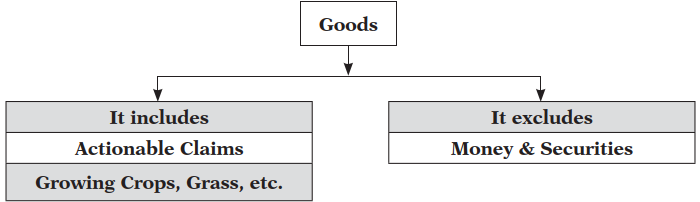
Goods

Actionable Claim – The section 2(1) of CGST Act provides that the definition of actionable claims shall have the same meaning as assigned to it in section 3 of the Transfer of Property Act, 1882. As per section 3 of the Transfer of Property Act, 1882,

“actionable claim means a claim to any debt, other than a debt secured by mortgage of immovable property or by hypothecation or pledge of movable property, or to any beneficial interest in movable property not in the possession, either actual or constructive, of the claimant, which the civil courts recognise as affording grounds for relief, whether such debt or beneficial interest be existent, accruing, conditional or contingent.”

It may be noted that there are certain activities listed in Schedule III which are treated neither as Supply of goods nor as Supply of services. Actionable claims (other than lottery, betting & gambling) have been included in this Schedule. Thus, only lottery, betting & gambling shall be treated as Supply under GST. All the other actionable claims shall not be Supplies.

Money – As per section 2(75) of CGST Act,

“Money means the Indian legal tender or any foreign currency, cheque, promissory note, bill of exchange, letter of credit, draft, pay order, traveller cheque, money order, postal or electronic remittance or any other instrument recognised by the Reserve Bank of India when used as a consideration to settle an obligation or exchange with Indian legal tender of another denomination but shall not include any currency that is held for its numismatic value.”

Transaction in Money – The transaction in money is outside the ambit of GST as it is not included in the definition of goods/services. When we deposit principal amount in the bank or if such amount is withdrawn, then it is simply a transaction in money. These transactions do not constitute service & thus are not chargeable to GST. However, if a separate consideration is charged for these activities, then this consideration is subject to GST. For example – if Rs. 2000 note is exchanged for 20 notes of Rs. 100 then it is transaction in money. But, if in consideration Rs. 1950 is given, then GST becomes payable on Rs. 50.

Securities – The term “securities” shall have the same meaning as assigned to it in clause (h) of section 2 of the Securities Contracts (Regulation) Act, 1956. As per this Act, the term securities include the following in India:

  • Shares, scrips, stocks, bonds, debentures, debenture stock or other marketable securities of a like nature in or of any incorporated company or other body corporate
  • Derivatives which includes
  • Government security – a security created and issued by the Central Government or a State Government
  • Units or any other instrument issued by any collective investment scheme to the investors in such schemes
  • Units or any other such instrument issued to the investors under any mutual fund scheme but does not include any unit linked insurance policy which is a hybrid instrument providing for life risk cover and investments
  • Security receipts issued under SARFAESI Act (Securitisation and Reconstruction of Financial Assets and Enforcement of Security Interest Act, 2002)
  • Securitised debt instruments (collateralised debt obligations, etc.)
  • Such other instruments as may be declared by the Central Government to be securities; and
  • Rights or interest in securities.
Please note that Securities are neither goods nor Services.

3.2 Service

The term ‘Service’ has been defined under section 2(102) of CGST Act, 2017. As per this section,

“service means anything other than goods, money and securities but includes activities relating to the use of money or its conversion by cash or by any other mode, from one form, currency or denomination, to another form, currency or denomination for which a separate consideration is charged.”
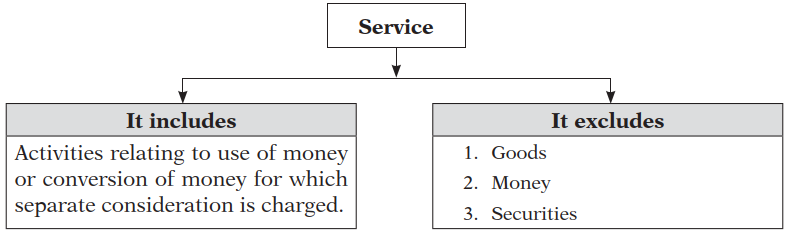
Service

It means the Service refers to anything other than goods, money and securities but includes activities relating to use of money or conversion of money for which separate consideration is charged.

Explanation to section 2(102)#

Statutory Provision – “For removal of doubts, it is hereby clarified that the expression ‘Services’ includes facilitating or arranging transactions in securities.”

Explanation – AS per the definition of goods and services, the securities are excluded from the definition of both ‘goods’ and ‘services’ in the CGST Act and they are neither goods nor services. However, facilitating or arranging transactions in securities is liable to GST. In order to clarify the same, the above explanation has been inserted to section 2(102).

Example – In relation to transactions in securities, if some service charges or service fees or documentation fees or broking charges or such like fees or charges are charged, then the same would be a consideration for provision of service and shall be chargeable to GST.

Note – Under GST, the supply should be of goods or services. Supply of anything other than goods or services does not attract GST.

Supply to Be Classified Either as Goods or as Services
As stated above, supply should involve goods and/or Services viz. either as wholly goods or wholly services. Now, a question arises, what will happen where a supply involves both goods and services? The GST law provides that such supplies would be classifiable either as, wholly goods or wholly services. This classification has been provided in Schedule II of the Act, which has been discussed later in this article.

4. Types of Supplies

As already stated in previous Para, the term supply under GST includes supply of goods as well as supply of services. This supply may be classified on various basis.

(a) On the basis of movement/flow

(a) Inward supply

(b) Outward supply

(b) On the basis of Continuity

(a) One time supply

(b) Continuous supply

(c) On the basis of taxability

(a) Taxable supply

(b) Non-taxable supply

(c) Exempt supply

(d) Zero-rated supply

    (d)  On the basis of Geographical location

(a) Intra-state supply

(b) Inter-state supply

(c) Supplies in territorial waters

    (e)  On the basis of Goods supplied in conjunction

(a) Composite supply

(b) Mixed supply

4.1 Types of Supplies on the Basis of Movement/Flow

Every transaction necessarily involves two parties namely supplier and recipient. When we consider a supply of goods/services from the point of view of either of the party, it may be classified as inward supply or outward supply.

(a) Inward Supply – In relation to a person, “inward supply” means receipt of goods or services or both, whether by purchase, acquisition or any other means with or without consideration.

(b) Outward Supply – In relation to a taxable person, “outward supply” means supply of goods or services or both, whether by sale, transfer, barter, exchange, licence, rental, lease or disposal or any other mode, made or agreed to be made by such person in the course or furtherance of business.

Example – Ravish Computers Ltd., a registered dealer has sold desktop computer to ABC Ltd. at a price of Rs. 26,000 plus GST. This single transaction of supply of computer constitutes “inward Supply” for recipient (i.e. for ABC Ltd.) and “Outward Supply” for the Supplier (i.e. for Ravish computers Ltd.)

4.2 Types of Supplies on the Basis of Continuity

The recurrence of a Supply is the basis for this classification:

(a) One-time Supply – It simply refers to Supply of goods or Services which is provided or agreed to be provided on non-recurrent basis as a Standalone Supply. For Example – when Mahesh purchases a machine from M/s. ABC, then it is one-time Supply. This category is required just to recognise the other type of Supply, which is continuous Supply.

(b) Continuous Supply – The continuous supply may be as regards goods as well as for services.

Continuous Supply of Goods – As per section 2(32) of CGST Act, 2017, “continuous supply of goods” means a supply of goods which is provided, or agreed to be provided, continuously or on recurrent basis, under a contract, whether or not by means of a wire, cable, pipeline or other conduit, and for which the supplier invoices the recipient on a regular or periodic basis.

Continuous Supply of Services – As per section 2(33) of CGST Act, 2017, “continuous supply of services” means a supply of services which is provided, or agreed to be provided, continuously or on recurrent basis, under a contract, for a period exceeding three months with periodic payment obligations.

Example – Kanika uses LPG stove and is a registered customer with Shivani Enterprises, a dealer of LPG Cylinders. She acquires two cylinders every month on regular basis. It is the example of one-time supply where every supply of cylinder is a separate transaction. On the other hand, Ms Tania has taken PNG connection at her kitchen from Indraprastha Gas Limited. The billing is done monthly on the basis of meter reading. It is the case of continuous supply of goods.

4.3 Types of Supplies on the Basis of Taxability

The scope of supply has been given in section 7 of CGST Act, 2017. Even if an activity is a supply, it is not necessary that the same is subject to GST. On this basis, there can be following types of supplies:

(a) Taxable Supply – As per section 2(108) of CGST Act,

“Taxable Supply refers to a Supply of Goods and/or Services which is leviable to tax under CGST Act”.

(b) Non-Taxable Supply – As per section 2(78) of CGST Act,

“Non-Taxable Supply means a Supply of Goods or Services or both which is not leviable to tax under CGST Act or under the IGST Act”.

(c) Exempt Supply – As per section 2(47) of CGST Act,

“Exempt Supply means a Supply of any Goods or Services or both which attracts Nil rate of tax or which may be wholly exempt from tax under Section 11, or under section 6 of IGST Act, and includes non-taxable Supply”.

(d) Zero Rated Supply – It is Supply of any Goods and/or Services on which no tax is payable but input tax credit pertaining to that Supply is admissible. As per Section 16(1) of IGST Act, 2017, “zero rated supply” means any of the following supplies of goods or services or both, namely:

(a)  export of goods or services or both; or

(b) supply of goods or services or both to a Special Economic Zone developer or a Special Economic Zone unit.

4.4 On the basis of Geographical location

When we consider the movement of Supply geographically, it can be of three types namely Inter-State Supply, Intra-State Supply and Supplies in the territorial waters.

(1) Inter-State Supply – As per Section 7(1) of IGST Act, Subject to the provisions of section 10, supply of goods, where the location of the supplier and the place of supply are in:

(a) two different States;

(b) two different Union territories; or

(c) a State and a Union territory,

shall be treated as a supply of goods in the course of inter-State trade or commerce.

Similarly, as per Section 7(3), Subject to the provisions of section 12, supply of services, where the location of the supplier and the place of supply are in:

(a) two different States;

(b) two different Union territories; or

(c) a State and a Union territory,

shall be treated as a supply of services in the course of inter-State trade or commerce.

(2) Intra-State Supply – As per Section 8(1) of IGST Act, Subject to the provisions of section 10, supply of goods where the location of the supplier and the place of supply of goods are in the same State or same Union territory shall be treated as intra-State supply:

Provided that the following supply of goods shall not be treated as intra-State supply, namely:

(i) supply of goods to or by a Special Economic Zone developer or a Special Economic Zone unit;

(ii) goods imported into the territory of India till they cross the customs frontiers of India; or

(iii) supplies made to a tourist referred to in section 15.

    (3)  Supplies in the Territorial Waters – As per Section 9 of IGST Act, Notwithstanding anything contained in this Act:

(a) where the location of the supplier is in the territorial waters, the location of such supplier; or

(b) where the place of supply is in the territorial waters, the place of supply, shall, for the purposes of this Act, be deemed to be in the coastal State or Union territory where the nearest point of the appropriate baseline is located.

5. Types of Supplies in Case of Combination Supplies

The GST is payable on individual goods or Services or both at the notified rates. For example – The Tooth-paste and Tooth-brush are liable to GST @ 12% and 18% respectively. It means the GST on these items will be calculated accordingly. Sometimes, two or more goods or Services are supplied in combination at a Consolidated price. In this case, a question arises about the rate of GST to be levied as the goods/services in package may be subjected to different rates of tax. For example:

(a) A desktop computer (GST @ 28%) and a wooden table (GST @ 18%) are offered by supplier at a consolidated price of Rs. 52,500.

(b) Supply of LCD with warranty and maintenance for 1 year again at a consolidated price.

For the purpose of taxability, the CGST Act, classifies these “Combination Supplies” into two types:

  1. Composite Supply
  2. Mixed Supply

5.1 Composite Supply

As per section 2(30) of CGST Act, 2017,

“Composite Supply” means a supply made by a taxable person to a recipient consisting of two or more taxable supplies of goods or services or both, or any combination thereof, which are naturally bundled and supplied in conjunction with each other in the ordinary course of business, one of which is a principal supply.

The following are the basic features of a composite supply:

(a) It should be the supply made by taxable person to a recipient.

(b) It should consist of two or more taxable supplies of Goods or services or both.

(c) The combination should be naturally bundled and supplied in conjunction with each other in the ordinary course of business.

  • The Supplied in conjunction means that they should be occurring in the same point in time and space.

(d) Out of two naturally bundled supplies, one should be a principal supply.

  • Where goods are packed and transported with insurance, the supply of goods, packing materials, transport and insurance is a composite supply and supply of goods is a principal supply.
  • Principal Supply means supply which forms the predominant element of the composite supply and other parts of the supply are only ancillary or supportive to that predominant part.

Examples on Composite Supply

Example 1
Supply – Prakash buys LCD and also gets warranty and a maintenance contract with the LCD.

Comment – This supply is a composite supply. The supply of LCD is the principal supply and warranty/maintenance services are ancillary.

Example 2
Supply – Samrat Hotel in Shimla, provides 4 days-3 nights package at Rs. 8,000 wherein the facility of breakfast and dinner is provided along with the room accommodation.

Comment – It is composite supply since the supply of breakfast and dinner with the accommodation in the hotel are naturally bundled.

Example 3
Supply – The Xiaomi Communication Co. Ltd. has recently launched a mobile phone with the brand name “Redmi Note 4”. The company supplies the accessories, earphone and charger along with the handset.

Comment – The supply of earphone and charger with the mobile phone handset are naturally bundled. This supply qualifies as “composite Supply.” The Supply of mobile phone is the principal supply.

Clarification by CBIC

CBIC has clarified as to what constitutes the principal supply in the given composite supplies:

1. Activity/Transaction:
Supply of printed books, pamphlets, brochures, envelopes, annual reports, leaflets, cartons, boxes etc., printed with design, logo, name, address or other contents supplied by the recipient of such printed goods.
Principal Supply:
Supply of Service – In the case of printing of books, pamphlets, brochures, annual reports, and the like, where only content is supplied by the publisher or the person who owns the usage rights to the intangible inputs while the physical inputs including paper used for printing belong to the printer, supply of printing [of the content supplied by the recipient of supply] is the principal supply and therefore such supplies would constitute supply of service.

Supply of Goods – In case of supply of printed envelopes, letter cards, printed boxes, tissues, napkins, wallpaper etc. by the printer using its physical inputs including paper to print the design, logo etc. supplied by the recipient of goods, predominant supply is supply of goods and the supply of printing of the content [supplied by the recipient of supply] is ancillary to the principal supply of goods and therefore such supplies would constitute supply of goods.

[Circular No. 11/11/2017-GST dated 20-10-2017]

2. Activity/Transaction:
Activity of Bus Body Building
Principal Supply:
The principal supply may be determined on the basis of facts and circumstances of each case [Circular No. 34/8/2018-GST dated 01-03-2018]
3. Activity/Transaction:
Retreading of Tyres
Principal Supply:
Supply of Service – Pre-dominant element is process of retreading which is a supply of service. Rubber used for retreading is an ancillary supply.

Supply of Goods – Supply of retreaded tyres, where the old tyres belong to the supplier of retreaded tyres, is a supply of goods.

[Circular No. 34/8/2018-GST dated 01-03-2018]

5.2 Mixed Supply

As per Section 2(74),

“Mixed supply means two or more individual supplies of goods or services, or any combination thereof, made in conjunction with each other by a taxable person for a single price where such supply does not constitute a composite supply.”

The essence of the definition is that there should be supply of two or more individual goods or services or any combination thereof, in conjunction with each other. In fact, in case of mixed supplies, the goods/services which are supplied to the recipient at one price can be supplied individually. In other words, the individual supplies are independent of each other and are not naturally bundled.

In nutshell, a supply of more than one goods and/or services as a bundle will be reckoned as mixed supply if the following conditions are fulfilled:

(i) Such goods/or services are supplied for a single price.

(ii) They are not naturally bundled together and

(iii) It does not qualify as composite supply.

Examples on Mixed Supply:

Example 4
Supply – A gift pack comprising of canned foods, sweets, chocolates, cakes, dry fruits, aerated drinks and fruit juices supplied for a single price.

Comment – It is an example of mixed supply as all these goods can be sold independently.

Example 5
Supply – Rent deed executed for renting of the different floors of a building, one for residence and another for commercial purpose to the same person.

Comment – It will be treated as mixed supply as the two floors could have been rented independently.

Example 6
Supply – A supply of a package Comprising of shirt, trouser, tie and belt for a single price.

Comment – It is a mixed supply. The reason being each of these items can be supplied separately and is not dependent on any other.

Works Contract and Restaurant Services
1.  As per section 2(119) of CGST Act, 2017, “Works contract means a contract for building, construction, fabrication, completion, erection, installation, fitting out, improvement, modification, repair, maintenance, renovation, alteration or commissioning of any immovable property wherein transfer of property in goods (whether as goods or in some other form) is involved in the execution of such contract.”

2.  Works contract and restaurant services are the classic example of composite supplies. However, the GST law identifies both as supply of services [as per Schedule II]


# Inserted by the CGST (Amendment) Act, 2018, dated 30-8-2018, w.e.f. 1-2-2019 vide Notification No. 02/2019-Central Tax, dated 29-1-2019.

The post Supply Under GST – Meaning | Types | Taxable Event appeared first on Taxmann Blog.

source

Categories
Blog Updates

IRDAI Proposes Ind AS Implementation for Insurers from 1 April 2026

IRDAI Ind AS implementation for insurers

The Insurance Regulatory and Development Authority of India (IRDAI) has issued an Exposure Draft proposing amendments to its regulations to facilitate the implementation of Indian Accounting Standards (Ind AS) for the insurance sector.

The proposed framework seeks to enable insurers to transition to the Ind AS reporting regime from 1 April 2026.

1. Background Introduction of Ind AS 117 and Ind AS 109

The proposal follows the notification of key accounting standards relevant to insurers:

  • Ind AS 117 – Insurance Contracts
  • Ind AS 109 – Financial Instruments

These standards significantly change the accounting and financial reporting framework for insurance companies by introducing more transparent and globally aligned measurement and disclosure requirements.

2. Objective of the Proposed Amendments

The draft amendments aim to align financial reporting by insurers with globally accepted IFRS-based standards. This alignment is intended to improve comparability, transparency, and consistency in the financial statements of insurance companies.

3. Key Areas Covered in the Draft Framework

The exposure draft and consultation paper outline several important aspects relating to the transition to Ind AS, including:

  • The proposed transition approach for insurers
  • Regulatory alignment required to integrate Ind AS with existing insurance regulations
  • Implementation considerations for insurers adopting the new standards
  • Measures to ensure a smooth transition to the revised financial reporting framework

4. Invitation for Stakeholder Comments

IRDAI has invited comments and suggestions from stakeholders on the proposed amendments. Stakeholders may submit their feedback until 24 March 2026.

5. Significance of the Proposal

The proposed implementation of Ind AS for the insurance sector represents a major step towards aligning India’s insurance accounting framework with global IFRS standards. It is expected to enhance transparency, improve financial reporting quality, and strengthen investor confidence in the insurance sector.

Click Here To Read The Full Update

The post IRDAI Proposes Ind AS Implementation for Insurers from 1 April 2026 appeared first on Taxmann Blog.

source

Categories
Blog Updates

HC Quashes Duplicate GST Orders on GSTR-2A/3B Mismatch

GSTR-2A/3B Mismatch

Case Details: Tvl. Vishagan Traders vs. Deputy State Tax Officer-2 [2026] 183 taxmann.com 664 (Madras)

Judiciary and Counsel Details

  • Krishnan Ramasamy, J.
  • A. Satheesh Murugan for the Petitioner.
  • R.Suresh Kumar, AGP for the Respondent.

Facts of the Case

The petitioner challenged two assessment orders passed for the same tax period concerning mismatch between Form GSTR-2A and Form GSTR-3B. It was submitted that pursuant to a show cause notice, the first authority passed an order on the sole issue of GSTR-2A and GSTR-3B mismatch. Subsequently, another show cause notice (SCN) was issued and the second authority passed an order covering two issues, including the same mismatch, thereby separately quantifying the tax demand for the identical issue in both orders. It was contended that such duplication resulted in double taxation for the same subject matter. The matter was accordingly placed before the High Court.

High Court Held

The High Court held that the proceedings arose from an assessment under Section 73 of the CGST Act and the Tamil Nadu GST Act and that passing two separate orders on the identical issue of mismatch between Form GSTR-2A and Form GSTR-3B for the same period resulted in duplication and double taxation. The Court observed that service of SCN only through portal upload without furnishing the original notice and without granting personal hearing violated the principles of natural justice in the context of Section 75 read with Section 169 of the CGST Act and the Tamil Nadu GST Act. Accordingly, the Court quashed the order. The matter was remanded to the jurisdictional authority for fresh consideration subject to payment of 25% of the disputed tax.

The post HC Quashes Duplicate GST Orders on GSTR-2A/3B Mismatch appeared first on Taxmann Blog.

source

Categories
Blog Updates

HC Condoned Delay in GST Appeal for ITC Dispute

GST Appeal for ITC Dispute

Case Details: Vishal Durgadas Jaiwant vs. Joint Commissioner of Commercial Taxes (Appeals) [2026] 183 taxmann.com 665 (Karnataka)

Judiciary and Counsel Details

  • Mrs K.S. Hemalekha, J.
  • S.G. Solargoppa, Adv. for the Petitioner.
  • Praveen K. Uppar, AGA for the Respondent.

Facts of the Case

The petitioner challenged the rejection of his appeal against the denial of Input Tax Credit (ITC) arising from a mismatch caused by the supplier’s failure to upload the relevant invoice in GSTR-1. It was submitted that ITC had been availed based on the supplier’s invoice. He contended that, due to a bona fide belief that the supplier would rectify the error and a lack of awareness and assistance regarding the limitation period, the appeal could not be filed within time. The petitioner, therefore, sought condonation of the delay and adjudication of the appeal on the merits. The matter was accordingly placed before the High Court.

High Court Held

The High Court held that the explanation furnished by the petitioner disclosed a bona fide belief and reasonable cause for the delay. The Court observed that the dispute arose from an assessment under Section 73 of the CGST Act and that the appeals filed under Section 107 of the CGST Act and the Karnataka GST Act required consideration on the merits. It further noted that instructions issued under Section 168 were relevant in cases of ITC mismatch due to supplier non-reporting. Accordingly, the Court set aside the order rejecting the appeal as time-barred and directed that the appeal be treated as filed within time and decided on the merits.

List of Cases Referred to

The post HC Condoned Delay in GST Appeal for ITC Dispute appeared first on Taxmann Blog.

source

Categories
Blog Updates

[Global Financial Insights] IASB Update – February 2026 | Key Highlights and More

IASB February 2026 update

Editorial Team – [2026] 184 taxmann.com 56 (Article)

Global Financial Insights is a weekly feature for the Accounts and Audit Module subscribers of Taxmann.com. It provides you with the latest updates on financial reporting and auditing practices from across the globe. Here is this week’s financial update:

1. IASB Update – February 2026 | Key Highlights

The International Accounting Standards Board held its meetings on 24–25 February 2026 to discuss various research, standard-setting and maintenance projects. Key highlights of the meetings are summarised below:

(a) Financial Instruments with Characteristics of Equity

The IASB met on 24 February 2026 to continue redeliberating the Exposure Draft on Financial Instruments with Characteristics of Equity, focusing on proposed amendments to IAS 32 related to the classification of derivatives on own equity when applying the fixed-for-fixed condition. The Board tentatively agreed to proceed with the proposed requirements, subject to minor drafting improvements and targeted refinements. These clarifications include defining a derivative as meeting the fixed-for-fixed condition if there is a fixed amount of consideration and either a fixed number of own equity instruments or a fixed exchange ratio, and confirming that derivatives between group entities can meet the condition in consolidated financial statements under specified functional currencies. Terminology was updated: “preservation adjustments” are now “adjustments that compensate the future holders of the equity instruments,” and “passage-of-time adjustments” are now “adjustments that are solely a function of time,” with further guidance on predetermined adjustments and share-for-share exchanges. All 13 IASB members agreed with these decisions.

The Board also received an update on the project plan but made no further decisions. The IASB will continue to redeliberate the classification topics in the Exposure Draft in upcoming meetings.

(b) Post-implementation Review of IFRS 16, Leases

The IASB discussed additional feedback received on its request for information for the Post-implementation Review of IFRS 16, including matters relating to transition requirements and academic research. No decisions were taken. The Board will continue analysing feedback before determining whether further actions are required.

(c) Amortised Cost Measurement – IFRS 9

The IASB tentatively decided to clarify that a modification of a financial instrument constitutes a change in contractual terms affecting the nature, timing, amount or uncertainty of cash flows under IFRS 9. It also decided to clarify that a substantial modification of a financial asset results in derecognition of the original asset and recognition of a new asset, assessed using a principles-based approach. All 13 IASB members agreed with these decisions, and the Board will continue deliberating the remaining proposals in future meetings.

(d) Equity Method

The IASB met on 25 February 2026 to continue reviewing the proposals in the Exposure Draft on the Equity Method of Accounting—IAS 28 Investments in Associates and Joint Ventures. The Board tentatively decided to retain the existing guidance on impairment indicators, clarifying that a single event may not indicate impairment and that investors should consider all observable information when assessing whether an investment in an associate has lost value. They also agreed to update the language in IAS 28, replacing “decline in fair value … below its cost” with “decline in fair value … to less than its carrying amount,” removing references to a “significant or prolonged” decline, and confirming that investors should use observable price information, including market prices, when determining impairment, especially for publicly traded associates.

Regarding other matters, the IASB decided not to move the impairment requirements from IAS 28 to IAS 36 and will not address two application issues related to reversing impairment losses at this stage. All 13 IASB members agreed with these decisions, and the Board will continue deliberating the remaining proposals in future meetings.

(e) Post-implementation Review of IFRS 9 – Hedge Accounting

The IASB discussed the objective, activities and timeline for the first phase of the post-implementation review of hedge accounting requirements under IFRS 9. No decisions were taken. The Board plans to engage with consultative groups and other stakeholders to inform a request for information, which it expects to publish in the second half of 2026.

(f) Provisions – Targeted Improvements

The IASB had earlier issued an Exposure Draft titled “Provisions—Targeted Improvements”, proposing targeted amendments to the recognition criteria for provisions under IAS 37 Provisions, Contingent Liabilities and Contingent Assets and inviting stakeholder feedback.

At its meeting on 24 February 2026, the IASB redeliberated the feedback received on the Exposure Draft, focusing on aspects of the present obligation recognition criterion, particularly the past-event condition and the proposed transfer condition.

In relation to levies, the Board tentatively decided to supplement the proposed past-event condition with additional application requirements. These would establish the principle that the economic benefit or activity satisfying the past-event condition is the activity the government seeks to levy, supported by a constraining presumption that such activity would generally be one specified in the levy legislation for the levy to become payable. The IASB also discussed whether this presumption should be rebuttable in certain circumstances, although no decision was taken on this matter.

The IASB also tentatively decided to retain the proposal to introduce an explicit ‘transfer condition’ in the recognition criterion. The Board agreed to further clarify the distinction between an obligation to transfer an economic resource and an obligation to exchange economic resources, noting that an exchange involves both a transfer and a corresponding right to receive another economic resource, which may result in the recognition of either an asset or an expense. Additional guidance and examples will be expanded to explain how the transfer condition applies to asset decommissioning and environmental rehabilitation obligations and how it interacts with measurement requirements in IAS 37.

Further, the Board agreed to clarify the implications of the transfer condition for levies by defining ‘levy’ as a non-reciprocal charge and specifying that obligations for levies would, by definition, meet the transfer condition.

The IASB will continue redeliberating the proposals in the Exposure Draft in subsequent meetings.

Source – International Financial Reporting Standard

Click Here To Read The Full Article

The post [Global Financial Insights] IASB Update – February 2026 | Key Highlights and More appeared first on Taxmann Blog.

source