Categories
Blog Updates

[Opinion] SEBI’s New RPT Framework – Turnover-Linked Thresholds and Stronger Subsidiary Controls

SEBI related party transaction framework

Adv. Shivam Chaudhary & Harsh  [2025] 181 taxmann.com 844 (Article)

1. Introduction

Corporate governance in India has long grappled with the complex reality of Related Party Transactions (RPTs). While RPTs are often necessary for operational efficiency—allowing groups to leverage synergies and economies of scale—they simultaneously present the most significant risk for the expropriation of minority shareholder wealth. The challenge for the regulator has always been to distinguish between abusive tunnelling of funds and legitimate business exchanges.

In a decisive move to calibrate this balance, the Securities and Exchange Board of India (SEBI) has recently amended the SEBI (Listing Obligations and Disclosure Requirements) Regulations 2015(LODR Regulations). These amendments represent a paradigm shift from a “one-size-fits-all” approach to a more nuanced, scale-sensitive framework. By introducing a turnover-linked, slab-based materiality threshold under the newly added Schedule XII, and by tightening the noose around indirect RPTs routed through subsidiaries, SEBI has signalled that substance will prioritise over form. This article analyses the implications of these amendments, examining how the transition to proportional governance impacts the compliance landscape for India Inc.

2. The Death of the Fixed Threshold Analysing Schedule XII

Under the erstwhile regime, the determination of a “material” RPT—which triggers the requirement for shareholder approval—was often a point of contention. Previously, a transaction was considered material if it exceeded 10% of the annual consolidated turnover of the listed entity. Subsequently, absolute monetary thresholds (such as Rs 1,000 crore) were introduced to capture high-value transactions of large conglomerates that might otherwise slip under the 10% radar.

However, fixed monetary thresholds suffered from a binary flaw: they were either too high to protect shareholders in smaller entities or too low for mega-corporations, resulting in a clutter of procedural compliances for routine operational transfers. The recent amendment replaces this rigid structure with a slab-based mechanism introduced in Schedule XII of the LODR Regulations. This change acknowledges that “materiality” is relative. A Rs 50 crore transaction might be negligible for a Nifty 50 company but existential for a small-cap entity.

By linking thresholds to specific turnover slabs, SEBI ensures that the governance burden scales with the size of the entity. For smaller companies, lower thresholds ensure that even moderate leakage of funds is scrutinised by shareholders. Conversely, for larger entities, the slabs prevent the Audit Committee and shareholders from being inundated with approval requests for transactions that, while large in absolute terms, are statistically insignificant relative to the company’s balance sheet.

This analytical shift aligns Indian governance with global best practices, where materiality is viewed as a function of risk and scale rather than an arbitrary number. It forces the Audit Committee to assess transactions not just on their face value, but on their relative impact on the company’s financial health.

3. Piercing the Veil The Subsidiary Trap

One of the most profound aspects of the recent amendments is the tightening of norms regarding subsidiaries. Historically, promoters have often utilised the complex webs of holding and subsidiary companies to obfuscate the trail of transactions. A listed entity might divert funds to a subsidiary, which would then transact with a related party, effectively bypassing the approval mechanisms of the listed parent company.

The amendments dismantle this loophole by refining the approval norms for RPTs undertaken through subsidiaries. The regulator has introduced a bifurcation based on the reliability of financial data separate thresholds now apply for subsidiaries with audited financials versus those without.

For subsidiaries without audited financials—often the opaque vehicles used for financial engineering—the thresholds for triggering parent-level approval are significantly stricter. This forces listed entities to either maintain higher standards of financial reporting for their subsidiaries or face the scrutiny of the listed entity’s shareholders.

Furthermore, the amendments clarify the triggers for approval. It is no longer sufficient for the subsidiary’s board to sign off on a transaction. If the value of the RPT exceeds the prescribed threshold under the new framework, it triggers a requirement for approval from the Audit Committee, the Board, or the shareholders of the listed entity itself.

This effectively pierces the corporate veil for the purpose of governance. It recognises that the economic interest of the shareholder in the listed parent extends to the assets held by the subsidiary. As noted in various judicial precedents, including Vodafone International Holdings BV v. Union of India, the legal independence of a subsidiary does not preclude the economic reality of control. SEBI’s amendments operationalise this economic reality into regulatory compliance.

Click Here To Read The Full Article

The post [Opinion] SEBI’s New RPT Framework – Turnover-Linked Thresholds and Stronger Subsidiary Controls appeared first on Taxmann Blog.

source

Categories
Blog Updates

Jharkhand Appellant Entitled to Pay Parity under Bihar Reorganisation Act | SC

Bihar Reorganisation Act

Case Details: Sanjay Kumar Upadhyay vs. State of Jharkhand - [2025] 181 taxmann.com 542 (SC)

Judiciary and Counsel Details

  • J.K. Maheshwari & Vijay Bishnoi, JJ.
  • Sudhanshu S. PandeyArjun D. SinghRoshan KumarMaitreya MahaleyYimyanger LongkumerKamei Bestman Kabui, Advs. & Gaichangpou Gangmei, AOR for the Appellant.
  • Shantanu Sagar, AOR & Anil Kumar, Adv. for the Respondent.

Facts of the Case

In the instant case, pursuant to a common recruitment process conducted in 1981, the appellant was appointed as an Industries Extension Officer (IEO) by the State of Bihar. Upon reorganisation of the State of Bihar, the appellant was allocated to the State of Jharkhand. The appellant filed a writ petition before the High Court seeking issuance of an appropriate writ directing the respondent-employer to grant him the genuine pay scale in place of the anomaly in pay scale, in parity with other similarly situated persons.

The learned Single Judge of the High Court of Jharkhand allowed the writ petition, holding that the case was squarely covered by the judgments of the Patna High Court in Nagendra Sahani v. State of Bihar [CWJC No. 8419 of 1992], and directed the State to revise the appellant’s pay scale from the date of his appointment, with arrears and consequential benefits.

On appeal, the Division Bench of the High Court allowed the intra-court appeal and set aside the judgment of the learned Single Judge.

Supreme Court Held

The Hon’ble Supreme Court observed that the principle of equality enshrined in Article 14 does not permit discrimination between persons who are similarly situated, and that any differential treatment must be based on an intelligible differentia having a rational nexus with the object sought to be achieved. It was further observed that Section 34(4) mandates that judicial orders of the Patna High Court continue to bind the successor State.

By virtue of Section 34(4) of the Bihar Reorganisation Act, 2000, the judgment of the Patna High Court in Nagendra Sahani v. State of Bihar [CWJC No. 8419 of 1992], granting a higher pay scale to similarly situated employees, is binding on the State of Jharkhand in the appellant’s case. Once it is established that the factual matrix is identical and the legal issue involved is the same, similar relief is required to be granted. Therefore, when other similarly situated employees have already been granted the benefit through judicial pronouncement, denial of the same relief to the appellant would be unjust.

Accordingly, the Hon’ble Supreme Court held that the impugned judgment of the Division Bench was liable to be set aside, restoring the judgment of the learned Single Judge.

List of Cases Reviewed

  •  Order of High Court of Jharkhand, Division Bench LPA No. 269 of 2012, judgment dated 30.03.2022 (para 33) set aside
  • Nagendra Sahani v. State of Bihar [CWJC No. 8419 of 1992] (para 31) followed

List of Cases Referred to

  • Nagendra Sahani v. State of Bihar [CWJC No. 8419 of 1992] (para 2)
  • Alakh Kumar Sinha v. State of Bihar [CWJC No. 12301 of 2004] (para 2)
  • Suprita Chandel v. Union of India [2025] 12 taxmann.com 1219 (SC) (para 11)
  • Mary Pushpam v. Telvi Curusumary (2024) 3 SCC 224 (para 22)
  • M.R. Gupta v. Union of India [1996] 1995 taxmann.com 1574 (SC) (para 24).

The post Jharkhand Appellant Entitled to Pay Parity under Bihar Reorganisation Act | SC appeared first on Taxmann Blog.

source

Categories
Blog Updates

HC Sets Aside GST Demand on Govt Enterprise’s Lease Proceeds

GST demand on government lease proceeds

Case Details: NBCC (India) Ltd. vs. Additional Commissioner CGST Delhi South - [2025] 181 taxmann.com 604 (Delhi)

Judiciary and Counsel Details

  • Prathiba M. Singh & Shail Jain, JJ.
  • Bhuvnesh SatijaMs Vibhooti MalhotraUdit SharmaAniket Khanduri, Advs. for the Petitioner.
  • Ms Samiksha Godiyal, SSC, Tenzing N. BhutiaB.D. Rao Kundan, Advs. for the Respondent.

Facts of the Case

The petitioner, a government enterprise, undertook the redevelopment and executed a memorandum of understanding (MOU) with the Ministry of Urban Development. An escrow agreement appointed the petitioner as the agency to manage lease proceeds, which were credited to escrow for onward transfer to the Ministry or the Consolidated Fund. The receipts originated from Government Departments, autonomous bodies, PSUs, and others. The Directorate General of GST Intelligence investigated the project and the escrow collections, confirming a GST demand on the escrow receipts. It was contended that the GST demand was unsustainable. The matter was accordingly placed before the High Court.

High Court Held

The High Court held that the GST demand raised lacked merit in view of the Ministry of Finance’s office memorandum. The Court observed that the memorandum clarified the treatment of escrow receipts from redevelopment projects and addressed the applicability of exemption and reverse charge mechanisms under Section 9 of the CGST Act. It was concluded that the petitioner’s claims were consistent with the memorandum and that the GST demand could not be sustained. Consequently, the Court set aside the impugned order.

The post HC Sets Aside GST Demand on Govt Enterprise’s Lease Proceeds appeared first on Taxmann Blog.

source

Categories
Blog Updates

[World Tax News] OECD Issues Updated FAQs on CRS and CARF and More

OECD CRS and CARF FAQs update

Editorial Team [2025] 181 taxmann.com 847 (Article)

World Tax News provides a weekly snippet of tax news from around the globe. Here is a glimpse of the tax happening in the world this week:

1. OECD Issues Updated FAQs on CRS and CARF

The OECD has published updated FAQs on the application of the Common Reporting Standard (CRS) and the Crypto-Asset Reporting Framework (CARF).

These FAQs are intended to promote uniform and consistent implementation of the OECD’s International Standards for Automatic Exchange of Information in Tax Matters. The questions reflected in the FAQs were raised by business representatives and government delegates, and newly added or revised FAQs are marked in yellow.

Source:

2. Israel Proposes R&D Tax Credit to Preserve Incentives under OECD Pillar Two Global Minimum Tax Rules

Israel has initiated a public consultation on draft legislation to safeguard R&D tax incentives within the global minimum tax regime. The Israeli Ministry of Finance has, with effect from 14 December 2025, invited public comments on a draft memorandum proposing the introduction of an R&D tax credit that will remain operative under the OECD/G20 Inclusive Framework’s global minimum tax rules (Pillar Two/GloBE).

Under the draft proposal, an R&D tax credit linked to qualifying domestic R&D expenditure would be available to knowledge-intensive companies, with credit rates varying by plant location category—15% for “Group A” locations and 2% for “Group B” locations. The proposal further provides for enhanced credit rates, up to 30% for Group A and 4% for Group B, for specified categories of resident companies that are members of a multinational enterprise group exceeding a prescribed threshold.

In the Pillar Two context, the OECD’s GloBE rules generally treat Qualified Refundable Tax Credits as income, rather than as a reduction of covered taxes, when calculating the Pillar Two effective tax rate. Consequently, jurisdictions have been restructuring tax incentives to align them with the QRTC framework.

Source  Public Consultation

Click Here To Read The Full Article

The post [World Tax News] OECD Issues Updated FAQs on CRS and CARF and More appeared first on Taxmann Blog.

source

Categories
Blog Updates

SEBI Updates BSDA Norms on Valuation | Exclusions | Eligibility Review

SEBI BSDA norms

Circular No. HO/38/11/11(3)2025-MIRSD-POD/I/1101/2025, Dated 24.12.2025

1. Regulatory Background

The Securities and Exchange Board of India (SEBI) has directed further enhancements to the Facility for Basic Services Demat Account (BSDA) with the objective of strengthening financial inclusion, ensuring fair classification of investors, and preventing inadvertent migration of eligible investors to regular demat accounts.

The revised framework introduces clarifications on valuation, exclusions from threshold computation, periodic eligibility review, and investor consent requirements.

2. Key Enhancements to the BSDA Framework

2.1 Exclusion of Certain Securities From BSDA Threshold

SEBI has clarified that the following securities shall not be considered while computing the value threshold for BSDA eligibility:

  • Zero Coupon Zero Principal (ZCZP) Bonds
  • Delisted Securities

This exclusion ensures that investors holding such instruments are not disqualified from BSDA eligibility due to non-tradable or special-purpose securities.

2.2 Valuation of Illiquid Securities

The framework provides clarity on the valuation methodology for illiquid securities held in demat accounts for BSDA eligibility determination.

This ensures:

  • Uniform valuation practices across Depository Participants (DPs)
  • Prevention of arbitrary or inflated valuation of non-liquid holdings
  • Fair and transparent assessment of investor eligibility

2.3 Mandatory Quarterly Reassessment by Depository Participants

SEBI has mandated that:

  • Depository Participants must reassess BSDA eligibility on a quarterly basis
  • Eligibility must be determined based on the value of holdings as per the prescribed framework

This periodic review ensures:

  • Continued availability of BSDA benefits to eligible investors
  • Timely migration only where thresholds are genuinely breached
  • Ongoing accuracy in investor classification

2.4 Active and Verifiable Investor Consent for Regular Demat Accounts

To strengthen investor protection, SEBI has directed that:

  • Investors opting for regular demat accounts instead of BSDA must provide Active, explicit, and verifiable consent
  • Passive consent, default migration, or implied acceptance is not permitted

This ensures that investors:

  • Are fully informed of cost implications
  • Make a conscious and documented choice
  • Are not automatically shifted to higher-cost demat accounts

3. Effective Date

  • The enhanced BSDA framework shall come into effect from March 31, 2026

DPs are required to complete system and process readiness well before the effective date.

4. Regulatory Intent

SEBI’s measures aim to:

  • Strengthen the original objective of BSDA as a low-cost demat facility
  • Prevent unintended exclusion of small investors
  • Improve transparency, consistency, and fairness in eligibility determination
  • Enhance investor autonomy and consent-based decision-making
  • Align demat account practices with consumer protection principles

5. Implications for Stakeholders

5.1 For Investors

  • Continued access to BSDA benefits despite holding ZCZP bonds or delisted securities
  • Clearer valuation norms and protection from forced account upgrades
  • Greater control through mandatory consent requirements

5.2 For Depository Participants

Need to:

  • Update systems for quarterly eligibility checks
  • Exclude specified securities from threshold computation
  • Implement robust consent capture and audit trails
  • Revise internal SOPs, disclosures, and investor communication

6. Key Takeaway

SEBI’s enhanced BSDA framework strengthens investor protection and inclusion by refining eligibility calculations, mandating periodic reassessment, excluding non-relevant securities, and ensuring explicit investor consent—with all changes effective from March 31, 2026.

Click Here To Read The Full Circular

The post SEBI Updates BSDA Norms on Valuation | Exclusions | Eligibility Review appeared first on Taxmann Blog.

source

Categories
Blog Updates

SEBI Simplifies Issuance of Duplicate Securities Procedure

SEBI duplicate securities issuance procedure

Circular No. HO/38/13/11(3)2025-MIRSD-POD/I/1102/2025, Dated 24.12.2025

1. Regulatory Background

The Securities and Exchange Board of India (SEBI) has reviewed and streamlined the procedure and documentation requirements for issuance of duplicate securities. The objective is to simplify, standardise, and expedite the process for investors while ensuring adequate safeguards.

2. Key Reforms Introduced

2.1 Higher Threshold for Simplified Documentation

  • The monetary threshold for availing simplified documentation has been increased from ₹5 lakh to ₹10 lakh.
  • This expansion allows a larger number of investors to benefit from a faster, less onerous process for obtaining duplicate securities.

2.2 Standardised Affidavit-cum-Indemnity

  • SEBI has prescribed a standardised affidavit-cum-indemnity format.
  • This replaces varied formats previously demanded by different intermediaries, ensuring uniformity and clarity across issuers, RTAs, and depositories.

2.3 Rationalisation for Higher-Value Securities

  • For cases involving securities exceeding ₹10 lakh, documentation requirements have been rationalised.
  • The revised framework removes duplication and unnecessary procedural steps while retaining appropriate risk controls.

2.4 Dispensing With Notarisation for Low-Value Cases

  • Notarisation requirements have been dispensed with for low-value cases falling within the simplified threshold.
  • This reduces cost, time, and logistical hurdles for investors.

3. Applicability and Effective Date

  • The revised framework applies with immediate effect.
  • All market intermediaries are required to adopt the updated procedures forthwith.

4. Regulatory Intent

SEBI’s reforms aim to:

  • Enhance investor convenience and service standards
  • Reduce processing time and compliance friction
  • Ensure uniform practices across market infrastructure institutions
  • Balance ease of doing business with adequate investor protection

5. Implications for Stakeholders

For Investors

  • Faster and simpler issuance of duplicate securities
  • Reduced paperwork and costs, especially for lower-value holdings
  • Greater predictability through standardised formats

For Issuers, RTAs and Depositories

  • Need to update SOPs, checklists, and customer communication
  • Implement the standard affidavit-cum-indemnity
  • Ensure immediate compliance with revised thresholds and documentation norms

6. Key Takeaway

SEBI’s revised framework significantly simplifies and standardises the issuance of duplicate securities by increasing the simplified-documentation threshold to ₹10 lakh, introducing a uniform affidavit-cum-indemnity, rationalising higher-value documentation, and removing notarisation for low-value cases—effective immediately.

Click Here To Read The Full Circular

The post SEBI Simplifies Issuance of Duplicate Securities Procedure appeared first on Taxmann Blog.

source

Categories
Blog Updates

CBDT Encourages Taxpayers to Review and Correct Ineligible Deduction/Exemption Claims

CBDT NUDGE campaign ineligible deductions

Press Release, dated 23-12-2025

1. Background

The Central Board of Direct Taxes (CBDT) has identified a set of cases for Assessment Year (AY) 2025–26 where taxpayers appear to have claimed ineligible refunds by availing deductions or exemptions to which they are not entitled.

The initiative forms part of CBDT’s Non-intrusive Usage of Data to Guide and Enable (NUDGE) campaign, which emphasises voluntary compliance through data-driven guidance rather than immediate enforcement.

2. Nature of Issues Identified

Based on data analytics and risk assessment, CBDT has flagged instances involving:

  • Bogus or doubtful donations claimed as deductions, including donations to Registered Unrecognised Political Parties (RUPPs)
  • Other ineligible deductions or exemptions claimed in Income-tax Returns (ITRs)
  • Quotation of incorrect or invalid PANs of donees
  • Errors in quantum of deduction or exemption claimed

These discrepancies have resulted in ineligible refund claims for the relevant assessment year.

3. NUDGE Campaign Taxpayer-Friendly Outreach

CBDT has initiated targeted outreach to affected taxpayers through:

  • SMS alerts, and
  • Email advisories sent to registered contact details

The communication encourages taxpayers to review their ITRs and voluntarily correct errors, if any.

4. Opportunity to Revise Returns

Taxpayers have been provided a clear window to regularise their filings:

  • Last date to file a revised return for AY 2025–26  31 December 2025

Taxpayers are advised to:

  • Re-examine deduction and exemption claims
  • Verify the genuineness of donee entities and correctness of PAN details
  • Revise the return where any claim is found to be incorrect or ineligible

Timely revision can help avoid further enquiries, scrutiny, or follow-up action.

5. What Happens After 31 December 2025

  • Taxpayers who miss the revision window may still file an updated return
  • Updated returns can be filed from 1 January 2026, but they will be subject to additional tax as prescribed under the Act

6. No Action Needed for Correct Claims

CBDT has clarified that:

  • Taxpayers whose claims are correct and lawful need not take any action
  • The NUDGE communications are advisory and targeted only at cases with identified risk indicators

7. Progress and Impact of the NUDGE Approach

CBDT highlighted encouraging compliance outcomes under the NUDGE framework:

  • Over 21 lakh taxpayers updated their ITRs for AYs 2021–22 to 2024–25
  • More than ₹2,500 crore paid through voluntary updates
  • Over 15 lakh returns already revised for AY 2025–26

This demonstrates strong taxpayer participation and the effectiveness of non-intrusive, guidance-based compliance measures.

8. Regulatory Intent

The initiative seeks to:

  • Promote voluntary and timely compliance
  • Reduce disputes, litigation, and enforcement burden
  • Use advanced data analytics for early risk identification
  • Encourage taxpayers to self-correct without fear of immediate penal action

9. Key Takeaways for Taxpayers

  • Review ITRs for AY 2025–26 if you receive an SMS/email from CBDT
  • Verify all deduction and exemption claims, especially donation-related claims
  • File a revised return by 31 December 2025, if required
  • Maintain correct PAN and documentation for all donees
  • Missing the revision window may lead to higher tax cost under the updated return route
Click Here To Read The Full Press Release

The post CBDT Encourages Taxpayers to Review and Correct Ineligible Deduction/Exemption Claims appeared first on Taxmann Blog.

source

Categories
Blog Updates

IFSCA Approves Regulatory Relaxations Across Funds | Intermediaries | GICs

IFSCA regulatory relaxations

Press Release Dated 23.12.2025

1. Regulatory Context

The International Financial Services Centres Authority (IFSCA), at its 26th meeting held on December 22, 2025, approved a series of amendments across multiple regulatory frameworks governing financial activities in GIFT IFSC.

These amendments reflect IFSCA’s continued effort to refine regulations based on industry feedback, address operational bottlenecks, and strengthen GIFT IFSC’s position as a global hub for high-value financial services.

2. Regulatory Frameworks Covered

The approvals span amendments across the following key regulatory domains:

  • Fund Management Framework
  • Capital Market Intermediaries
  • Global In-House Centres (GICs)
  • Book-keeping, Accounting, Taxation and Financial Crime Compliance (BATF) Services

Each set of amendments is tailored to the unique operational and compliance challenges faced by entities operating in IFSC.

3. Key Objectives of the Amendments

The regulatory changes aim to:

  • Address operational challenges encountered by regulated entities
  • Enhance ease of doing business through simplification and procedural clarity
  • Provide greater regulatory flexibility without diluting supervisory oversight
  • Support the scaling and diversification of high-value financial services
  • Improve regulatory alignment with global best practices

4. Focus Areas of Reform

4.1 Fund Management

Amendments in the fund management framework are designed to:

  • Improve operational efficiency for fund managers
  • Facilitate product innovation and fund structuring
  • Enhance investor access and cross-border fund flows

4.2 Capital Market Intermediaries

Changes relating to capital market intermediaries focus on:

  • Streamlining registration and compliance processes
  • Reducing procedural friction
  • Supporting market development and intermediary participation in IFSC

4.3 Global In-House Centres (GICs)

The approved amendments seek to:

  • Strengthen GIFT IFSC’s attractiveness as a destination for GICs
  • Enable financial institutions to centralise high-value functions such as risk, treasury, analytics, compliance, and operations
  • Provide clarity on permissible activities and regulatory expectations

4.4 BATF Services (Book-keeping, Accounting, Taxation & Financial Crime Compliance)

For BATF service providers, the amendments aim to:

  • Encourage growth of specialised professional services in IFSC
  • Provide regulatory certainty for outsourced and shared services
  • Support development of compliance, AML/CFT, and financial crime risk management ecosystems

5. Strategic Significance for GIFT IFSC

The approvals reinforce IFSCA’s strategy to:

  • Position GIFT IFSC as a globally competitive financial centre
  • Attract international capital, institutions, and talent
  • Promote innovation while maintaining robust regulatory standards
  • Build a deep ecosystem covering funds, markets, intermediaries, and professional services

6. Next Steps

Detailed notifications, circulars, or amendments to regulations are expected to be issued by IFSCA to operationalise the approved changes. Regulated entities should closely monitor:

  • Final regulatory texts
  • Transitional provisions, if any
  • Effective dates and compliance timelines

7. Key Takeaway

At its 26th meeting, IFSCA approved multi-sector regulatory amendments aimed at enhancing flexibility, operational ease, and growth potential across fund management, capital markets, GICs, and professional services—further strengthening GIFT IFSC’s role as a premier international financial hub.

Click Here To Read The Full Press Release

The post IFSCA Approves Regulatory Relaxations Across Funds | Intermediaries | GICs appeared first on Taxmann Blog.

source

Categories
Blog Updates

Parallel Proceedings and Supply under GST – Case Laws

Parallel Proceedings and Supply under GST

Parallel proceedings and supply under GST refer to two key concepts governing administration and levy of tax under the CGST Act, 2017. Parallel proceedings relate to the restriction on Central and State tax authorities from simultaneously initiating adjudicatory proceedings on the same subject matter, same contravention, and same tax liability once formal proceedings have commenced by one authority, as provided under Section 6(2) of the CGST Act. Supply, on the other hand, is the foundational basis for levy of GST and encompasses all forms of supply of goods or services such as sale, transfer, barter, exchange, license, rental, or lease made for consideration in the course or furtherance of business, subject to statutory inclusions and exclusions under Section 7 and Schedules II and III, which exclude transactions like transfer of immovable property and activities governed by the principle of mutuality.

Table of Contents

  1. Parallel Proceedings
  2. Supply
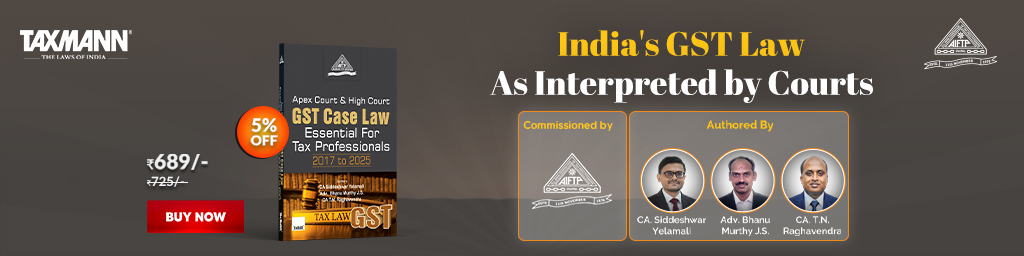
Check out AIFTP X Taxmann's Apex Court & High Court GST Case Law – 2017 to 2025 which  is an authoritative compilation of 100+ landmark GST judgments of the Supreme Court of India and leading High Courts, curated under the aegis of AIFTP and published by Taxmann. It distils eight years of evolving GST jurisprudence into concise, issue-focused case digests that seamlessly link statutory provisions with judicial interpretation. Covering core areas such as ITC, valuation, refunds, enforcement powers, arrest, and procedural safeguards, the book offers both doctrinal depth and practical clarity. Systematically organised and supported by robust research tools, it serves as a reliable single-point reference for practitioners, corporates, government officers, and researchers navigating GST law.

1. Parallel Proceedings

Armour Security (India) Ltd. Versus Commissioner CGST, Delhi – Supreme Court

Special Leave Petition (C) No. 6092 of 2025 date 14.08.2025 2025 SCC OnLine SC 1700

Issue  The following issues were for consideration before the Hon’ble Supreme Court:

  1. Whether issuance of summons can be regarded as “initiation of proceedings” within the meaning of Section 6(2)(b) of the CGST Act?
  2. Whether “subject matter” within the meaning of Section 6(2)(b) of the CGST Act includes all matters dealt with in summons under the Act?
  3. What is the purport of an “Order” under Section 6(2)(a) of the CGST Act?

Ruling The Hon’ble Supreme Court held as follows:

  1. Clause (b) of sub-section (2) of Section 6 of the CGST Act and the equivalent State enactments bars the “initiation of any proceedings” on the “same subject matter”.
  2. Any action arising from the audit of accounts or detailed scrutiny of returns must be initiated by the tax administration to which the taxpayer is assigned.
  3. Intelligence based enforcement action can be initiated by any one of the Central or the State tax administrations despite the taxpayer having been assigned to the other administration.
  4. Parallel proceedings should not be initiated by other tax administration when one of the tax administrations has already initiated intelligence-based enforcement action.
  5. All actions that are initiated as a measure for probing an inquiry or gathering of evidence or information do not constitute “proceedings” within the meaning of Section 6(2)(b) of the CGST Act.
  6. The expression “initiation of any proceedings” occurring in Section 6(2)(b) refers to the formal commencement of adjudicatory proceedings by way of issuance of a show cause notice, and does not encompass the issuance of summons, or the conduct of any search, or seizure etc.
  7. The expression “subject matter” refers to any tax liability, deficiency, or obligation arising from any particular contravention which the Department seeks to assess or recover.
  8. Where any two proceedings initiated by the Department seek to assess or recover an identical or a partial overlap in the tax liability, deficiency or obligation arising from any particular contravention, the bar of Section 6(2)(b) would be immediately attracted.
  9. Where the proceedings concern distinct infractions, the same would not constitute a “same subject matter” even if the tax liability, deficiency, or obligation is same or similar, and the bar under Section 6(2)(b) would not be attracted.
  10. The twofold test for determining whether a subject matter is “same” entails, first, determining if an authority has already proceeded on an identical liability of tax or alleged offence by the assessee on the same facts, and secondly, if the demand or relief sought is identical.
Taxmann's AIFTP X Taxmann's Apex Court & High Court GST Case Law – 2017 to 2025

The Hon’ble Supreme Court issued following guidelines to be followed in cases where, after the commencement of an inquiry or investigation by one authority, another inquiry or investigation on the same subject matter is initiated by a different authority.

  1. Where a summons or a show cause notice is issued by either the Central or the State tax authority to an assessee, the assessee is, in the first instance, obliged to comply by appearing and furnishing the requisite response, as the case may be. We say, so because, mere issuance of a summons does not enable either the issuing authority or the recipient to ascertain that proceedings have been initiated.
  2. Where an assessee becomes aware that the matter being inquired into or investigated is already the subject of an inquiry or investigation by another authority, the assessee shall forthwith inform, in writing, the authority that has initiated the subsequent inquiry or investigation.
  3. Upon receipt of such intimation from the assessee, the respective tax authorities shall communicate with each other to verify the veracity of the assessee’s claim. We say, so as this course of action would obviate needless duplication of proceedings and ensure optimal utilisation of the Department’s time, effort, and resources, bearing in mind that action initiated by one authority enures to benefit of all.
  4. If the claim of the taxable person regarding the overlap of inquiries is found untenable, and the investigations of the two authorities pertain to different “subject matters”, an intimation to this effect, along with the reasons and a specification of the distinct subject matters, shall be immediately conveyed in writing to the taxable person.
  5. The taxing authorities are well within their rights to conduct an inquiry or investigation until it is ascertained that both authorities are examining the identical liability to be discharged, the same contravention alleged, or the issuance of a show cause notice. Any show cause notice issued in respect of a liability already covered by an existing show cause notice shall be quashed.
  6. However, if the Central or the State tax authority, as the case may be finds that the matter being inquired into or investigated by it is already the subject of inquiry or investigation by another authority, both authorities shall decide inter se which of them shall continue with the inquiry or investigation. In such a scenario the other authority shall duly forward all material and information relating to its inquiry or investigation into the matter to the authority designated to carry the inquiry or investigation to its logical conclusion. We say, so because, the taxable person except for being afforded the statutory protection from duplication of proceedings, otherwise has no locus to claim which authority should proceed with the inquiry or investigation in a particular matter.
  7. However, where the authorities are unable to reach a decision as to which of them shall continue with the inquiry or investigation, then in such circumstances, the authority that first initiated the inquiry or investigation shall be empowered to carry it to its logical conclusion, and the courts in such a case would be competent to pass an order for transferring the inquiry or investigation to that authority.
  8. If it is found that the authorities are not complying with these aforementioned guidelines, it shall be open to the taxable person to file a writ petition before the concerned High Court under Article 226 of the Constitution of India.
  9. At the same time, taxable persons shall ensure complete cooperation with the authorities. It is incumbent upon them to appear in response to a summons and/or reply to a notice.

2. Supply

2.1 Principle of Mutuality

Indian Medical Association Versus Union of India – Kerala High Court

W.A.NO.1659 of 2024 date 11.04.2025 [2025] 173 taxmann.com 474 (Ker.)

2025 SCC OnLine Ker 2331

In Favour of Assessee

Issue The petitioner runs various mutual Schemes for the benefit of its member-doctors, e.g. Social Security Schemes or SSS (I, II, and III), Professional Disability Support Scheme (PDSS), Professional Protection Scheme, Kerala Health Scheme, etc. All the Schemes are to support fellow doctors, while one or two Schemes support their immediate family members. The member-doctors contribute an admission/annual fee, and in cases of certain Schemes (e.g. SSS, PDSS) also a fraternity contribution upon the death/disability of a fellow member doctor; the pooled sum is paid out to the widow of deceased doctors, disabled doctors, doctors afflicted with specified diseases, etc.

The question which was placed before the High Court was whether the Association is liable to pay GST on services rendered by it to its members under the aforesaid Schemes? In this background, the Petitioner challenged Constitutional validity of insertion Section 7(1)(aa) and Explanation thereto and its retrospective effect from July 01, 2017.

Ruling  The Hon’ble High Court held as follows:

  1. The Constitution has not been amended to deem a supply of service by a club or association to its members as a taxable service for the purposes of GST. The decision of the Supreme Court in State of West Bengal v. Calcutta Club Ltd. – [(2019) 19 SCC 107]/[2019] 110 taxmann.com 47 is authority for the proposition that the principle of mutuality has survived under the Constitution even after the 46th Amendment. A phrase as understood under the Constitution cannot be statutorily expanded by any legislature since the power to legislate is itself one that is conferred by the Constitution.
  2. The concepts of “supply” and “service” having been judicially interpreted as requiring at least two persons – a provider and a recipient, for inferring their existence, and the Supreme Court having held in Calcutta Club that the principle of mutuality has survived the 46th amendment to the Constitution. As the said judgment holds as a binding precedent and the Constitution is not amended suitably to remove the concept of mutuality from the concepts of supply and service thereunder, the impugned amendment to the CGST/SGST Acts necessarily fails the test of constitutionality.
  3. The provisions of Section 2(17)(e) and Section 7(1)(aa) and the Explanation thereto of the CGST Act, 2017 and the provisions of Section 2(17)(e) and Section 7(1)(aa) and the Explanation thereto of the KGST Act are declared as unconstitutional and void being ultra vires the provisions of Article 246A read with Article 366 (12A) and Article 265 of the Constitution of India.
  4. Retrospective operation to be illegal. The insertion of a statutory provision that alters the basis of indirect taxation with retrospective effect, so as to tax persons for a prior period when they had not anticipated such a levy and, consequently, had not obtained an opportunity to collect the tax from the recipient of their services, militates against the concept of Rule of Law.

2.2 Compensation Received Towards Acquisition of Land

Smt. Asha R, Versus Assistant Commissioner of Commercial Taxes (Enforcement-17), Bangalore – Karnataka High Court

Writ Petition No. 2552 of 2024 (T-IT) date 10.09.2024 [2025] 173 taxmann.com 863 (Kar.)

In Favour of Assessee

Issue The petitioners were owners of immovable properties which were acquired by the KIADB for the benefit of the BMRCL for the purpose of construction of Bangalore Metro Rail Project under the provisions contained in Section 28 of the KIAD Act. In pursuance of the same, the BMRCL offered package compensation to the petitioners, who accepted the same and entered into Agreements with the KIADB under Section 29(2) of the KIAD Act and received compensation towards acquisition of the lands. Subsequently, the revenue issued show cause notices calling upon the petitioners to pay GST towards the solatium component of the package compensation received by the petitioners. The petitioners having issued replies to the impugned show cause notices, the respondents passed the orders in original upholding and confirming the demands as per the impugned show cause notices. The issue before the High Court was whether the compensation paid in favour of the petitioners towards acquisition of their lands by the State/KIADB under the head ‘Solatium’ is exigible/amenable to levy of GST under the provisions of CGST/KGST Act, 2017?

Ruling The Hon’ble High Court held as follows:

  1. Neither the agreements nor other documents entered into between the petitioners and KIADB indicate that the petitioners have been paid solatium towards compensation received by them from the KIADB. In fact, it is only in the package compensation offered by the BMRCL that it chose to split up the compensation offered to the petitioners under various heads by designating solatium under one head amongst several heads of compensation; merely because the package compensation offered by the BMRCL is split into various heads, the compensation offered by the BMRCL under the designated head “Solatium” cannot be construed or treated or understood as solatium in the real sense of the term/expression “solatium” either under the Land Acquisition Act, 1894 (for short ‘the L.A. Act’), Right to Fair Compensation and Transparency in Land Acquisition, Rehabilitation and Resettlement Act, 2013 (for short ‘the RFCTLARR Act’).
  2. Though the BMRCL categorised a particular component of the consideration offered by them to the petitioners as solatium, in reality, the transaction essentially entered into between petitioners and KIADB under Section 29 (2) of the KIAD Act was in the nature of a sale/transfer of all rights in land of the petitioners which was directly and squarely exempted from levy of GST under Entry 5 of the Schedule – III of the CGST/KGST Act, since compulsory acquisitions of land where the owners lose their entire right on the property is akin to sale and ought to be treated as such and on this score also, the impugned orders, notices etc., deserve to be quashed.
  3. The primary/main ground for levying GST on solatium by the respondents is by contending that the act of the petitioners in receiving the solatium component tantamount to agreeing to an obligation to tolerate the act of acquisition within the meaning of Entry 5(e) of the CGST/KGST Act; in this regard, it is relevant to state that the entire compensation including the solatium component having been received by the petitioners pursuant to various documents executed by them in favour of the KIADB would clearly not amount to agreeing to an obligation to tolerate acquisition; in fact, rather than tolerating acquisition of their lands, petitioners have undisputedly executed various documents in favour of KIADB relinquishing/transferring/selling their right over the lands after receiving monetary compensation and neither these transactions nor any act, deed or thing done by the petitioners in this regard would amount to agreeing to the obligation to tolerate an act by the petitioners so as to attract Entry 5(e) of Schedule – II and consequently, on this ground also, the contention of the respondents cannot be accepted.
  4. The Hon’ble High Court held that the compensation paid in favour of the petitioners towards acquisition of their lands by the State/KIADB under the Head ‘Solatium’ is not exigible/amenable to levy of GST under the provisions of CGST/KGST Act, 2017.

2.3 Assignment of Leasehold Rights of the Plot of Land Allotted by GIDC

Gujarat Chamber of Commerce and Industry Versus Union of India – Gujarat High Court

R/Special Civil Application No. 11345 of 2023 date 03.01.2025

2025 SCC OnLine Guj 537/[2025] 170 taxmann.com 251

In Favour of Assessee

Issue Whether the assignment or transfer of leasehold rights in plots of land allotted by the Gujarat Industrial Development Corporation (GIDC) for 99 years, along with buildings constructed thereon, by the lessee/assignor to a third party/assignee for a lump-sum consideration constitutes a “supply of services” under the Central/State Goods and Services Tax Act, 2017 (GST Act), thereby attracting GST under Section 9(1).

Ruling The Hon’ble High Court held as follows:

  1. Section 7 of the GST Act which provides for the scope of supply of good or services or both for the purpose of the GST Act includes all forms of supply of goods or services or both by any form such as transfer, sale, barter, exchange, license, rental, lease or disposal made or agreed to be made for a consideration by a person in the course or furtherance of business. Therefore, considering the settled legal position as held by the Hon’ble Supreme Court and other High Courts from time to time, it is true that any lease or letting out of a building including commercial, industrial, residential complex for business either wholly or partly would be “supply of service”. Therefore, reading the provisions of the Act together and harmoniously to understand the nature of levy and the object and purpose of its imposition, no activity of the nature mentioned in the inclusive provision of section 7 of the GST Act can be left out of the net of tax. Simultaneously, the provisions of section 7 have to be read in terms of substantive provision and Schedules which treats the activity as supply of service, particularly, in relation to land and building and includes a lease. The consideration, therefore, as premium/one time premium is a measure on which tax is to be levied, assessed and recovered.
  2. When the GIDC allots the plot of land on lease of 99 years and charges premium for such allotment followed by periodical lease rent to be paid, is to be considered as supply of service in relation to land and building read with clause 5(a) of Schedule II which specifically provides that renting of immovable property shall be treated as supply of services.
  3. However, when such leasehold right is transferred by the lessee-assignor in favour of a third person-assignee by execution of deed of assignment, it would be nothing but transfer of an “immovable property” in view of the settled legal position to the effect that lease for 99 years or for a long-term in consideration of premium paid is as much an alienation as sale or mortgage.
  4. Scope of “supply of services” would not include transfer of leasehold rights as supply of service as it would be transfer of “immovable property” being a benefit arising out of immovable property consisting of land and building.
  5. Assignment by sale and transfer of leasehold rights of the plot of land allotted by GIDC to the lessee in favour of third party-assignee for a consideration shall be assignment/sale/transfer of benefits arising out of “immovable property” by the lessee-assignor in favour of third party-assignee who would become lessee of GIDC in place of original allottee-lessee. In such circumstances, provisions of section 7(1)(a) of the GST Act providing for scope of supply read with clause 5(b) of Schedule II and Clause 5 of Schedule III would not be applicable to such transaction of assignment of leasehold rights of land and building and same would not be subject to levy of GST as provided under section 9 of the GST Act.

2.4 Sale of Partially Constructed Building

Rohan Corporation India Pvt. Ltd. Versus Union of India – Karnataka High Court

Writ Petition No. 12700 of 2023 (T-RES) date 10.09.2024/[2025] 173 taxmann.com 480 (Kar.)

In Favour of Assessee

Issue Lotus Shopping Centres Private Limited was constructing a mall named Lotus Shopping Mall. During the pendency of the construction of the mall, there were insolvency proceedings initiated against the said company. NCLT appointed a liquidator and issued directions to him to liquidate the assets of the company in terms of the provisions contained in the Insolvency and Bankruptcy Code, 2016. The Liquidator invited tenders for sale of the property. On the basis of this invitation, the petitioner submitted the expression of interest and participated in the e-auction and the petitioner emerged to be the successful bidder. Liquidator intimated the payments to be done by the petitioner and also included the payment of GST, to which the petitioner resisted. Petitioner reiterating its stand that no GST was payable on the transaction of sale of land and partly constructed commercial building as the same was neither supply of goods nor supply of service in terms of Schedule III of GST Act. Due to paucity of time to complete the sale transaction, the Petitioner paid GST under protest reserving right to claim refund. Petitioner filed refund of with the GST department. Refund was rejected by holding that Entry 5(b) of Schedule II of the CGST/KGST Act was applicable to the subject transaction which was amenable/exigible to levy of GST and that Entry 5 of Schedule III which grants/provides exemption from levy/payment of GST was not applicable to the subject transaction.

The post Parallel Proceedings and Supply under GST – Case Laws appeared first on Taxmann Blog.

source

Categories
Blog Updates

[World Corporate Law News] ASIC Announces Transformational Package to Safeguard Australia’s Financial Markets

ASIC financial market reforms

Editorial Team  [2025] 181 taxmann.com 816 (Article)

World Corporate Law News provides a weekly snapshot of corporate law developments from around the globe. Here’s a glimpse of the key corporate law update this week.

1. Securities Law

1.1 ASIC Announces Transformational Package to Safeguard Australia’s Financial Markets in Response to ASX Inquiry Interim Report

On December 15, 2025, the Australian Securities and Investments Commission (ASIC) obtained commitments from ASX Group on a package of reforms, including:

(a) Strengthening the independence and governance of ASX’s Clearing and Settlement Facilities Boards

(b) A strategic reset of ASX’s transformation program ‘Accelerate’, with clear milestones and accountability for delivery

(c) The imposition of an additional $150 million capital charge on ASX Limited to ensure ASX maintains strong financial resources until remediation is complete.

(d) A commitment to stronger leadership

In addition, ASIC and the Reserve Bank of Australia (RBA) will step up their review to uplift their joint supervisory model.

The package is intended to strengthen confidence in ASX and Australia’s critical market infrastructure, provide certainty about the market operator’s reset, and respond to the panel’s Interim Report released today.

The inquiry, announced in June 2025 and led by an expert panel, has identified shortcomings in ASX’s governance, capability, risk management and culture that require urgent attention and response. Due to the urgency of the necessary reset, the Report’s insights were shared with ASIC, which then engaged with ASX.

The report concludes that, while some progress has been made, continuing with the same approach is not an option. The scale of transformation required is significant and cannot be achieved through current tactical, incremental measures or business as usual practices.

ASIC Chair Joe Longo stated that urgent action was needed to set ASX on the right path.

‘ASX needs to embrace a new era of accountability, investment, and stewardship to increase confidence, and meet the expectations of the market and the Australian public.

‘This package is a circuit-breaker.

‘Many of the problems the report identifies took years to develop, and while there are some immediate actions that will be put in place, the key issues are going to take time and resources to resolve. There are no quick fixes or shortcuts.

‘This reset is about addressing underlying issues, and laying the foundations for a resilient, world-class market operator.

‘This should be a clear signal to the market that ASX are committed to delivering the transformation necessary for resilient and future-ready national market infrastructure.’

Source  Official Announcement

Click Here To Read The Full Article

The post [World Corporate Law News] ASIC Announces Transformational Package to Safeguard Australia’s Financial Markets appeared first on Taxmann Blog.

source