

Categories
Blog Updates

Quirky Governance – Insider Trading & Whistle-Blowing

Quirky Governance

Quirky governance refers to unconventional mechanisms that influence corporate behaviour and market discipline outside traditional governance structures. It includes practices such as insider trading and whistle-blowing, which arise from information asymmetry within corporations. While insider trading reflects the misuse of unpublished price-sensitive information for personal gain, whistle-blowing involves the disclosure of illegal, unethical or improper conduct in the public interest. Together, these mechanisms highlight how information, incentives and individual actions can impact corporate accountability, investor confidence and the overall integrity of capital markets, even though they operate beyond formal board-driven governance frameworks.
Check out Taxmann's Corporate Governance which is a thoroughly revised, syllabus-driven textbook that blends theory, law, ethics, and case studies to offer a holistic understanding of governance in both Indian and global contexts. This 2nd Edition integrates the latest updates to the Companies Act 2013, SEBI LODR 2015, and post-Kotak reforms, reflecting contemporary expectations of board effectiveness and transparency. Tailored to the NEP-aligned B.Com. curriculum, the book provides clear learning objectives, structured pedagogy, and extensive assessment support. Through its rich theoretical frameworks, comparative models, and analyses of major corporate failures, it serves as an indispensable resource for students, educators, and governance professionals.

1. Introduction

Every corporate has a number of stakeholders and some of them have better access to valuable non-public information than others which they can use to their advantage. Examples of two such important instances are – first, when some people trade on the basis of price sensitive non-public information (insider trading) and second, when someone makes public information, especially negative, about corporate conduct and corporate performance (whistle blowing). Macey (2008) has labelled these two along with short selling as quirky governance.

2. Insider Trading

2.1 Meaning

Insider trading is transacting in securities of the company by an insider on the basis of unpublished price sensitive information (UPSI).

Key definitions as per SEBI (Prohibition of Insider Trading) Regulations, 2015:

  • Insider – A “connected person” or a person possessing or having access to unpublished price sensitive information;
  • Connected Person – One who has been associated with the company in any capacity such as a director, officer or employee or in a contractual or fiduciary relationship with the company; and includes a list of “deemed connected persons”;
  • Unpublished Price Sensitive Information (UPSI) – Any information relating to securities of a company that is not generally available, and, upon being available, is likely to materially affect the price of the company’s securities. It includes matters such as financial results, dividends, changes in capital structure, significant corporate transactions and changes in key managerial personnel.

2.2 Legal Position

Insider Trading in India is an offence on the basis of non-public price sensitive information according to SEBI (Prohibition of Insider Trading) Regulations, 2015.1

2.3 Rationale for Insider Trading Regulations

Most of the countries in the world prohibit insider trading in some form or the other. Some of the important reasons for doing it are as follows:

(i) Preserving capital market efficiency – Efficient capital markets are essential for encouraging investors to invest in securities. In an efficient market information, all the market participants should be able to access information equally. Insider trading results in distortions in capital markets as some participants have superior information than others.

(ii) Undermines investor confidence – Insider trading results in an unexplained and sudden increase or decrease in prices of the securities. Such unjustified volatility in prices undermines investors’ confidence in the company.

(iii) Against good corporate governance practices – Insider trading is unfair as it enriches few at the cost of wider stakeholders. Transparency and business ethics are also sacrificed. High standards of corporate governance cannot be, therefore, attained.

2.4 SEBI (Prohibition of Insider Trading) Regulations, 2015

The Securities and Exchange Board of India (SEBI) has notified the SEBI (Prohibition of Insider Trading) Regulations, 2015 on 15th January, 2015. These supersede the Regulations related to Insider Trading in 1992 by SEBI. The new Regulations are stricter and have imposed huge penalties for non-compliance and contravention. Some of the important provisions of these Regulations are

(i) Role of Compliance Officer – The major responsibility for monitoring and implementing the Codes of Conduct is upon the Compliance Officer.

(ii) Prohibition on the exercise of ESOPs – Designated persons have been prohibited to exercise ESOPs during six months after sale of shares.

(iii) Threshold limit for Disclosures – Certain persons, as specified under Regulations, on crossing the set limit of value of the securities traded in a certain period shall disclose it to the Compliance Officer.

(iv) Formulation of a trading plan by an insider2 – The concept of a trading plan allows insiders to trade in compliance with the regulations without violating the prohibitions imposed. A ‘trading plan’ refers to a plan framed by an insider for trades to be executed at a future date. It is particularly suitable for individuals within an organization who may, by way of their position, seniority, or any other reason, be in possession of UPSI at all times. Since the Regulations prohibit trading when in possession of UPSI, trading plans serve as an exemption to such prohibition. An insider can formulate a trading plan and present it to the compliance officer for approval and public disclosure. Based on the approved plan, trades may be carried out on behalf of the insider. The time gap for the commencement of trading from the date of public disclosure of the trading plan is 120 calendar days. The compliance officer must approve or reject the plan within two trading days of receipt.

(v) Maintenance of disclosures – The disclosures made under these regulations shall be maintained by the company for a minimum period of eight years in a structured digital database. In this database, records about the persons who possess UPSI are kept. The data on SDD must be managed with a trusted database software instead of using software such as MS Word, MS Excel, MS PowerPoint, where the data can be edited.

(vi) Formulation of Whistle Blower Policy – Regulations created an obligation on listed companies to formulate a Whistle-Blower Policy. In 2019, SEBI introduced a mechanism for informants to file complaints directly with it. In 2021, SEBI raised the compensation for whistle-blowers in insider trading cases to ₹10 crore from ₹1 crore.

These new Regulations have been issued by SEBI to ensure a level playing field in the securities market for all the investors and to safeguard their interest as well.

3. Whistle Blowing

3.1 Introduction

The act of an insider making public acts of corruption, illegal practices, and other forms of unethical behaviour by organisations is common throughout the World. For such acts, U.S. civic activist Ralph Nader, gave the term whistle blowing in 1970’s and such insiders are called whistle-blowers. The scope of the term has become wider over the years. Since 1990’s, the act of an employee raising these concerns internally outside the normal chain of command are also being termed as whistle blowing.

3.2 Definition

According to Vandekerckhove (2006),

“A whistle-blower is a person who exposes any kind of information or activity that is deemed illegal, unethical, or not correct within an organization that is either private or public.”

Important features of whistle-blowing, on the basis of above definition, are as follows:

(i) A whistle-blower can be an employee or a former employee or any other person in a contractual relationship with a company.
(ii) He makes public wrongful acts/information to the outside world or internally outside the usual hierarchical line.
(iii) He reports these acts to someone who is in a position to take action or has an authority to do so.
(iv) Whistle blowing can happen in public or private organisations.

3.3 Types of Whistle-Blowing

Whistle blowing can be classified on the basis of:

3.3.1 External Whistle-Blowing and Internal Whistle-Blowing

(a) If the whistle-blower reports misconduct to a person outside the organization, such as regulatory agency or the media, it is termed as external whistle-blowing. Internal whistle-blowing is a situation when a whistle-blower reports misconduct to another person within the organization but outside the usual line of command.

One of the famous external whistleblowers is Erin Brockovich, a legal clerk and environmental advocate who gained recognition for uncovering the contamination of groundwater in Hinkley, California, by Pacific Gas & Electric (PG&E). The contaminant was hexavalent chromium, a harmful chemical linked to severe health issues in the community. In the 1990s, Brockovich spearheaded efforts to investigate the issue, bringing to light PG&E’s responsibility for pollution. Her work played a key role in securing a $333 million settlement for the affected residents, one of the largest environmental settlements in U.S. history, and raised awareness about corporate environmental misconduct. Cynthia Coppers, who blew the lid off WorldCom Scam, was an employee of the company and is an example of an internal whistle blower.

(b) From a corporate’s point of view both types reflect whistle-blower’s disillusionment with and distrust of the system. However, the damage to reputation of the entity done by external whistle blowing is much more than the latter. It may result in heavy fines and penalties imposed by regulatory authorities.
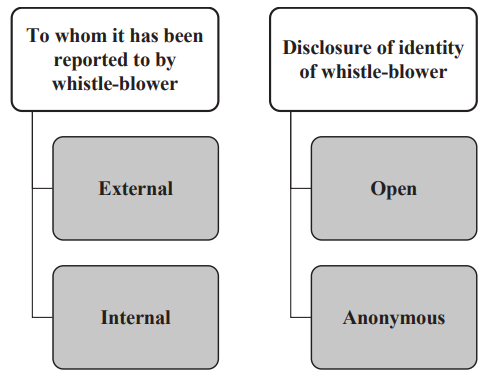
Figure: 5.1 Types of Whistle-blowing

Types of Whistle-blowing

3.3.2 Open Whistle-Blowing and Anonymous Whistle-Blowing

(a) When whistle-blower reveal his identity as he conveys the information, it is said to be open whistle-blowing and if identity is concealed, it is termed as anonymous whistle-blowing. The main advantage with open whistle-blowing is that the security can be provided to such a person and he/she can be contacted for further information.

(b) In many situations, open whistle blowers have been hugely rewarded in terms of money and, thus, the real motive behind whistle-blowing by such remains doubtful. Anonymous whistle blowing may not be taken seriously by the regulators or the organization and burden of protection of whistle-blower is also not there.

3.4 Pros and Cons of Whistle-Blowing

Whistle-blowing can be a rewarding experience for some whistle-blowers. But others may have to face a backlash or mistrust of others –

3.4.1 Pros of Whistle-Blowing

(a) Financial compensation – Many times, whistle-blower law/policy has a provision of rewarding the whistle-blower financially. For example, whistle-blowers in the US are, generally, entitled to a part of a settlement collected by the Government. Dinesh Thakur, the whistle-blower who helped the US Government show systemic product-testing failures at Ranbaxy and which led to the $500 million settlement in 2013, received $48 million. In US, the Dodd-Frank Act offers financial rewards for whistleblowers who expose securities fraud.

(b) Legal protection – Many people face retaliation when they become a whistle-blower. Organisational policies and laws can protect them from adverse consequences. To take an example, in India Whistle Blowers Protection Act, 2014 seeks to protect whistle blower who has made a public interest disclosure related to an act of corruption, misuse of power, or criminal offense by a public servant.

(c) Reduces risk – One of the main reasons to blow the whistle on any illegal or unethical activity is to protect colleagues and other stakeholders or public at large from certain risks. Whistle-blowing acts as a safeguard.

(d) Ethical responsibility – Whistle-blower may have been pushed to do so by his sense of right and wrong. For example, Sherron Watkins, the former Vice-President of Enron Corporation in US and whistle-blower alerted then-CEO Ken Lay in August 2001 to accounting irregularities within the company. She testified before Congressional Committees from the House and Senate investigating Enron’s demise.

3.4.2 Cons of Whistle-blowing

(a) Retaliation – Whistle-blower may have to face potential retaliation from management, colleagues or even Government. The case of Edward Snowden is an example of a backlash. He leaked details of several top-secret United States mass surveillance programs to the media and was forced to flee the country and seek asylum in Russia to escape prosecution by the US Government. In June 2024, the outgoing CEO of Boeing Dave Calhoun accepted at a Senate hearing in US that Boeing is trying to protect whistle-blowers at his company but still they have faced retaliation.3

(b) Conflict of interest – Many whistle-blowers face an ethical dilemma – whether to protect the short-term interest of colleagues and the organization or to protect the public at large; whether to be disloyal, whether to protect short-term interest of the shareholders or caution future investors. Cynthia Cooper, while serving as Vice President of Internal Audit at WorldCom, played a pivotal role in exposing what was, at the time, the largest case of corporate fraud too faced an ethical dilemma. Recalling the time, she was contemplating exposure she said in a talk, “There were times when I was scared to death. I remember my hands shaking.”4 She knew after the exposure; thousands of employees would lose their jobs and retirement savings. Mississippi, where WorldCom was based, would also lose millions in revenue. Despite being sure that she was right, Cooper struggled with depression and found it difficult to move forward from the scandal even after disclosure, as the fallout affected not just the company, but also her own personal and professional life.

3.5 Advantages of a Good Whistle-Blower Policy to Organization

The revelation made by the whistle-blower should be handled promptly by the organization. Many large-scale corporate frauds have come to light through internal whistle-blowing. To ensure transparency and continuous trust and support from all the stakeholders, it is imperative for every organization to lay down a clear and comprehensive whistle blowing policy. Some of the advantages that may accrue to it by such a policy are listed below:
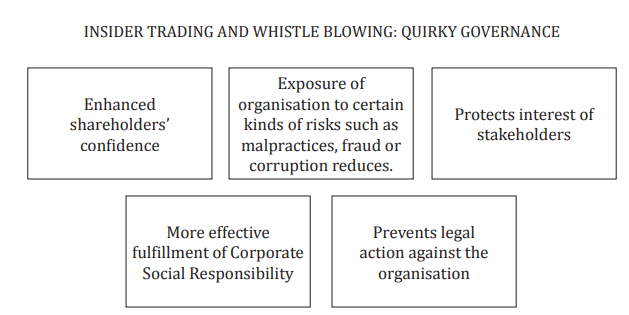
Figure 5.2 Advantages of Whistle-Blower Policy

Advantages of Whistle-Blower Policy

3.6 Whistle-Blowing Laws in India

Regulations in India have been laid down relating to whistle-blowing and protection of whistle-blowers. The Companies Act, 2013 and SEBI’s Listing Agreement Requirements have included provisions related to whistle-blowing/ vigil mechanism. The Indian Parliament has also passed Whistle-blowers Protection Act, 2014.

3.6.1 The Companies Act, 2013 and Whistle-Blowing

The Companies Act, 2013, has been framed in the backdrop of various corporate scandals. It prescribes stricter compliance, vigil and disclosure norms than laid by previous Companies Acts. Some examples are as below:

Section 177(9) and 177(10) read with Rule 7 of the Companies (Meetings of Board and its Powers) Rules, 2014 and Schedule IV provides for requirements of Vigil Mechanism as under:

(a) Establishment of vigil mechanism

  • Every listed company and the companies belonging to the following class or classes shall establish a vigil mechanism for their directors and employees to report their genuine concerns or grievances –
  1. the companies which accept deposits from the public:
  2. the companies which have borrowed money from banks and public financial institutions more than fifty crore rupees
  • It may be noted that while section 177(9) of the Act mandates to establish vigil mechanism for directors and employees to report genuine concerns, in case of a listed company, such mechanism is available to all stakeholders.

(b) Overseeing of vigil mechanism:

  • The companies which are required to constitute an Audit Committee shall oversee the vigil mechanism through the committee and if any of the members of the Committee have a conflict of interest in each case, they should recuse themselves and the others on the committee would deal with the matter on hand.
  • In case of other companies, the Board of Directors shall nominate a director to play the role of audit committee for the purpose of mechanism to whom other directors and employees may represent concerns.

(c)  Safeguard against victimisation and direct access:

  • Policy against victimisation of employees and directors who avail of the mechanism should be laid.
  • Provide for direct access to the chairperson of the Audit Committee or the director nominated to play the role committee in exceptional cases.

(d) Disclosure

The company must disclose details of the mechanism on its website and in the Board’s report.

(e) Safeguard against frivolous complaints:

  • In case of repeated frivolous complaints being filed by a director or an employee, the Audit Committee or the director nominated to play the role of Audit Committee may take suitable action against concerned director or employee including reprimand.

(f) Role of independent directors Schedule IV: Code for Independent Directors:

  • Ascertain and ensure that the company has an adequate and functional vigil mechanism.
  • Ensure that interests of a person who uses the mechanisms are not affected.

3.6.2 SEBI and Whistle-Blowing

  • EBI has introduced the concept of whistleblowing by adding Chapter IIIA to the SEBI (Prohibition of Insider Trading) Regulations, 2015 (PIT Regulations). This enables whistleblowers to report insider trading violations directly to SEBI, circumventing the internal reporting mechanisms of companies. The goal is to externalize the reporting process, thereby enhancing the security and anonymity of whistleblowers, which is expected to lead to an increase in reported violations.
  • Additionally, SEBI has announced financial rewards to further encourage whistleblowing. SEBI retains the sole discretion to declare an informant eligible for a reward and will notify the informant or their legal representative to file an application in the specified format to claim the reward. The reward is set at 10% of the monetary sanctions, capped at INR 10 crores, or a higher amount as may be specified by SEBI from time to time

3.6.3 Whistle-Blowers Protection Act, 2014

On May 14, 2014, the Whistle-Blowers Protection Act, 2014 received Presidential assent. The salient features of this Act are:

(a) The Act seeks to protect persons making a public interest disclosure (whistle-blowers) related to an act of corruption, misuse of power, or criminal offence by a public servant.
(b) The Central Vigilance Commission (CVC) is empowered to receive complaints, assess public disclosure requests, and safeguard complainants.
(c) Every complaint must include the identity of the complainant.
(d) It ensures confidentiality of the complainant and penalizes any public official who reveals a complainant’s identity, without proper approval.
(e) The Act prescribes penalties for knowingly making false complaints.

The Whistle-Blower Protection Act has attempted to balance two conflicting interests—the need to protect the whistle-blowers against the need to protect public officials from unnecessary harassment.


  1. Section 195 of the Companies Act, 2013 that dealt with insider trading of securities has been omitted by the Companies Amendment Act, 2017.
  2. https://www.taxmann.com/post/blog/analysis-sebis-new-insider-trading-regulations-key-changes-and-implications
  3. https://www.latimes.com/business/story/2024-10-08/boeing-whistleblower-lawsuit-story
  4. https://www.jmu.edu/news/2013/11/14-cooper-demonstrates-power-of-choice-in-business-ethics.shtml

The post Quirky Governance – Insider Trading & Whistle-Blowing appeared first on Taxmann Blog.
source

Categories
Blog Updates

[Opinion] Key Policy Changes in the Income-Tax Act, 2025

Income-Tax Act 2025 policy changes

CA. Rakesh Kedia & Yamish Jain – [2026] 182 taxmann.com 44 (Article)

1. Background and Need for Re-enactment

The Income-tax Act, 2025 replaces the Income-tax Act, 1961 after more than six decades of continuous amendments that resulted in fragmentation, excessive cross-referencing, and uneven drafting. The new legislation is presented as a overall restructuring undertaken to modernize the tax code.

The Government asserts through the Statement of Objects and Reasons for the Income Tax Act, 2025 that three foundational principles of this act are:

1. Textual and structural simplification for improved clarity and coherence
2. No major tax policy changes to ensure continuity and certainty.
3. Stability of tax rates to ensure predictability for taxpayers and businesses.

To implement the goal of simplification, the Income-tax Act, 2025 adopts a refined drafting approach—featuring shorter sentences, clearer terminology, reduced reliance on legal jargon and provisos, extensive tabulation of provisions, and consolidation of related rules into unified sections.

For example, phrases like “Notwithstanding anything contained” and “Without prejudice to…” have been replaced with more direct and accessible language. However, it is important to note that these linguistic changes do not alter the legal interpretation of the provisions. Despite differences in wording, the substance and intent remain consistent with the earlier law. What may appear to be a deviation on a plain reading is, in fact, a clarification aimed at enhancing understandability without affecting the legal position.

While some provisions may at first glance appear to reflect policy changes, it is important to note that they are intended to be interpreted in the same manner as under the earlier law. The legislative intent behind the Income-tax Act, 2025 is one of structural and linguistic simplification rather than substantive overhaul. Accordingly, all judicial pronouncements rendered under the 1961 Act continue to remain valid and form the basis for interpretation under the new act.

2. Key Changes Which May Appear to be Policy Departures

2.1 Mandatory Taxability of Unexplained Credits/Investments

One of the most debated changes in the Income-tax Act, 2025, is the shift in language across provisions dealing with unexplained income. The relevant section numbers as per the old act and the new act are as under:

Nature of Income 1961 Act Section No. 2025 Act Section No.
Unexplained credits 68 102
Unexplained investments 69  103
Unexplained money, bullion, jewellery 69A 104
Amounts not fully disclosed in books 69B 103
Unexplained expenditure 69C 105
Amounts borrowed/repayments not explained 69D 106
Previously, under the Income-tax Act, 1961, sections like 68 to 69D gave the Assessing Officer (AO) the discretion to decide whether certain unexplained credits, investments, or expenditures may be taxed, based on the facts of the case.
However, in the Income-tax Act, 2025, the word “may” has been replaced with “shall”. Does this mean the AO no longer has any discretion? Let’s take a closer look.
Under the 1961 Act, Section 68 read as follows:
“Where any sum is found credited in the books of an assessee maintained for any previous year, and the assessee offers no explanation about the nature and source thereof or the explanation offered by him is not, in the opinion of the Assessing Officer, satisfactory, the sum so credited may be charged to income-tax as the income of the assessee of that previous year”.
This language clearly indicated that the AO had discretion. Even if the explanation given by the assessee was unsatisfactory, the AO could choose not to treat the amount as income, depending on the overall facts and circumstances.
Click Here To Read The Full Article 

The post [Opinion] Key Policy Changes in the Income-Tax Act, 2025 appeared first on Taxmann Blog.

source

Categories
Blog Updates

Effectiveness of Independent Directors in Corporate Governance – Board Oversight and Accountability

Effectiveness of Independent Directors in Corporate Governance

The effectiveness of independent directors in corporate governance refers to the extent to which independent directors are able to exercise objective judgment, provide robust oversight, and protect the interests of shareholders and other stakeholders by ensuring transparency, accountability, and ethical conduct within a company. Effective independent directors strengthen board governance by monitoring management performance, overseeing risk management and internal controls, scrutinising related-party transactions, ensuring integrity of financial reporting, and preventing abuse of power by controlling shareholders or promoters. Their effectiveness depends on genuine independence, adequate authority, access to accurate information, professional competence, sufficient time commitment, and freedom from undue influence of promoters or executives. When independent directors function effectively, they enhance decision-making quality, improve compliance with legal and regulatory frameworks, reduce governance failures, and contribute to long-term corporate sustainability and investor confidence.

Table of Contents

    1. Effectiveness of Independent Directors
    2. Board Duality
Check out Taxmann's Corporate Governance – Theory and Practice, which offers a clear, contemporary introduction to how corporations are governed across ethical, structural, strategic, and legal dimensions. Drawing on over 35 years of experience, the author integrates foundational theories with real-world cases, regulatory developments, and major governance failures. Updated for the NEP curriculum, the book emphasises case-based learning, global comparisons, and practical assignments to build analytical and professional competence. It explains not only how governance mechanisms work but why they matter in boardrooms, markets, and crises. This Edition serves as a comprehensive resource for students, faculty, practitioners, and researchers seeking a practical understanding of modern corporate governance.

1. Effectiveness of Independent Directors

The major role that independent directors play in a company broadly includes improving the overall corporate governance framework and risk management processes of the company. The empirical evidence in different jurisdictions point out a significant improvement in the corporate governance standards with the induction of independent directors. In the boards especially in family controlled and concentrated shareholding companies the presence of independent directors has ensured structured agenda, deliberate discussions, and compliance regarding board processes. One of the important roles of board is to oversee and ensure compliance of the company with the rules and regulations. Independent directors are legally liable for negligence and are required to exercise utmost due diligence over all the financial and executive decisions of the company they are associated with.  They are expected to bring out, misappropriation, non-compliance with legal provisions, malpractices etc. in the company.

In case of Satyam computer scam the court imposed hefty fine on the independent directors. There are many cases including Enron, WorldCom, Dewan Housing Finance, IL&FS wherein independent directors not only came under scrutiny, but they dented their reputation also.

Independent directors act as monitor of controlling shareholders. Independent directors prevent business decisions that are unfair to minority shareholders and other stakeholders. The audit committee headed by an independent director monitors all the related–party transactions, engage with the statutory auditors, and ensure integrity of financial reports. There are many instances wherein independent directors have blocked decisions which are not in the interest of the companies. There is no dearth of cases of independent directors asking tough questions and taking tough decisions despite pressure from the promoters or controlling group of shareholders. In fact, the institution of independent directors is well established and respected all over the world.

However, questions are often raised about the ‘genuine independence’ and effectiveness of independent directors. This is because these are appointed by the controlling group of shareholders or the promoters in most companies in Asia marked by domination of families. As independent directors are dependent on the families or the controlling group of shareholders for their appointment and continuation of appointment, it may impair their independence. In widely held big corporations of the US and UK, nomination process of independent directors is tilted more in favour of executives of the company particularly the CEOs of the companies who suggest the names of potential directors and finally the appointments are carried through the ‘nomination committees’ of the boards before approved formally by the shareholders in the annual general meetings. The independent directors may thus become dependent on the CEOs or chairman of the companies for their continuation/re–election.

Despite the prescribed independence criteria, some independent directors may have past or ongoing associations with the company’s promoters or management. While these relationships may not be classified as “material” under the legal definition of independent director, in many cases it impacts judgment and decision–making of the independent directors. In state run public enterprises wherein political workers or persons loyal to the political party in power are obliged by offering them independent directorships in the companies, subconscious biases, affiliations, and loyalties, or undue familiarity sway judgment diluting the rigour and neutrality expected of their role. It gives rise to a fundamental issue of independence in fact (real independence) and independence in appearance (perceived independence).

Leaving the issue of ‘independence’ aside, doubts are also expressed on the efficacy of independent directors. As independent directors may be engaged in activities other than directorships in companies, they have limited time at their disposal to participate in board processes effectively. When making decisions, these directors have to rely on the information presented to them by the executives of companies. In some jurisdictions, directors have a legal right to inspect records of companies. Yet time constraints generally render this right ineffective. Many a times, independent directors lack proper training and orientation to influence board decisions. Given these constraints, independent directors can hardly initiate much of the corporate strategies or policies or bring to fore ‘independent and objective judgments’ to ensure that corporate decisions are made in the best interests of all the shareholders.

Failure of board of directors especially independent directors is the most common governance failure noticed in various corporate failures whether it is Enron or WorldCom or Parmalat or the Satyam. Some of the cases are as under:-

(i) Enron Corporation was an American energy, commodities, and services company based in the USA collapsed in 2001. On paper, Enron had a model board of directors comprising predominantly outsiders with significant ownership stakes and a talented audit committee. In its 2000 review of best corporate boards, Chief Executive included Enron among its top five  boards. Collapse of Enron may be construed as failure of corporate governance in particular the board of directors of Enron. The board failed miserably in its oversight responsibilities. The board had no clue of what the executives were doing. The directors failed to understand the related party transactions between Enron and SPEs. The board flawed in implementing proper systems of control and risk management.

(ii) The non-executive directors on the Maxwell Communication board, all reputed persons, did little in discharging their responsibilities. Unrestricted movement of funds across group companies, pledging shares of a company to raise funds for another company, excessive borrowings took place under the nose of the board. It appeared that the board was helpless in the face of larger-than-life personality of Robert Maxwell.

(iii) WorldCom had the board of directors consisting of 11 directors, eight of whom were independent. The board failed to fulfil its basic responsibilities. Acquisitions made by the company with the approval of the board, in many instances appeared to be opportunistic rather than part of the long-term strategic plan. The board’s review of acquisitions was not comprehensive and left the company highly levered. These strained the financial structure of the company and complicated the analysis of the financial performance measurement. The board neglected in every aspect of the monitoring and oversight over the executives. The board failed to act or ignored accounting irregularities besetting the company more than 12 months before the company collapsed ultimately.

(iv) The debacle of Satyam Computer in 2009 demonstrated the ineffectiveness of independent directors. The board of directors of Satyam had well acclaimed persons as the members. The board failed miserably in its prime duty of oversight. The fraud had been cooking in Satyam for years together. On the behest of the promoters the board cleared the deal of acquiring family concerns of the promoters even though it was a major departure from the normal activities and expertise of Satyam. The high-profile independent directors chose to remain silent spectators to the pranks of the chairman of the company reducing themselves to the ‘passive observers’.  The board of directors of Satyam composed of a majority of independent directors, and the ‘independent’ Audit Committee of the Company miserably failed to exercise the important ‘oversight’ role and remained either ignorant of the whole scam or turned a blind eye to wrong practices ostensibly in fear of losing continuance of their job in the company from which they were getting hefty remuneration.  The Central Bureau of Investigation report stated

“The members of the Board of Directors had acted as “rubber stamps”, unwilling to oppose the fraud. Not a single vote of dissent has been recorded in the minutes of the Board meetingsi”.

(v) One of the important roles assigned to independent directors is overseeing the policy implementation and ensuring that the business is carried on in the interest of the company. Infrastructure Leasing & Financial Services Ltd. (IL&FS) became highly levered and started making default in debt repayments in 2018. IL&FS had a board of directors consisting of eminent persons as independent directors and nominee directors from SBI, LIC and CBI. It seems that the directors in the company were either negligent or they lacked expertise in managing a complex infrastructure financing NBFC. The board failed miserably in managing the liquidity crisis that was brewing over the last four years. It is no wonder that, with such poor board oversight, IL&FS had ventured down a path of mis-governance, resulting in the company defaulting on its financial obligations.

1.1 Enhancing the Effectiveness of Independent Directors

  1. Strengthening the Selection Process – Policymakers and regulators should establish robust criteria for determining the independence of directors. In India there is an online data bank of the independent directors and the requirement to pass online proficiency test, but generally directors are hand-picked by promoters. The role of nomination committee of the board is important in setting standards for nomination of directors and screening the probable candidates.
  2. Promote diversity on Boards – Independent directors should be appointed with a diverse range of expertise and professional backgrounds. Companies should appoint directors from diverse backgrounds including gender and region. This will ensure that boards have a range of perspectives and experiences which can lead to better decision-making.
  3. Enhancing the authority of Independent Director – The authority granted to independent directors does not commensurate with their responsibility.  There is a need to augment the authority granted to the. A comprehensive board charter outlining the roles, responsibilities, and authority of independent directors should be established. The company needs to ensure that independent directors have timely access to accurate and relevant information about the company’s operations, financials, risks, and performance. This will empower them to make informed judgments and actively participate in discussions.
  4. Induction, Training and Development of  Directors – A newly appointed director needs to undergo an induction programme to obtain essential knowledge about the company and its industry. For incumbent directors, continuous updating and professional development has become more important in the wake of growing complexities of the business and rapid acceleration of new regulations and legal requirements for directors. These programs should cover corporate governance best practices, legal and regulatory requirements, risk management, ethics, and sustainability. Companies should invest in continuous training and development programmes for independent directors to keep them updated on industry trends, best practices, and changing regulatory landscapes.
  5. Performance Evaluation – Regular evaluation of independent directors’ performance, both individually and collectively should be undertaken by the entire board. This will identify potential conflicts of interest or shortcomings in fulfilling their responsibilities. The peer review can consider the constructive and less constructive roles individual directors play in discussions, the value and use of various board members’ skill sets, interpersonal styles, individuals’ preparedness and availability, and directors’ initiative and links to critical stakeholders. This process should be driven by a board committee such as a nominating or governance committee. The continuation of independent directors should depend on satisfactory evaluation report. Absence of evaluation has often led to the situation of independent director being a ‘puppet independent director’ who are unable to perform the duties of directors as they lack skills inside the board rooms.
  6. Promote greater engagement between directors and other stakeholders, including shareholders, employees, and customers. This will help ensure that directors have a better understanding of the concerns and perspectives of the stakeholders. It will facilitate the directors to deliberate effectively in the boardrooms.
  7. Appointment of Lead Independent Director – When the Chairman of the board of directors is not independent or serves as CEO of the company also, there is a practice in some jurisdictionsii to designate an independent director as the ‘Lead Independent Director’ or Senior Independent Director’ to serve in a lead capacity to coordinate the activities of the other independent directors and to perform such other duties and responsibilities as the board of directors may determine. Lead independent director serve as liaison between chief executive office, senior management of the company and the independent directors. Such  director also chairs the meetings of the independent directors without the presence of executive directors. This practice should be adopted by the companies to enhance the effectiveness of independent directors.

Corporate Governance – Theory and Practice

2. Board Duality

CEO duality is a governance structure where the CEO of a company also serves as the chairman of the board of directors. While CEO is liable for the performance of the company and for safeguarding the stakeholders’ interests, the role of the chairman in a company is to run the board and ensure effectiveness of the board in implementation of the strategies. Both positions are equally important top-level leadership in a company responsible for the success and sustainability of the firm.

One of the most contentious issues in corporate governance is whether the positions of CEO and chairman may be combined in the same person or separated. The reforms in corporate governance which came largely in the wake of the corporate scandals all over the world, prescribe persistently a clear division of responsibilities between chairman and CEO of the company.  Sir Adrian Cadbury, chairman of the Committee in the U.K. which investigated corporate governance issues in the early 1990s emphasised that ‘the jobs of chairman and chief executive demand different responsibilities and perhaps temperaments. It is very much in shareholders’ interests to ensure they are performed by different people’. The Cadbury Committee clearly recommended that “there should be a clear division of responsibilities at the head of the company between the running of the board and the executive responsibility for the running of the company’s business. No one individual should have unfettered powers of decision”. Asserting chairman and CEO as two jobs and not one, many corporate governance codes and guidelines seek to institute independent chairman of the board of directors.

The primary role of a board of directors is to monitor and supervise the operations and ensure that the CEO and other executives run the company in the best interest of the shareholders. The CEO heads the management to implement the policies and strategies laid down by the board of directors.  When CEO is also the chairman, he/she monitors her/himself, which may lead to abuse of power and position. This has given rise to many corporate scams and frauds.

The preference for the separate CEO-Chairman is largely grounded in the agency theory of corporate governance concerning the potential for managerial abuse. Cadbury Committee, 1992 and many codes of corporate governance strongly advocate that CEO of the company should not serve simultaneously as chairperson of the board. If chairman and CEO is the same person, it becomes more difficult for the board to provide an independent oversight of management or to evaluate the CEO or to express independent opinion on the management. An independent structure of the chairman is prescribed to facilitate objective assessment of the company and the top management of the company.

On the other side, the practicing managers rarely adopt the view that separation of the two positions is the superior structure. The CEO and the board chairman are two of the most positions in a company. Since CEO duality combines the responsibilities of both positions into one person, it cultivates a stronger and unified leadership at the top. The stewardship theory also suggests that the duality of the CEO and chairman joint structure provides unified firm leadership and removes any internal or external ambiguity regarding who is responsible for firm processes and outcomes. Duality offers the clear direction of a single leader, and a faster response to external events. The CEO-cum chairman is expected to have a greater knowledge of the company and the industry and have greater commitment to the company than a separate chairman.

CEO duality is more common in the U.S.A. than other part of the world. Although the current U.S. reforms do not mandate the separation of the roles of Chairman and CEO, they certainly reflect a desire to shift the power centre of the corporation away from the CEO to the Board. While Sarbanes-Oxley Act (SOX) addresses issues of managerial and board integrity through a number of provisions, listing rules of the NYSE and NASDAQ call for the boards to be comprised of a majority of independent directors.

In the UK on the other hand, the corporate governance code prescribes that the roles of chairman and chief executive should be split and further a chief executive should not go on to become chairman of the same company. There is a high level of compliance in the U.K., particularly among larger listed companies of the principle of separation of the two roles.

The Indian codes of corporate governance viz. CII code, Clause 49 of the Listing Agreement, Revised Clause 49 while silent on the issue of separation of chairman and CEO, linked independent (non-executive) chairman with the component of independent directors in the board of directors of company. The CII report recommended that if the chairman and CEO (or Managing Director) is the same person, independent directors should constitute 50% of the board, and 30% of the board in case the two positions are separate. The Kumar Mangalam Birla Committee’s views on the subject were quite ambiguous. The committee believed the chairman’s role should in principle be different from that of the chief executive, though the same individual may perform both the roles.

In the mandatory category of recommendations, the committee dittos the CII recommendations of linking non-executive chairman with the composition of board of directors of the company. The same provision was incorporated in Clause 49 as well reiterated in the Revised Clause 49 of the Listing agreement by the SEBI.

Based on the recommendations of the Uday Kotak Committee on Corporate Governance, the Securities and Exchange Board of India (SEBI) amended the SEBI (Listing Obligations and Disclosure Requirements (LODR)) Regulations, 2015. The amendment requires the split of the positions of the Chairman and Chief Executive Officer (CEO). In addition, the LODR Regulations provide that the chairman and CEO must not be related to each other. The amendment also requires that the position of chairman be held by a non-executive member. This regulation was to be applicable to the top 500 listed entities by market capitalisation from April 1, 2022. However, on the persistent demand of the corporate sector, SEBI made the rule of separation of CEO and Chairman voluntary.

2.1 Gender Diversity in Boards

In recent years board diversity has caught the attention of policy makers and practitioners, primarily driven by a concern for greater equality for men and women at the level of the board. It is also strengthened by the belief of behavioural difference in core values of female directors who would bring a different perspective in the board room.

The gender diversity in the board is advocated worldwide either through quota regulations or codes. The regulations in developed economies like Norway, Germany, Belgium, Iceland, and France pose a requirement of at least 40 per cent women on the boards of publicly traded firms. The governments of many other countries, like Australia, Britain and Sweden desire the listed entities to appoint an appropriate mix of women directors on the boards.

In quite a few European countries and in India, board gender diversity was introduced in listed firms by the legislation. A sustained pressure also came from national and international bodies.

In India, section 149(1) of the Companies Act, 2013 requires that the following class of companies must appoint at least one-woman directors on the board:

(i) Every listed company.

(ii) Every other public company having paid up capital of ₹ 100 crore or more, or turnover of ₹ 300 crore or more.

The Securities and Exchange Board of India (SEBI) Regulations, 2015 (LODR) also requires the boards of the top 1000 listed entities to appoint at least one independent woman director.

Presently, the composition of female members in the Indian boards is just 13.8 per cent which is much below the worldwide average. With Norway on the top with 41 per cent, France 37.2 per cent, South Africa 26.4 per cent, the global average is 16.9 per cent (Deloitte, 2018).

There are few theories which provide a strong rationale of women directors in the boardrooms.  Resource Dependence theory posits the board’s role to connect the firm with the external environment and bring various resources to expand the boundaries. It is argued that female directors bring a different set of knowledge, skills, and experience. A study of Bank of America Merrill Lynch (2018) also opines that gender diversity may provide a heterogeneous opinion in the boardrooms enabling the company to compete and adapt to changes in the industry. It has been pointed out that women bring ‘competitive advantage’ to the firm by dealing with the labour and product market efficiently. There is evidence which shows the experience of women in the boardroom valuable as they may understand consumers in some markets better than men. Thus, gender diversity on the round table enhances creativity and innovation.

The study of Forbes also advocated that a ‘diverse board is better positioned to understand its customer base and the business environment in which it operates’ (Forbes, 2018). Women directors make the board diversified to represent diverse customer base (The Economist, 2014). There are various psychological studies which state that women in leadership position enhance communication between different stakeholders and hence improves firm chance to perform better.

Gender role theory links gender with the behaviour and effectiveness of the individual. Women are regarded as risk-aversive and are less willing to take the extreme risk to earn phenomenal returns. There are many research studies which postulate the risk-averse nature of women. These studies concluded that firms which had more females in the top management team exhibited lower risk and better performance.

Many studies both by the researchers and consultancy firms have been undertaken to explore relationships between women directors and corporate financial outcomes. Many of these (Credit Suisse Research Institute, 2019, Bank of America Merrill Lynch, 2018, and Deloitte, 2018) unequivocally pointed out diversity as not only the right thing to do but also leading to ‘smarter decision-making’ impacting earnings significantly.


i. Satyam CBI Report (http://www.topnews.com.sg/content/22973-satyam-scam-board-directors-also-party-fraud)
ii. The practice is mandated by the codes of corporate governance of the quite some countries. It is discussed in detail in chapter.

The post Effectiveness of Independent Directors in Corporate Governance – Board Oversight and Accountability appeared first on Taxmann Blog.

source

Categories
Blog Updates

AO Cannot Tax Gross Receipts Where Real Income is Service Charges | ITAT

taxation of gross receipts vs real income

Case Details: Deputy Commissioner of Income-tax vs. MKF Logistics (P.) Ltd. - [2025] 181 taxmann.com 740 (Delhi - Trib.)

Judiciary and Counsel Details

  • Yogesh Kumar U.S., Judicial Member & Srifaur Rahman, Accountant Member
  • Om Prakash, Sr DR for the Appellant.
  • Saksham Garg, CA & Ajay Wadhwa, Adv. for the Respondent.

Facts of the Case

The assessee, MKF Logistics (P.) Ltd. was engaged in the business of freight forwarding and handling of cargo. For A.Y. 2016-17, it filed its return of income declaring a total revenue of about Rs. 31.32 lakhs. During assessment proceedings, the Assessing Officer observed that the gross receipts reflected in Form 26AS were substantially higher than the turnover disclosed in the profit and loss account.

The assessee submitted that, in the course of its freight forwarding business, it collected gross amounts from customers, of which only the service charges retained by it constituted its income. The remaining amount represented freight charges payable to airlines or shipping companies. These freight collections were credited to a separate “freight payable” account and were neither routed through the profit and loss account nor claimed as expenditure.
The Assessing Officer, however, treated the difference between the gross receipts reflected in Form 26AS and the income disclosed by the assessee as undisclosed income and made an addition. On appeal, the Commissioner (Appeals) deleted the addition, against which the Revenue preferred an appeal before the Tribunal.

Tribunal Held

The Tribunal held that, in a freight forwarding business, the assessee’s real income is confined to the service charges earned, rather than the entire gross collections received from customers. It noted that the assessee had furnished detailed reconciliations along with documentary evidence demonstrating remittance of freight charges to airlines and shipping companies, and that such amounts were not claimed as expenditure.

The Tribunal further observed that the mere reflection of gross receipts in Form 26AS could not, by itself, justify an addition unless it was established that the entire amount constituted consideration for services rendered by the assessee. Accordingly, the Tribunal upheld the order of the Commissioner (Appeals), deleted the addition, and dismissed the Revenue’s appeal.

The post AO Cannot Tax Gross Receipts Where Real Income is Service Charges | ITAT appeared first on Taxmann Blog.

source

Categories
Blog Updates

Loan Claim Rejected For No Demand Before CIRP | NCLAT

loan claim rejected before CIRP

Case Details: Surender Modi vs. Ashish Singh - [2025] 181 taxmann.com 450 (NCLAT- New Delhi)

Judiciary and Counsel Details

  • Justice Ashok Bhushan, Chairperson & Barun Mitra, Member
  • Anirban Bhattacharya  & Rajeev Choudhary, Advs. for the Appellant.
  • Abhijeet Sinha, Sr Adv., Krishnendu Dutta, Sumant Batra, Abhishek Parmar, Sarthak Bhandari, Ms. Riya Kaur Arora, Saurabh Kalia, Ateendra Saumya SinghAnand Mishra, Advs. for the Respondent.

Facts of the Case

In the instant case, the corporate debtor was admitted into the CIRP following which RP invited claims from creditors of corporate debtor by way of public announcement. The appellant claimed to be a financial creditor submitted a claim on basis of loan agreement dated 20-12-2007, which was rejected by the RP.

The Adjudicating Authority by the impugned order also rejected claim of the appellant. Thereafter, an appeal was made before the NCLAT.

It was noted that claim filed by the appellant was based on a Loan Agreement which was fundamentally flawed and that absence of vendor stamps, serial numbers and date of purchase undermined its validity.

Further, it was noted that alleged agreement was executed solely by two brothers, both of whom served as directors of Corporate Debtor and that Loan Agreement was devoid of any formal authorization by way of board resolution thus undermining its enforceability. The loan amount was never treated or acknowledged as a loan in books of Corporate Debtor.

The NCLAT observed that the appellant had not demonstrated any efforts made by it to recover loan amount since 2007 until the corporate debtor got admitted into the CIRP. Further, audited balance sheet of the corporate debtor classified amount claimed by the appellant to be ‘Other Advances’ rather than as an unsecured loan as claimed by the appellant.

NCLAT Held

The NCLAT held that the sum was provided as an advance and was treated as a liability and not a borrowing in the balance sheet and therefore did not partake character of the financial debt. Thus, there was no infirmity in the impugned order passed by the Adjudicating Authority.

List of Cases Reviewed

  • NCLT’s order dated 23.9.2025 in I.A. Nos. 3020 of 2022 and 1950 of 2023 in C.P. (IB) No. 983 (ND)/2020 (Para 37) affirmed

List of Cases Referred to

The post Loan Claim Rejected For No Demand Before CIRP | NCLAT appeared first on Taxmann Blog.

source

Categories
Blog Updates

Govt Directed to Consider GST Rate Difference Claim | HC

disbursement of GST rate difference

Case Details: Kanthan Associates vs. State of Tamil Nadu - [2025] 181 taxmann.com 722 (Madras)

Judiciary and Counsel Details

  • N. Sathish Kumar, J.
  • Shrivirudishni V. for the Petitioner.
  • V. Jeevagiridharan, Additional Government Pleader & D. Veerasekaran, Standing Counsel for the Respondent.

Facts of the Case

The petitioner was engaged in construction activities and participated in a competitive bid issued by the Tamil Nadu Housing Board (TNHB) for the construction of a commercial complex. It was awarded the work contracts, and in the payment certifications issued by TNHB, GST was initially applied at a reduced rate of 12% instead of the statutory rate of 18%. It was submitted that this discrepancy resulted in an underpayment of GST amounting to 6% for all work rendered and requested that TNHB disburse the difference, along with applicable interest and penalties that the GST Authority might levy. The matter was accordingly placed before the High Court.

High Court Held

The High Court held that TNHB was to consider the representations and pass appropriate orders in accordance with law. It was observed that the statutory provisions under Section 14 of the CGST Act and the Tamil Nadu GST Act, entitled the petitioner to receive the difference of 6% GST along with applicable interest and penalties that might be levied by the GST Authority due to the discrepancy in rates. Accordingly, the Court directed TNHB to consider the petitioner’s claims and disburse the outstanding GST amount in line with statutory provisions.

List of Cases Referred to

The post Govt Directed to Consider GST Rate Difference Claim | HC appeared first on Taxmann Blog.

source

Categories
Blog Updates

Sundays and Paid Holidays Count for Continuous Service | HC

paid holidays counted as service

Case Details: Lal Chand Jindal vs. Regional Manager - [2025] 181 taxmann.com 640 (HC - Rajasthan)

Judiciary and Counsel Details

  • Anoop Kumar Dhand, J.
  • Suresh Kashyap for the Petitioner.

Facts of the Case

In the instant case, the petitioner-workman filed a statement of claim seeking retrenchment compensation. The Tribunal rejected the said claim on the technical ground that the workman had failed to establish on record that he had worked for more than 240 days in the preceding calendar year.

Aggrieved thereby, the petitioner approached the High Court by way of a writ petition. The High Court observed that, for the purpose of retrenchment compensation, Section 25B(2) of the Industrial Disputes Act, 1947 is applicable.

Relying upon the judgment of the Supreme Court in Workmen of American Express International Banking Corporation v. Management of American Express International Banking Corporation [1985] 1300 taxmann.com (SC), the High Court held that Sundays and other paid holidays are required to be included while computing continuous service of a workman.

High Court Held

The High Court held that the Tribunal had failed to record any finding on this aspect. In the absence of such consideration, the impugned award was held to be unsustainable in the eyes of law and was accordingly quashed and set aside.
The matter was remitted to the Tribunal for fresh adjudication, after affording due opportunity of hearing to both the parties.

List of Cases Reviewed

List of Cases Referred to

The post Sundays and Paid Holidays Count for Continuous Service | HC appeared first on Taxmann Blog.

source

Categories
Blog Updates

Weekly Round-up on Tax and Corporate Laws | 28th December 2025 to 03rd January 2026

Tax and Corporate Laws; Weekly Round up 2025

This weekly newsletter analytically summarises the key stories reported at taxmann.com during the previous week from Dec 28th  2025 to Jan 03rd 2026, namely:

  1. Revised 2024 compounding guidelines cannot override final HC directions; fee to be recomputed under 2008 CBDT rules: HC;
  2. HC can’t conduct roving enquiry at pre-trial stage to ascertain whether cheque was issued for discharge of liability: SC;
  3. Employee designated as manager in front office without supervisory powers or authority over staff is a workman: SC;
  4. Money is excluded from the definition of goods, cash can’t be seized unless linked to taxable supply: HC;
  5. GST rate schedules amended for pan masala, tobacco and related products from 01.02.2026: Notification;
  6. GSTN to block excess ITC re-claim and RCM ITC through system validations in GSTR-3B: Advisory;
  7. Recognition of past service cost under the New Labour Codes: Ind AS 19 and Ind AS 34 perspective; and
  8. Extension of Phase IV peer review mandate: Relief for practice units.

1. Revised 2024 compounding guidelines cannot override final HC directions; fee to be recomputed under 2008 CBDT rules: HC

The petitioner, a senior citizen, faced prosecution for offences under the Income-tax Act arising from reassessment proceedings for the assessment year 2002-03. The petitioner had paid tax, interest, and penalty. He applied compounding of the offence under section 279(2), and the competent authority rejected the same.

The matter reached the Madras High Court, which held that the case was suitable for compounding, given the petitioner’s age and the prolonged prosecution. The court remitted the matter only for the fixation of compounding fee and held that the CBDT Guidelines dated 16-5-2008 governed the case.

The Supreme Court also dismissed the Department’s appeal and directed the authorities to compute and communicate the compounding fee within 60 days. Pursuant thereto, the petitioner was asked to pay compounding charges by applying the revised CBDT Compounding Guidelines dated 17-10-2024, including enhanced charges computed on the tax sought to be evaded. Aggrieved by the order, the petitioner filed the instant writ petition.

The Madras High Court held that the determination of the compounding charges payable by the petitioner as per the revised Guidelines dated 17-10-2024 is unsustainable. This was the third round of litigation and the fourth order in a row passed by the CIT.

During the last order, the revised Guidelines dated 17-10-2024 were not in force. In fact, the Circular bearing F.No.285/08/2014-IT(Inv-V)/147 dated 14-6-2019 was in force with effect from 17-6-2019, which was directed to be applied by the Court vide its order dated 31-1-2020 in Contempt Petition. However, the respondents were aggrieved by it and filed a Writ Appeal.

The Division Bench, by its order dated 11-12-2023 in Writ Appeal, also held that the petitioner was governed by the compounding guidelines dated 16-5-2008. The law on the subject is also clear. Thus, only the CBDT Guidelines in F. No.285/90/2008-IT(Inv.)/12 dated 16-5-2008 were to be applied.

Since the respondents applied the revised Guidelines dated 17-10-2024, the writ petition was allowed, and the matter was remanded to the concerned respondent to issue a fresh calculation of the compounding fee.

Read the Ruling

Taxmann.com | Research | Subscribe Now!

2. HC can’t conduct roving enquiry at pre-trial stage to ascertain whether cheque was issued for discharge of liability: SC

The Supreme Court, in the matter of Sri Om Sales vs. Abhay Kumar @ Abhay Patel [2025] 181 taxmann.com 756 (SC), held that the High Court erred in quashing complaint proceedings under Section 138 of the Negotiable Instruments Act at the pre-trial stage by examining whether the cheque was issued for discharge of a legally enforceable debt or liability.

Facts of the Case

In the present case, the complainant filed a complaint under Section 138 of the Negotiable Instruments Act alleging that the accused had taken delivery of goods from the complainant. Towards payment for the said goods, the accused issued a cheque in favour of the complainant. When the cheque was presented for encashment, it was returned unpaid by the bank due to insufficiency of funds in the drawer’s account.

Upon consideration of the complaint and the supporting material, the Magistrate took cognisance of the offence and issued summons to the accused.

Aggrieved thereby, the accused approached the High Court by filing a petition under Section 482 of the Code of Criminal Procedure. The High Court, by the impugned order, quashed the complaint proceedings on the ground that the cheque was not issued for discharge, in whole or in part, of any legally enforceable debt or other liability.

The Supreme Court noted that the High Court, while exercising jurisdiction under Section 482, undertook an unwarranted enquiry into whether the cheque was issued towards discharge of a debt or liability. Under Section 139 of the Act, there exists a statutory presumption that the holder of a cheque received it for discharge, in whole or in part, of a debt or other liability.

The Supreme Court observed that such presumption is rebuttable only by evidence led during trial. Whether the cheque was issued towards discharge of liability is a matter to be decided at trial or, thereafter, by the Appellate or Revisional Court. Conducting a roving enquiry at the pre-trial stage was impermissible, particularly when the complaint itself disclosed that the cheque was issued for discharge of liability.

Supreme Court Held

The Supreme Court held that the High Court committed an error in quashing the summoning order and complaint proceedings at the pre-trial stage. The impugned order of the High Court was set aside and the complaint was restored for adjudication in accordance with law.

Read the Ruling

Taxmann's Bare Act with Section Notes

3. Employee designated as manager in front office without supervisory powers or authority over staff is a workman: SC

The Supreme Court, in the matter of Srinibas Goradia vs. Arvind Kumar Sahu [2025] 181 taxmann.com 667 (SC), held that an employee designated as a ‘front office manager’ without supervisory or managerial powers qualifies as a ‘workman’.

Facts of the Case

In the instant case, the appellant was appointed as a cashier in the hotel of the respondent-employer. The employer designated the appellant as a ‘front office manager’. In his identity card, he was shown as an executive. However, the appellant stated that he was actually performing the duties of a receptionist and used to handle the hotel boys. He denied that he was a manager or that he exercised any supervisory powers. He further stated that no employee was working under him and that he had no authority over the staff.

After rendering service for about 12 to 13 years, his salary was suddenly stopped by the employer. Upon seeking information under the Right to Information Act, the appellant received a letter from the respondent-employer stating that his services had already been terminated and that he had been offered one month’s notice pay.

The appellant invoked the jurisdiction of the Labour Court by filing a reference on 20-7-2019. The terms of reference before the Labour Court were whether the termination letter issued to the appellant by the respondent was legal.

The employer filed its written statement before the Labour Court, stating that the dispute did not fall within the scope of an ‘industrial dispute’ and that the appellant was not a ‘workman’ within the meaning of the Act.

The employer also contended that the appellant used to work as a ‘Front Office Executive’ and was entrusted with the work of Receptionist and supervising the room boys, and since his duty was supervisory in nature, he was not a ‘workman’ to be entitled to seek the industrial reference. However, the appellant asserted that he was not a supervisor and had not been assigned any supervisory or administrative duties.

The Labour Court held that the dispute between the parties was in the nature of ‘industrial dispute’ within the meaning of section 2(j) of the Industrial Disputes Act, that the hotel business run by the respondent-management was an ‘industry’ and also that the appellant fell within the definition of ‘workman’ under section 2(s) of the Act.

Further, the Labour Court concluded that the termination of the appellant was in breach of provisions of section 25F of the Industrial Disputes Act, 1947, and accordingly directed the appellant to be reinstated with back wages. The High Court set aside the order of the Labour Court on the ground that the appellant was engaged in supervisory or managerial work and, therefore, could not be treated as a ‘workman’ under section 2(s) of the Act. Thereafter, an appeal was made before the Supreme Court.

While analysing the definition of ‘workman’, the Supreme Court noted that a workman means any person employed in any industry to perform manual, unskilled, skilled, technical, operational, clerical, or supervisory work for hire or reward, whether the terms of employment may be expressed or implied.

The definition of a workman also includes a person who has been dismissed, discharged, or retrenched in connection with or as a consequence of any dispute. However, sub-clause (iii) excludes persons employed mainly in a managerial or administrative capacity. Sub-clause (iv) excludes persons employed in a supervisory capacity who draw wages exceeding a particular monetary limit, or who, by virtue of their duties attached to their job or by reason of powers vested in them, discharge functions mainly of a managerial nature.

The Supreme Court observed that the appellant was not found to be discharging any supervisory or authoritative functions. Instead, he was performing the work of a receptionist and was used to handling hotel boys. Further, the appellant denied that he was a manager or exercised any supervisory powers, stating that no employee was under him and that he was unable to exercise his own authority over staff.

Supreme Court Held

The Supreme Court held that merely because the management named the post of the appellant as a ‘front office manager, it would not ipso facto take him out of the purview of a workman. The appellant was not entrusted with any independent supervisory authority or work, except such duties as were incidental to manual work.

Further, the Supreme Court held that the bald assertion on behalf of the respondent employer that the appellant was a manager and vested with supervisory powers remained unsupported by any cogent material and, therefore, without substantiation. Hence, the appellant fell within the definition of ‘workman’, and accordingly, the termination of his services was liable to be set aside.

Read the Ruling

Taxmann.com | Research | Labour Laws

4. Money is excluded from the definition of goods, cash can’t be seized unless linked to taxable supply: HC

The High Court held that money stands excluded from the definition of goods, and cash cannot be seized by GST authorities unless it is directly linked to a taxable supply. It was reasoned that mere possession of unexplained cash, without nexus to any identifiable taxable transaction, does not justify seizure under GST law.

Facts of the Case

The assessee was a private limited company. A search and seizure operation was conducted at the assessee’s office and residential premises. The proper officer found cash, which was sealed in the assessee’s premises and kept in the custody of the assessee himself. The assessee was unable to explain the source of such cash and thus, it was considered as unaccounted cash against the clandestine supply of taxable goods and services without any bill or invoice. A writ petition was filed to the Calcutta High Court contending that the GST authorities lack any power to seize any amount of cash. The GST authorities can seize goods or documents or books or things if they have reasons to believe that such goods or documents or books or things shall be useful or relevant to any proceeding under this Act and have been secreted in any place. It was not stated with any degree of conviction that the currency notes that had been seized shall be useful or relevant to any proceeding to be undertaken by GST Authorities against the petitioner or that the same could be correlated or traced to any transaction by the petitioner which respondent GST authorities were required to establish.

High Court Held

The Calcutta High Court held that money stands excluded from the purview of goods. The action of the respondent GST authorities in seizing cash and sealing the same in the custody of the petitioners is beyond the power domain of the GST authorities in the facts of the present case. Accordingly, the GST authorities were directed to forthwith de-seal the said amount so as to enable the petitioners to use the same in accordance with law.

Read the Ruling

Taxmann.com | Learning— Workshop | Year in Review – GST Judgments That Shaped 2025

5. GST rate schedules amended for pan masala, tobacco and related products from 01.02.2026: Notification

The Government has issued a notification amending the CGST rate schedules for pan masala, tobacco, and related products with effect from 01-02-2026. It shifts biris to 9% CGST, pan masala and specified tobacco/tobacco substitutes to 20% CGST, and deletes the 14% CGST schedule.

About the Update

The Government has issued a notification amending Notification No. 9/2025–Central Tax (Rate) dated 17-09-2025, whereby the rate schedules applicable to certain tobacco-related goods have been revised. Pursuant to the amendment:

  • Biris have been inserted under Schedule II and are now taxable at 9% CGST;
  • Pan masala and specified tobacco and tobacco-substitute products, including inhalation products, have been inserted under Schedule III and are taxable at 20% CGST; and
  • Schedule VII, which prescribed a 14% CGST rate, has been omitted.

Consequently, the CGST rate of 14% is no longer applicable to the said goods. The revised classifications and tax rates shall apply to all relevant supplies made on or after 01 February 2026.

Read the Notification

Taxmann.com | Learning—Workshop | Advanced Classification in GST

6. GSTN to block excess ITC re-claim and RCM ITC through system validations in GSTR-3B: Advisory

The GSTN has issued an advisory introducing system validations to restrict excess ITC re-claim and RCM ITC through GSTR-3B. It mandates that GSTR-3B filing will be blocked where ITC reclaimed or RCM ITC exceeds the available ledger balance until excess ITC is reversed or RCM liability is paid. This was stated in GSTN Advisory, Dated 29-12-2025

About the Update

The GSTN has issued an advisory introducing system validations for the ITC Reclaim Ledger and RCM Liability/ITC Statement. It provides FAQs explaining that GSTR-3B filing will be blocked if the ITC being reclaimed or the RCM ITC claimed exceeds the available balance in the respective ledgers.

Taxpayers will be required to reverse any excess ITC or pay the additional RCM liability before filing GSTR-3B. The system validations are intended to ensure that claims in the GSTR-3B return do not exceed ledger balances, and the filing will only be accepted once the excess ITC or liability is adjusted accordingly.

Read the Advisory

Taxmann’s Advisory & Research | Use our Legacy for your Advantage

7. Recognition of past service cost under the New Labour Codes: Ind AS 19 and Ind AS 34 perspective

A company reporting under Ind AS, maintains defined benefit gratuity and long-term leave encashment plans that are actuarially valued in accordance with Ind AS 19, Employee Benefits and reported in quarterly interim financial results under Ind AS 34, Interim Financial Reporting. During FY 2025–26, the New Labour Codes became effective from 21st November 2025, bringing a revised definition of wages and expanded employee eligibility for gratuity and leave benefits. Based on legal advice, the Company concluded that these revised provisions are immediately applicable for employees whose last working day falls on or after that date, notwithstanding that detailed Rules are yet to be notified. Accordingly, the actuarial valuation as at 31st December 2025 reflects a significant increase in employee benefit obligations due to inclusion of additional wage components and higher benefit bases.

This increase in obligation does not arise from a change in actuarial assumptions such as discount rates or employee attrition, but from a legislative change that alters the benefit formula and coverage itself. In substance, this represents a modification of the terms of the defined benefit plans and therefore qualifies as a plan amendment under Ind AS 19, giving rise to past service cost. Ind AS 19 requires past service cost to be recognised immediately in the Statement of Profit and Loss in the period in which the plan amendment occurs and specifically prohibits its recognition through other comprehensive income. Further, applying Ind AS 34, interim financial statements must follow the same recognition principles as annual financial statements. Since the revised Labour Code provisions create a present obligation as at 31st December 2025, the resulting increase in gratuity and leave encashment liability exists at the interim reporting date and cannot be deferred merely because the detailed Rules are pending.

Accordingly, the incremental employee benefit obligation arising from the New Labour Codes is required to be recognised in the quarter ended 31st December 2025 as past service cost charged to profit or loss, and deferral of recognition to the annual financial statements for the year ending 31st March 2026 would not be appropriate.

Read the Story

Taxmann's Indian Accounting Standards & Corporate Accounting Practices

8. Extension of Phase IV peer review mandate: Relief for practice units

To enhance the quality of assurance services, the Peer Review Board of the ICAI mandates Practice Units to undergo Peer Review. Practice Units intending to undertake audits of Public Sector Bank branches, as well as firms with three or more partners rendering attestation services, are required to hold a valid Peer Review Certificate prior to accepting statutory audit assignments. The ICAI Council has now decided to extend the applicability of Phase IV of the Peer Review mandate, which was earlier effective from 1st January 2026 up to 31st December 2026.

Read the Story

Taxmann.com | Learning— Webinar | Strengthening Audit Excellence with NFRA's Audit Strategy Memorandum (ASM) – A Smarter Approach to Strategy & Documentation

The post Weekly Round-up on Tax and Corporate Laws | 28th December 2025 to 03rd January 2026 appeared first on Taxmann Blog.

source

Categories
Blog Updates

[Opinion] GST 2.0 and the Shift Toward Consumer-Centric Growth

GST 2.0 inclusive growth

CA. Divya Jain & Tassu Sharma – [2026] 182 taxmann.com 5 (Article)

 1. Introduction

The Goods and Services Tax (GST) framework plays a pervasive role in India’s economy, influencing the pricing of goods and services consumed by households and businesses alike. In pursuit of the national vision of Viksit Bharat 2047, the Government has initiated a series of structural reforms to enhance efficiency, transparency, and ease of compliance within the indirect tax regime.

In the address to the nation on the occasion of the 79th Independence Day of India, Hon’ble Prime Minister Shri Narendra Modi Ji underscored the importance of tax reforms in delivering tangible economic relief to citizens. While income tax reductions effective from April 2025 were announced to support the middle class, the rationalisation of GST rates was positioned as a measure to reduce the cost burden across a broader segment of society, including low-income households.

Aligned with this vision, the 56th GST Council Meeting held on 03-09-2025 approved the framework for GST 2.0, which was subsequently implemented with effect from 22-09-2025 under the theme ‘Har Ghar Khushhali, Bachat Utsav Wali.’ This initiative represents a significant phase in the evolution of India’s indirect tax system, with a focus on simplification, rationalisation, and consumer-centric reforms.

Given that GST impacts almost every facet of daily consumption from essential goods to a wide range of services. This article seeks to examine the key features of GST 2.0 and analyse how these reforms translate into practical economic benefits for taxpayers, consumers and the broader economy.

2. Understanding GST 2.0

GST 2.0 emerges as a decisive effort to modernise India’s indirect tax system. The reform seeks to reduce tax incidence across key sectors such as education, technology, automobiles, handicrafts, healthcare, food processing, textiles, and footwear, thereby lowering costs, enhancing competitiveness, and encouraging innovation.

The initiative also addresses long-standing anomalies in the previous GST framework, making compliance easier for businesses and promoting entrepreneurship and job creation. It is expected to increase disposable incomes, stimulate consumer spending, and strengthen domestic manufacturing.

At a glance, the key highlights of the next generation GST reforms are as follows:-

  • Introduction of a simplified two-rate GST structure (5% and 18%), with a higher rate of 40% applicable to luxury and sin goods
  • Treatment of Intermediary services as exports based on the recipient location.
  • Allowance of post-sale discounts through credit notes without the requirement of pre-agreed contractual terms
  • Risk-based provisional refunds for zero-rated supplies and input services.
  • Refund eligibility for low-value exports of Rs. 1,000 or less
  • Simplified GST registration for small taxpayers and e-commerce sellers.
  • Exemption of GST on individual life and health insurance premiums.
  • Operationalisation of Goods and Service Tax Appellate Tribunal (GSTAT)

3. Simplified GST Rate Structure

A cornerstone of GST 2.0 is the rationalisation of the earlier four-slab structure (5%, 12%, 18%, and 28%) into a more streamlined framework, aimed at reducing classification disputes and compliance complexity.

Revised GST Rates:

  • Merit Rate (5%): Applicable to essential goods, including daily-use items, agricultural products, and healthcare devices.
  • Standard Rate (18%): Applicable to the majority of goods and services, serving as the default rate.
  • Sin/Luxury Rate (40%): Levied on goods considered harmful or ultra-luxury, including pan masala, certain alcoholic and tobacco products, high-end vehicles, and other luxury items.

Here are some sector-wise follow-up of the reforms and their expected impact.

(a) Food & Household Sector

GST 2.0 delivers immediate relief to families by exempting essential items such as UHT milk, paneer and various Indian breads from GST. Packaged foods and preserved meat are now taxed at 5%. Common household goods, such as, soaps, shampoos, toothbrushes and bicycles have also been brought under the 5% slab, directly reducing the cost of living.

(b) Automobile Sector

The reform rationalises tax rates across the automobile industry, reducing GST on mass-segment vehicles such as small cars and two-wheelers (up to 350cc) from 28% to 18%. Commercial vehicles, including buses and trucks, along with auto components, have also transitioned to 18% slab, improving affordability and supporting logistics efficiency.
image

(c) Service Sector

The service sector receives a substantial boost through reduced GST rates on hospitality, wellness, transportation and personal care services. Services such as gyms, salons, barber services, and yoga have seen their GST rates lowered from 18% to 5%.

(d) Health & Life Insurance Sector

A major policy move under GST 2.0 is the complete exemption of GST on life and health insurance premiums. The reform aligns with the national objective of achieving ‘Insurance for All by 2047’ and is expected to encourage wider insurance penetration.

Click Here To Read The Full Article

The post [Opinion] GST 2.0 and the Shift Toward Consumer-Centric Growth appeared first on Taxmann Blog.

source

Categories
Blog Updates

CBDT Compounding Guidelines Applicability – Madras HC Bars Use of 2024 Rules

CBDT compounding guidelines applicability

Case Details: K.M. Mammen vs. Principal Commissioner of Income-tax - [2025] 181 taxmann.com 733 (Madras) 

Judiciary and Counsel Details

  • C.Saravanan, J.
  • Rajagopal Vasudevan & J. Sivanandaraj, Senior Standing Counsel for the Petitioner.
  • A.P.Srinivas, Senior Standing Counsel & A.N.R. Jayaprathap, Junior Standing Counsel for the Respondent.

Facts of the Case

The petitioner, a senior citizen, faced prosecution for offences under the Income-tax Act arising from reassessment proceedings for the assessment year 2002-03. The petitioner had paid tax, interest, and penalty. He applied compounding of the offence under section 279(2), and the competent authority rejected the same.

The matter reached the Madras High Court, which held that the case was suitable for compounding, given the petitioner’s age and the prolonged prosecution. The court remitted the matter only for the fixation of compounding fee and held that the CBDT Guidelines dated 16-5-2008 governed the case.

The Supreme Court also dismissed the Department’s appeal and directed the authorities to compute and communicate the compounding fee within 60 days. Pursuant thereto, the petitioner was asked to pay compounding charges by applying the revised CBDT Compounding Guidelines dated 17-10-2024, including enhanced charges computed on the tax sought to be evaded. Aggrieved by the order, the petitioner filed the instant writ petition.

High Court Held

The Madras High Court held that the determination of the compounding charges payable by the petitioner as per the revised Guidelines dated 17-10-2024 is unsustainable. This was the third round of litigation and the fourth order in a row passed by the CIT.

During the last order, the revised Guidelines dated 17-10-2024 were not in force. In fact, the Circular bearing F.No.285/08/2014-IT(Inv-V)/147 dated 14-6-2019 was in force with effect from 17-6-2019, which was directed to be applied by the Court vide its order dated 31-1-2020 in Contempt Petition. However, the respondents were aggrieved by it and filed a Writ Appeal.

The Division Bench, by its order dated 11-12-2023 in Writ Appeal, also held that the petitioner was governed by the compounding guidelines dated 16-5-2008. The law on the subject is also clear. Thus, only the CBDT Guidelines in F.No.285/90/2008-IT(Inv.)/12 dated 16-5-2008 were to be applied.
Since the respondents applied the revised Guidelines dated 17-10-2024, the writ petition was allowed, and the matter was remanded to the concerned respondent to issue a fresh calculation of the compounding fee.

List of Cases Referred to

  • K. M. Mammen v. Dy. CIT [SLP (Crl.) No. 6179 of 2019, dated 5-3-2025] (para 3),
  • K.M. Mammen v. DGIT (Investigation) [W.P. No. 3929 of 2014, dated 28-8-2019] (para 5)
  • K.M. Mammen v. D.C. Patwari [Contempt Petition No. 2079 of 2019, dated 31-1-2020] (para 8)
  • D.C. Patwari v. K.M. Mammen [W.A. No. 967 of 2020, dated 11-2-2021] (para 9),
  • K.M. Mammen v. Pr. CIT [2022] 139 taxmann.com 57/445 ITR 266 (Mad) (para 12)
  • Pr. CIT v. K.M. Mammen [2024] 158 taxmann.com 46 (Mad) (para 14)
  • K. M. Mammen v. Dy. CIT [SLP (C) No. 7047 of 2024, dated 5-3-2025] (para 15),
  • Madras Bar Association v. Union of India [2021] 128 taxmann.com 218 (SC) (para 19)
  • Madan Mohan Pathak v. Union of India [W.P. No.108 of 1976, dated 21-2-1978] (para 19)
  • Y.P. Chawla v. M.P. Tiwari [1992] 63 Taxman 538/195 ITR 607 (SC) (para 21)
  • Cauvery Water Disputes Tribunal, In re 1993 Supp (1) SCC 96 (2) (para 41)
  • Medical Council of India v. State of Kerala (2019) 13 SCC 185 (para 41)
  • Virender Singh Hooda v. State of Haryana (2004) 12 SCC 588 (para 43)
  • State of Gujarat v. Raman Lal Keshav Lal Soni (1983) 2 SCC 33 (para 46)
  • S.R. Bhagwat v. State of Mysore (1995) 6 SCC 16 (para 47).


The post CBDT Compounding Guidelines Applicability – Madras HC Bars Use of 2024 Rules appeared first on Taxmann Blog.

source