Categories
Blog Updates

Carry Over Provisions Under Income-Tax Act, 2025

Carry Over Effect Income Tax Act 2025

V K Subramani – [2026] 182 taxmann.com 122 (Article)

The Income-tax Act, 1961 which remained in force for the last 6 decades or so, is now replaced by the Income-tax Act, 2025 w.e.f 01.04.2026. There are many far reaching changes made in the new Act and any serious practitioner of income-tax law would be somewhat nervous since the old Act which was so familiar to him goes out of the usage and he has to understand the new law. Even when in deep sleep when one is asked to wake up and explain certain simple legal provisions it could be done comfortably. Now the familiar matters covered in sections like sections 43B , 44AB , 44AD , 56(2) , 80C etc when posed it would be embarrassing since the new section numbers are not yet familiar and the changes are also not fully comprehended. Of course, it is too early and we have about 3 months i.e. last quarter of F.Y. 2025-26 to catch up with the changes or refer the parallel mapping of legal provisions to wade through the legal provisions to appreciate whether there is, any upside-down changes made in the law. It is with respect and with lot of circumspection it is stated that the new law carries forward all the legacies of the old law including controversial interpretations and legal decisions.

Instead of pick and choose of each of the legal provisions with microscopic analysis, at least how the erstwhile legal provisions of the Income-tax Act, 1961 will have a bearing while applying the Income-tax Act, 2025 is sought to be analyzed in this write up.

1. Legal provision

Section 536 of the Income-tax Act, 2025 has the title “Repeal and savings”. Section 536 is the last legal provision which is succeeded to by the Schedules forming part of the Act.

Sub-section (1) of section 536 says that the Income-tax Act, 1961 is hereby repealed. Sub-section (2) of the Income-tax Act virtually deals with various scenarios of how the provisions of the repealed Act would impact the taxpayers after the Income-tax Act, 2025 becomes operational.

2. Past orders [Section 536(2)(a) and (b)]

As per clauses (a) and (b) of section 536(2) the provisions of the Income-tax Act, 2025 shall not affect the previous operation of the repealed Income-tax Act and orders or anything duly done or suffered thereunder.
Any right, privilege, obligation or liability, acquired, accrued or incurred under the repealed Income-tax Act or orders under such repealed Act will not be affected by anything contained in the Income-tax Act, 2025.

3. Pending and fresh proceedings under the repealed Act [Section 536(2)(c)]

The provisions of the Income-tax Act, 1961 shall continue to apply to any proceeding pending on the date of commencement of this Act i.e. from 01.04.2026. Also, any proceedings initiated on or after 1st day of April, 2026 including notices, assessment, re-assessment, recomputation, rectification, penalty, reference, revision and appeals in respect of the assessment year up to 2026-27 shall be carried out as per the procedure specified in the repealed Income-tax Act, 1961.

4. Penalty proceedings [Section 536(2)(d)]

Any proceeding for the imposition of penalty up to and including the assessment year 2026-27 may be initiated and any such penalty shall be imposed under the repealed Income-tax Act, 1961 as though the Income-tax Act, 2025 had not been enacted.

5. Pending proceedings before income-tax authority and appellate authorities [Section 536(2)(e)]

Any proceeding pendingas on 1st day of April, 2026 before any income-tax authority or any other authority such as appellate tribunal or any court, by way of application, appeal, reference or revision or by any other means, shall be continued and disposed of as per the provisions of the Income-tax Act, 1961 (as though the Income-tax Act, 2025 had not been enacted).

6. Any election or option exercised [Section 536(2)(f)]

Any election or declaration made, or option exercised, by an assessee under any provision of the Income-tax Act, 1961 and in force immediately before the commencement of the Income-tax Act, 2025 shall be deemed to have been an election or declaration made or option exercised, under the corresponding provision of the Income-tax Act, 2025. (Example: Trust giving option for accumulation or presumptive income determination provisions contained in section 44AD of the repealed Act).

7. Refund and default of tax [[Section 536(2)(g)]

In respect of any proceedings relating to any assessment year up to and including the assessment year 2026-27, where a refund falls due after the commencement of the 2025 Act or default is made after such commencement in the payment of any sum due under such proceeding as per the provisions of the 2025 Act relating to interest payable by the Central Government and interest payable by the assessee for default, shall apply for the period after the commencement of the 2025 Act. (Refund up to the assessment year 2026-27 and any tax due in respect of any proceeding up to the assessment year 2026-27, interest payable thereon from 1st day April, 2026 shall be as per the provisions of the Income-tax Act, 2025).

8. Deduction claimed [Section 536(2)(h)]

Where any deduction has been allowed or any amount has not been included in the total income of any person subject to fulfilment of certain conditions for any assessment year up to the assessment year 2026-27, and in case of violation of such condition after 1st day of April, 2026 any sum which was allowed as deduction or exemption was required to be included in the total income of the assessee in the subsequent year under the Income-tax Act, 1961 shall apply as if it had not been so repealed. Thus, the sum shall be deemed to the income of the tax year in which the violation takes place and included in the total income of the said person under the same head of income as it would have been included under the repealed Income-tax Act, 1961. Example: A capital gain exemption under section 54 or section 54F availed in the assessment year 2023-24 is to be taxed in the tax year 2027-28 due to breach of conditions contained in the repealed Act.

9. Tax arrear recovery [Section 536(2)(i)]

Any sum payable under the repealed Income-tax Act, 1961 may be recovered under the Income-tax Act, 2025 without prejudice to any action already taken for the recovery of such sum under the repealed Income-tax Act. Example: Tax arrear and recovery proceedings of the assessment year 2024-25 could be pursued under the Income-tax Act, 2025 without prejudice to any action previously taken under the repealed Act.

10. DTAAs, Circulars and Notifications [Section 536(2)(j)]

Any agreement entered into, appointment made, approval given, recognition granted, circular, direction, instruction, notification, order or rule or any scheme framed therein issued under any provision of (the repealed) the Income-tax Act, 1961 in so far as it is not inconsistent with the provisions of the Income-tax Act, 2025 shall be deemed to have been entered into, made, granted, given or issued under the corresponding provisions of this Act and shall continue in force accordingly. Example: All circulars, DTAAs, approvals (trust), recognition, notifications under the Income-tax Act, 1961 would continue to be relevant under the Income-tax Act, 2025 unless it is inconsistent with the relevant provisions of the Act.

Click Here To Read The Full Article

The post Carry Over Provisions Under Income-Tax Act, 2025 appeared first on Taxmann Blog.

source

Categories
Blog Updates

[World Corporate Law News] OSC Investor Alerts and Warnings

OSC Investor Warnings December 2025

Editorial Team – [2026] 182 taxmann.com 124 (Article)

World Corporate Law News provides a weekly snapshot of corporate law developments from around the globe. Here’s a glimpse of the key corporate law update this week.

1. Securities Law

1.1 OSC investor warnings and alerts for December 2-23, 2025

On December 23, 2025, the Ontario Securities Commission (OSC) warned Ontario investors that the following companies are not registered to deal or advise on securities in Ontario:

(a) Titan Capital Partners
(b) Caruselepro
(c) Deals-nzs.top
(d) OV Finance
(e) Allegiant Metals Group
(f) JA Stock
(g) Royal Wealth Ltd.
(h) Golden-X-Net
(i) TrueCanTrust Canada
(j) Provexgrowth.net
(k) Yourtradingssystem
(l) Gatevex

The OSC issues investor warnings and alertsregarding possible harmful or illegal activities and maintains a warning list of companies or individuals whose activities may pose risks to investors.

Ontarians who have been approached by any of the individuals or firms listed above, or by any other unregistered company or individual, are advised to contact the OSC Contact Centre at 1-877-785-1555 or via email at inquiries@osc.gov.on.ca.

The mandate of the OSC is to protect investors from unfair, improper or fraudulent practices; to encourage fair, efficient and competitive capital markets and confidence in the capital markets; to promote capital formation; and to contribute to the stability of the financial system and the reduction of systemic risk. Investors are urged to check the registration of any persons or companies offering an investment opportunity and to review the OSC investor materials available at https://www.osc.ca.

Source Press Release

Click Here To Read The Full Article 

The post [World Corporate Law News] OSC Investor Alerts and Warnings appeared first on Taxmann Blog.

source

Categories
Blog Updates

Section10(23BBA) Exemption Not Available to Temples | HC

Section 10(23BBA) Exemption

Case Details: Madhur Sree Madanantheswara Vinayaka Temple vs. Income-tax Officer - [2025] 181 taxmann.com 506 (Kerala)

Judiciary and Counsel Details

  • Ziyad Rahman A.A., J.
  • Mahesh V Ramakrishnan, Adv. for the Petitioner.
  • Christopher Abraham, P.R. Ajith Kumar, Advs., R.Lakshmi Narayan, Sr. Adv., Smt R.Ranjanie, Jose Joseph and P.G. Jayashankar, SCs for the Respondent.

Facts of the Case

The assessee-petitioners were either administrative bodies of temples under the Malabar Devaswom Board or temples represented by their administrative bodies. They sought the benefit of section 10(23BBA) for exemption from income tax, for a refund of TDS deducted on deposits held in the names of the respective temples with financial institutions, and, in some cases, a declaration of exemption.

The administrative bodies were constituted under schemes framed pursuant to section 58 of the Madras Hindu Religious and Charitable Endowments Act, 1951, and under the scheme, the properties and endowments from which income arose belonged to the deity/temple, with the administrative bodies managing such properties and income.

In some instances, assessment orders were passed against the temples, while in others, claims for refund of Tax Deducted at Source (TDS) on temple deposits were rejected or notices under section 148A were issued. Aggrieved by the order, the assessee preferred a writ petition to the Kerala High Court.

High Court Held

The Court held that the exemption contemplated under section 10(23BBA) is only for the body or authority created by the statute to govern public religious institutions, but the said provision is not intended to provide exemptions to public religious institutions governed by such body or authority. In other words, the exemption contemplated as per the said provision is for the income of bodies like the Devaswom Board, Waqf Board, etc., and not to the religious establishments governed by such institutions.

Further, there is a separate provision for exemption under sections 11, 12, and 12A for religious establishments. The religious institutions referred to in section 10(23BBA), including trusts, endowments, or societies, are eligible for exemption under sections 11 and 12 upon complying with the conditions stipulated in those provisions.

Further, the income of such body or authority alone is exempted, and the establishments/institutions which are under the administration of the said authority, as such, are not exempted from the liability to pay the income tax. A proviso to the said provision confirms the said aspect, by clearly specifying that the provisions under the said Act should not be construed to mean that the income of any proposed endowment or society which is subjected to the administration by the bodies referred to in the provision is exempted from tax.

List of Cases Reviewed

  • Sri. Amrithakadeswaraswamy Devasthanam Dharumapuram Adheenam v. Asstt. CIT [CDJ 2021 MHC 1706] (para 18) followed
  • Payyannur Sree Subrahmanya Swami Temple v. ITO [W.P.C. No. 8524 of 2019, dated 1-7-2019] (para 16)
  • Jagannath Temple Managing Committee v. CIT [2008] 299 ITR 56 (Orissa) /AIR 2008 Ori.37 (para 18)
  • State of Haryana v. Bharti Teletech Ltd. [2014] 45 taxmann.com 7/45 GST 283 (SC)/(2014) 3 SCC 556 (para 18)distinguished

List of Cases Referred to

The post Section10(23BBA) Exemption Not Available to Temples | HC appeared first on Taxmann Blog.

source

Categories
Blog Updates

Rule 16 Applies for Gratuity Deduction on Over-Retention | HC

Rule 16 Gratuity Deduction Pension Rules

Case Details: Smt. D. Bhagya Laxmi vs. Union of India [2025] 181 taxmann.com 329 (HC - Calcutta)

Judiciary and Counsel Details

  • Sujoy Paul, ACJ.
  •  Partha Sarathi Sen, J.
  • Ujjal Ray, Arpa Chakraborty & Binit Kumar, Advs. for the Petitioner.
  • Ram Chandra Agarwal, Adv. for the Respondent.

Facts of the Case

In the instant case, the petitioner was the widow of a deceased railway employee who died while in occupation of a Type IV government quarter. The petitioner did not vacate railway accommodation within the permissible period and, therefore, the department adjusted about Rs. 10 lakhs from Death-cum-Retirement Gratuity on account of overstay.

The petitioner challenged the said recovery before the Tribunal, which was rejected. Thereafter, an appeal was made before the High Court.
It was noted that Rule 16 of the Railway Services (Pension) Rules, 1993, is clearly applicable for the purpose of deduction of the amount of gratuity because of over retention of government accommodation.

Further, the Public Premises (Eviction of Unauthorised Occupants) Act, 1971, a proceeding which was initiated by the department, was only in relation to the eviction of an unauthorised occupant/petitioner, and when the petitioner received notice, she vacated the accommodation and thus, the proceeding became infructuous and was not required to be taken to its logical end.

High Court Held

The High Court held that the petitioner had not raised any ‘dispute’ about the quantification of amount of penal rent and, therefore, quantification of the amount did not fall within the ambit of ‘dispute’ as per clause (e) of sub-rule 8 of Rule 16 and the Public Premises (Eviction of Unauthorized Occupants) Act, 1971, was not attracted. Therefore, the Railway Administration had rightly deducted the amount from the gratuity of the deceased railway employee’s widow.

List of Cases Reviewed

  • Order of Central Administrative Tribunal in O.A. No.350/2089/2021, dated 31.08.2023 (para 14) affirmed
  • Union of India v. Gurtiboina appaia V. G. Shankar [W.P.C.T. No.140 of 2019, dated 17-11-2021] (para 12) distinguished

List of Cases Referred to

  • Union of India v. Gurtiboina appaia V. G. Shankar [W.P.C.T. No.140 of 2019, dated 17-11-2021] (para 4)
  • Secretary, ONGC Ltd. v. V. U. Warrier (2005) 5 SCC 245 (para 5).

The post Rule 16 Applies for Gratuity Deduction on Over-Retention | HC appeared first on Taxmann Blog.

source

Categories
Blog Updates

Refund of Cess ITC on Exported Goods Allowed | HC

Refund of Accumulated ITC of Cess

Case Details: Aurobindo Pharma Ltd. vs. State of Telangana [2025] 181 taxmann.com 704 (Telangana)

Judiciary and Counsel Details

  • Aparesh Kumar Singh, CJ.
  • G.M. Mohiuddin, J.

Facts of the Case

The petitioner challenged the rejection of its refund claims for accumulated unutilized credit of compensation cess paid on inputs, specifically coal, used in the manufacture of goods for export. The Department of Revenue denied the refund on the ground that the goods manufactured were non-taxable supplies and, therefore, the refund was not admissible. The petitioner submitted that the refund of the accumulated input tax credit of compensation cess should be allowed under the applicable provisions. The matter was accordingly placed before the High Court.

High Court Held

The High Court held that the refund of accumulated unutilized credit of compensation cess on inputs used in the manufacture of goods for export is admissible. The Court observed that the goods manufactured were exempt from tax, and the refund provisions under the CGST Act apply mutatis mutandis to the Compensation Cess Act. Consequently, the impugned orders were set aside, and the matter was remanded to the original authority to take a fresh decision in accordance with the Section 54 of the CGST Act/Telangana GST Act.

List of Cases Reviewed

List of Cases Referred to

The post Refund of Cess ITC on Exported Goods Allowed | HC appeared first on Taxmann Blog.

source

Categories
Blog Updates

Quirky Governance – Insider Trading and Whistle-Blowing

Quirky Governance

Quirky governance refers to unconventional mechanisms that influence corporate behaviour and market discipline outside traditional governance structures. It includes practices such as insider trading and whistle-blowing, which arise from information asymmetry within corporations. While insider trading reflects the misuse of unpublished price-sensitive information for personal gain, whistle-blowing involves the disclosure of illegal, unethical or improper conduct in the public interest. Together, these mechanisms highlight how information, incentives and individual actions can impact corporate accountability, investor confidence and the overall integrity of capital markets, even though they operate beyond formal board-driven governance frameworks.
Check out Taxmann's Corporate Governance which is a thoroughly revised, syllabus-driven textbook that blends theory, law, ethics, and case studies to offer a holistic understanding of governance in both Indian and global contexts. This 2nd Edition integrates the latest updates to the Companies Act 2013, SEBI LODR 2015, and post-Kotak reforms, reflecting contemporary expectations of board effectiveness and transparency. Tailored to the NEP-aligned B.Com. curriculum, the book provides clear learning objectives, structured pedagogy, and extensive assessment support. Through its rich theoretical frameworks, comparative models, and analyses of major corporate failures, it serves as an indispensable resource for students, educators, and governance professionals.

1. Introduction

Every corporate has a number of stakeholders and some of them have better access to valuable non-public information than others which they can use to their advantage. Examples of two such important instances are – first, when some people trade on the basis of price sensitive non-public information (insider trading) and second, when someone makes public information, especially negative, about corporate conduct and corporate performance (whistle blowing). Macey (2008) has labelled these two along with short selling as quirky governance.

2. Insider Trading

2.1 Meaning

Insider trading is transacting in securities of the company by an insider on the basis of unpublished price sensitive information (UPSI).

Key definitions as per SEBI (Prohibition of Insider Trading) Regulations, 2015:

  • Insider – A “connected person” or a person possessing or having access to unpublished price sensitive information;
  • Connected Person – One who has been associated with the company in any capacity such as a director, officer or employee or in a contractual or fiduciary relationship with the company; and includes a list of “deemed connected persons”;
  • Unpublished Price Sensitive Information (UPSI) – Any information relating to securities of a company that is not generally available, and, upon being available, is likely to materially affect the price of the company’s securities. It includes matters such as financial results, dividends, changes in capital structure, significant corporate transactions and changes in key managerial personnel.

2.2 Legal Position

Insider Trading in India is an offence on the basis of non-public price sensitive information according to SEBI (Prohibition of Insider Trading) Regulations, 2015.1

2.3 Rationale for Insider Trading Regulations

Most of the countries in the world prohibit insider trading in some form or the other. Some of the important reasons for doing it are as follows:

(i) Preserving capital market efficiency – Efficient capital markets are essential for encouraging investors to invest in securities. In an efficient market information, all the market participants should be able to access information equally. Insider trading results in distortions in capital markets as some participants have superior information than others.

(ii) Undermines investor confidence – Insider trading results in an unexplained and sudden increase or decrease in prices of the securities. Such unjustified volatility in prices undermines investors’ confidence in the company.

(iii) Against good corporate governance practices – Insider trading is unfair as it enriches few at the cost of wider stakeholders. Transparency and business ethics are also sacrificed. High standards of corporate governance cannot be, therefore, attained.

2.4 SEBI (Prohibition of Insider Trading) Regulations, 2015

The Securities and Exchange Board of India (SEBI) has notified the SEBI (Prohibition of Insider Trading) Regulations, 2015 on 15th January, 2015. These supersede the Regulations related to Insider Trading in 1992 by SEBI. The new Regulations are stricter and have imposed huge penalties for non-compliance and contravention. Some of the important provisions of these Regulations are

(i) Role of Compliance Officer – The major responsibility for monitoring and implementing the Codes of Conduct is upon the Compliance Officer.

(ii) Prohibition on the exercise of ESOPs – Designated persons have been prohibited to exercise ESOPs during six months after sale of shares.

(iii) Threshold limit for Disclosures – Certain persons, as specified under Regulations, on crossing the set limit of value of the securities traded in a certain period shall disclose it to the Compliance Officer.

(iv) Formulation of a trading plan by an insider2 – The concept of a trading plan allows insiders to trade in compliance with the regulations without violating the prohibitions imposed. A ‘trading plan’ refers to a plan framed by an insider for trades to be executed at a future date. It is particularly suitable for individuals within an organization who may, by way of their position, seniority, or any other reason, be in possession of UPSI at all times. Since the Regulations prohibit trading when in possession of UPSI, trading plans serve as an exemption to such prohibition. An insider can formulate a trading plan and present it to the compliance officer for approval and public disclosure. Based on the approved plan, trades may be carried out on behalf of the insider. The time gap for the commencement of trading from the date of public disclosure of the trading plan is 120 calendar days. The compliance officer must approve or reject the plan within two trading days of receipt.

(v) Maintenance of disclosures – The disclosures made under these regulations shall be maintained by the company for a minimum period of eight years in a structured digital database. In this database, records about the persons who possess UPSI are kept. The data on SDD must be managed with a trusted database software instead of using software such as MS Word, MS Excel, MS PowerPoint, where the data can be edited.

(vi) Formulation of Whistle Blower Policy – Regulations created an obligation on listed companies to formulate a Whistle-Blower Policy. In 2019, SEBI introduced a mechanism for informants to file complaints directly with it. In 2021, SEBI raised the compensation for whistle-blowers in insider trading cases to ₹10 crore from ₹1 crore.

These new Regulations have been issued by SEBI to ensure a level playing field in the securities market for all the investors and to safeguard their interest as well.

3. Whistle Blowing

3.1 Introduction

The act of an insider making public acts of corruption, illegal practices, and other forms of unethical behaviour by organisations is common throughout the World. For such acts, U.S. civic activist Ralph Nader, gave the term whistle blowing in 1970’s and such insiders are called whistle-blowers. The scope of the term has become wider over the years. Since 1990’s, the act of an employee raising these concerns internally outside the normal chain of command are also being termed as whistle blowing.

3.2 Definition

According to Vandekerckhove (2006),

“A whistle-blower is a person who exposes any kind of information or activity that is deemed illegal, unethical, or not correct within an organization that is either private or public.”

Important features of whistle-blowing, on the basis of above definition, are as follows:

(i) A whistle-blower can be an employee or a former employee or any other person in a contractual relationship with a company.

(ii) He makes public wrongful acts/information to the outside world or internally outside the usual hierarchical line.

(iii) He reports these acts to someone who is in a position to take action or has an authority to do so.

(iv) Whistle blowing can happen in public or private organisations.

3.3 Types of Whistle-Blowing

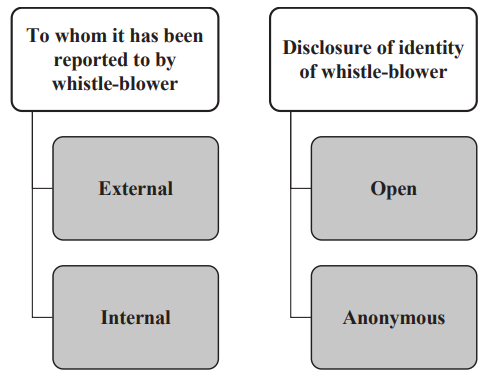
Whistle blowing can be classified on the basis of:

3.3.1 External Whistle-Blowing and Internal Whistle-Blowing

(a) If the whistle-blower reports misconduct to a person outside the organisation, such as regulatory agency or the media, it is termed as external whistle-blowing. Internal whistle-blowing is a situation when a whistle-blower reports misconduct to another person within the organisation but outside the usual line of command.

One of the famous external whistleblowers is Erin Brockovich, a legal clerk and environmental advocate who gained recognition for uncovering the contamination of groundwater in Hinkley, California, by Pacific Gas & Electric (PG&E). The contaminant was hexavalent chromium, a harmful chemical linked to severe health issues in the community. In the 1990s, Brockovich spearheaded efforts to investigate the issue, bringing to light PG&E’s responsibility for pollution. Her work played a key role in securing a $333 million settlement for the affected residents, one of the largest environmental settlements in U.S. history, and raised awareness about corporate environmental misconduct. Cynthia Coppers, who blew the lid off WorldCom Scam, was an employee of the company and is an example of an internal whistle blower.

(b) From a corporate’s point of view both types reflect whistle-blower’s disillusionment with and distrust of the system. However, the damage to reputation of the entity done by external whistle blowing is much more than the latter. It may result in heavy fines and penalties imposed by regulatory authorities.
Types of Whistle-blowing

Types of Whistle-blowing

3.3.2 Open Whistle-Blowing and Anonymous Whistle-Blowing

(a) When whistle-blower reveal his identity as he conveys the information, it is said to be open whistle-blowing and if identity is concealed, it is termed as anonymous whistle-blowing. The main advantage with open whistle-blowing is that the security can be provided to such a person and he/she can be contacted for further information.

(b) In many situations, open whistle blowers have been hugely rewarded in terms of money and, thus, the real motive behind whistle-blowing by such remains doubtful. Anonymous whistle blowing may not be taken seriously by the regulators or the organization and burden of protection of whistle-blower is also not there.

3.4 Pros and Cons of Whistle-Blowing

Whistle-blowing can be a rewarding experience for some whistle-blowers. But others may have to face a backlash or mistrust of others:

3.4.1 Pros of Whistle-Blowing

(a) Financial Compensation – Many times, whistle-blower law/policy has a provision of rewarding the whistle-blower financially. For example, whistle-blowers in the US are, generally, entitled to a part of a settlement collected by the Government. Dinesh Thakur, the whistle-blower who helped the US Government show systemic product-testing failures at Ranbaxy and which led to the $500 million settlement in 2013, received $48 million. In US, the Dodd-Frank Act offers financial rewards for whistleblowers who expose securities fraud.

(b) Legal Protection – Many people face retaliation when they become a whistle-blower. Organisational policies and laws can protect them from adverse consequences. To take an example, in India Whistle Blowers Protection Act, 2014 seeks to protect whistle blower who has made a public interest disclosure related to an act of corruption, misuse of power, or criminal offense by a public servant.

(c) Reduces Risk – One of the main reasons to blow the whistle on any illegal or unethical activity is to protect colleagues and other stakeholders or public at large from certain risks. Whistle-blowing acts as a safeguard.

(d) Ethical Responsibility – Whistle-blower may have been pushed to do so by his sense of right and wrong. For example, Sherron Watkins, the former Vice-President of Enron Corporation in US and whistle-blower alerted then-CEO Ken Lay in August 2001 to accounting irregularities within the company. She testified before Congressional Committees from the House and Senate investigating Enron’s demise.

3.4.2 Cons of Whistle-blowing

(a) Retaliation – Whistle-blower may have to face potential retaliation from management, colleagues or even Government. The case of Edward Snowden is an example of a backlash. He leaked details of several top-secret United States mass surveillance programs to the media and was forced to flee the country and seek asylum in Russia to escape prosecution by the US Government. In June 2024, the outgoing CEO of Boeing Dave Calhoun accepted at a Senate hearing in US that Boeing is trying to protect whistle-blowers at his company but still they have faced retaliation.3

(b) Conflict of Interest – Many whistle-blowers face an ethical dilemma – whether to protect the short-term interest of colleagues and the organisation or to protect the public at large; whether to be disloyal, whether to protect short-term interest of the shareholders or caution future investors. Cynthia Cooper, while serving as Vice President of Internal Audit at WorldCom, played a pivotal role in exposing what was, at the time, the largest case of corporate fraud too faced an ethical dilemma. Recalling the time, she was contemplating exposure she said in a talk, “There were times when I was scared to death. I remember my hands shaking.”4 She knew after the exposure; thousands of employees would lose their jobs and retirement savings. Mississippi, where WorldCom was based, would also lose millions in revenue. Despite being sure that she was right, Cooper struggled with depression and found it difficult to move forward from the scandal even after disclosure, as the fallout affected not just the company, but also her own personal and professional life.

3.5 Advantages of a Good Whistle-Blower Policy to an Organisation

The revelation made by the whistle-blower should be handled promptly by the organisation. Many large-scale corporate frauds have come to light through internal whistle-blowing. To ensure transparency and continuous trust and support from all the stakeholders, it is imperative for every organisation to lay down a clear and comprehensive whistle blowing policy. Some of the advantages that may accrue to it by such a policy are listed below:
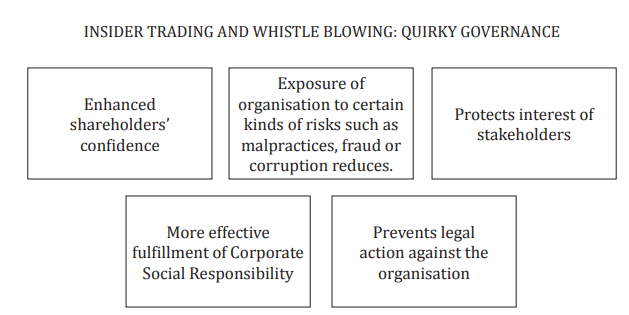
Advantages of Whistle-Blower Policy

Advantages of Whistle-Blower Policy

3.6 Whistle-Blowing Laws in India

Regulations in India have been laid down relating to whistle-blowing and protection of whistle-blowers. The Companies Act, 2013 and SEBI’s Listing Agreement Requirements have included provisions related to whistle-blowing/ vigil mechanism. The Indian Parliament has also passed Whistle-blowers Protection Act, 2014.

3.6.1 The Companies Act, 2013 and Whistle-Blowing

The Companies Act, 2013, has been framed in the backdrop of various corporate scandals. It prescribes stricter compliance, vigil and disclosure norms than laid by previous Companies Acts. Some examples are as below:

Section 177(9) and 177(10) read with Rule 7 of the Companies (Meetings of Board and its Powers) Rules, 2014 and Schedule IV provides for requirements of Vigil Mechanism as under:

(a) Establishment of Vigil mechanism

  • Every listed company and the companies belonging to the following class or classes shall establish a vigil mechanism for their directors and employees to report their genuine concerns or grievances:
    1. the companies which accept deposits from the public:
    2. the companies which have borrowed money from banks and public financial institutions more than fifty crore rupees
  • It may be noted that while section 177(9) of the Act mandates to establish vigil mechanism for directors and employees to report genuine concerns, in case of a listed company, such mechanism is available to all stakeholders.

(b) Overseeing of vigil mechanism:

  • The companies which are required to constitute an Audit Committee shall oversee the vigil mechanism through the committee and if any of the members of the Committee have a conflict of interest in each case, they should recuse themselves and the others on the committee would deal with the matter on hand.
  • In case of other companies, the Board of Directors shall nominate a director to play the role of audit committee for the purpose of mechanism to whom other directors and employees may represent concerns.

(c)  Safeguard against victimisation and direct access:

  • Policy against victimisation of employees and directors who avail of the mechanism should be laid.
  • Provide for direct access to the chairperson of the Audit Committee or the director nominated to play the role committee in exceptional cases.

(d) Disclosure

The company must disclose details of the mechanism on its website and in the Board’s report.

(e) Safeguard against frivolous complaints:

  • In case of repeated frivolous complaints being filed by a director or an employee, the Audit Committee or the director nominated to play the role of Audit Committee may take suitable action against concerned director or employee including reprimand.

(f) Role of independent directors Schedule IV: Code for Independent Directors:

  • Ascertain and ensure that the company has an adequate and functional vigil mechanism.
  • Ensure that interests of a person who uses the mechanisms are not affected.

3.6.2 SEBI and Whistle-Blowing

  • EBI has introduced the concept of whistleblowing by adding Chapter IIIA to the SEBI (Prohibition of Insider Trading) Regulations, 2015 (PIT Regulations). This enables whistleblowers to report insider trading violations directly to SEBI, circumventing the internal reporting mechanisms of companies. The goal is to externalise the reporting process, thereby enhancing the security and anonymity of whistleblowers, which is expected to lead to an increase in reported violations.
  • Additionally, SEBI has announced financial rewards to further encourage whistleblowing. SEBI retains the sole discretion to declare an informant eligible for a reward and will notify the informant or their legal representative to file an application in the specified format to claim the reward. The reward is set at 10% of the monetary sanctions, capped at INR 10 crores, or a higher amount as may be specified by SEBI from time to time

3.6.3 Whistle-Blowers Protection Act, 2014

On May 14, 2014, the Whistle-Blowers Protection Act, 2014 received Presidential assent. The salient features of this Act are:

(a) The Act seeks to protect persons making a public interest disclosure (whistle-blowers) related to an act of corruption, misuse of power, or criminal offence by a public servant.

(b) The Central Vigilance Commission (CVC) is empowered to receive complaints, assess public disclosure requests, and safeguard complainants.

(c) Every complaint must include the identity of the complainant.

(d) It ensures confidentiality of the complainant and penalises any public official who reveals a complainant’s identity, without proper approval.

(e) The Act prescribes penalties for knowingly making false complaints.

The Whistle-Blower Protection Act has attempted to balance two conflicting interests—the need to protect the whistle-blowers against the need to protect public officials from unnecessary harassment.


  1. Section 195 of the Companies Act, 2013 that dealt with insider trading of securities has been omitted by the Companies Amendment Act, 2017.
  2. https://www.taxmann.com/post/blog/analysis-sebis-new-insider-trading-regulations-key-changes-and-implications
  3. https://www.latimes.com/business/story/2024-10-08/boeing-whistleblower-lawsuit-story
  4. https://www.jmu.edu/news/2013/11/14-cooper-demonstrates-power-of-choice-in-business-ethics.shtml

The post Quirky Governance – Insider Trading and Whistle-Blowing appeared first on Taxmann Blog.

source

Categories
Blog Updates

[Opinion] Probing the Pulse of the Company Under Company Law Investigations

Inspection and Investigation of a Company

CS Neha Dangayach & Sumit Patel – [2026] 182 taxmann.com 45 (Article)

1. Introduction

The Companies Act, 2013 provides a comprehensive regulatory framework designed to ensure that companies in India operate with transparency, accountability, and proper corporate governance. To enforce these principles, the Act empowers various authorities- primarily the Registrar of Companies (ROC), the Ministry of Corporate Affairs (MCA), and the Serious Fraud Investigation Office (SFIO)-to review, examine, and scrutinise the affairs of companies. While inspection functions as a preliminary compliance-checking mechanism, investigation is a deeper examination initiated only when serious violations, mismanagement, or fraudulent practices are suspected. Together, these mechanisms help maintain discipline in corporate operations and protect the interests of shareholders, creditors, and the general public.

2. Inspections and Investigation under Companies Act, 2013

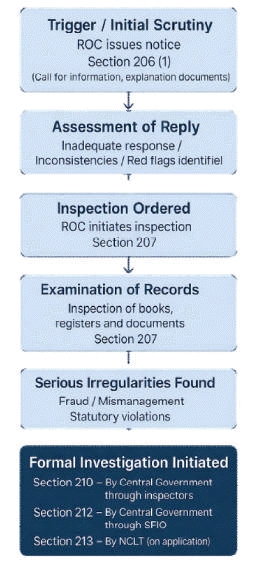
Under the Companies Act, 2013, the power to initiate and conduct inspection lies primarily with the ROC, whereas the power to order a formal investigation lies with the MCA, the National Company Law Tribunal (NCLT), or SFIO depending on the nature of the case. The process typically begins when the ROC issues a notice under Section 206(1) asking a company to furnish specific information, explanations, or documents. If the ROC finds the company’s response inadequate or inconsistent, or if the information supplied raises concerns of possible wrongdoing, the ROC may escalate the matter by ordering an inspection under Section 206(4). Once an inspection is initiated, ROC officers are empowered under Section 207 to examine books of account, statutory records, agreements, registers, and other documents that relate to the company’s affairs.

After completing the inspection, the ROC prepares a detailed report under Section 208 and submits it to the Central Government. If the report reveals significant irregularities- such as mismanagement, diversion of funds, non-disclosure of liabilities, fraudulent transactions, or violations of the Act- the MCA may order a full investigation. Such an investigation may be conducted under Section 210 by inspectors appointed by the Government, under Section 212 by the SFIO in cases of serious fraud, or under Section 213 by the NCLT upon application from shareholders or complainants. Thus, inspection often acts as the first step that triggers a full-scale investigation when deeper scrutiny is required.

Inspections and Investigation under Companies Act, 2013

3. Companies Covered Under These Powers

The powers of inspection and investigation apply broadly to all companies registered under the Companies Act, irrespective of their size, nature, or structure. This includes private companies, public companies (both listed and unlisted), One Person Companies, Section 8 not-for-profit entities, and subsidiaries of foreign companies operating in India. The Act does not provide any major exemption for any class of companies from being inspected or investigated. As long as an entity is incorporated under the Act, it remains subject to regulatory oversight.

Click Here To Read The Full Article 

The post [Opinion] Probing the Pulse of the Company Under Company Law Investigations appeared first on Taxmann Blog.

source

Categories
Blog Updates

Not-For-Profit Entity Liable on Forward Charge for Sponsorship | AAR

Sponsorship Services Forward Charge AAR

Case Details: Mining Geological and Metallargical Institute of India, In re - [2025] 181 taxmann.com 930 (AAR - WEST BENGAL)

Judiciary and Counsel Details

  • Jaydip Kumar ChakarbartiShafeeq S., Member
  • Surendra Joshi, CA & Abhisek Maroti, AR for the Applicant

Facts of the Case

The applicant, a not-for-profit company limited by guarantee incorporated under the Companies Act, 1882, sought clarification on the applicability of GST to sponsorship services provided to recipients located in the taxable territory. It was submitted that it has never declared dividends, had no beneficial shareholders, and functions solely as a not-for-profit entity. It requested guidance on whether its sponsorship services are liable to GST on a forward charge or reverse charge basis, given its non-profit status and historical interpretation of Section 9 of the CGST Act, in light of amendments to RCM notifications. The matter was accordingly placed before the Authority for Advance Ruling (AAR).

AAR Held

The AAR held that the applicant qualifies as a ‘company’ and a ‘body corporate’ under the Companies Act, 2013. It was observed that amendments to the GST notifications specifically exclude bodies corporate from the reverse charge exemption for sponsorship services, which were earlier subject to reverse charge only when supplied by certain non-corporate entities. As a result, sponsorship services provided by the applicant to recipients located within the taxable territory are now liable to GST under the forward charge mechanism, in accordance with Section 9 of the CGST Act. Therefore, all sponsorship-related receipts are subject to GST under forward charge.

List of Cases Referred to

  • Bharat Cooperative Bank v. Cooperative Bank Employees (2007) 4 SCC 685 (para 2.4)
  • Queen’s Educational Society v. CIT [2015] 55 taxmann.com 255/372 ITR 699/231 Taxman 286 (SC) (para 2.5)
  • Addl. CIT v. Surat Art Silk Cloth Manufacturers Association [1978] 121 ITR 1/[1979] 2 Taxman 501 (SC) (para 2.5)
  • Board of Trustees, Ayurvedic & Unani Tibia College v. State of Delhi AIR 1962 SC 458 (para 2.5)
  • Duli Chand v. Mahabir Pershad Trilok Chand Charitable Trust AIR 1984 Delhi 144 (para 2.5)
  • Renusagar Power Co. v. General Electric Co. AIR 1988 SC 1737 (para 2.5).

The post Not-For-Profit Entity Liable on Forward Charge for Sponsorship | AAR appeared first on Taxmann Blog.

source

Categories
Blog Updates

Accounting Treatment of Joint Development Agreements

Accounting and Reporting for Joint Development Agreements

“In a joint development, profit is shared—but accountability must never be”

A Joint Development Agreement (JDA) is a contractual arrangement in which parties come together to develop real estate —typically involving grant of development rights by landowner and construction/development by the developer. The output (flats/units/revenue) is shared based on agreed ratios. JDAs require detailed accounting evaluation as they create shared risks, rights, obligations, revenue streams, and asset usage.

1. Identification of the arrangement

The initial evaluation focuses on understanding the exact nature of contributions and the commercial intent of the agreement. This includes examining whether the parties grant development rights on land, construction expertise, finance or project management. It is also necessary to analyse the area/revenue sharing mechanism and determine who controls key development decisions. Under Ind AS, this assessment determines whether the arrangement qualifies as a joint arrangement. Under the earlier AS framework, JDAs were treated mainly as contractual real estate transactions without such classification requirements.

2. Accounting of Joint Development Agreement under Accounting Standard

The accounting of joint development arrangements under the Accounting Standards (AS) requires careful assessment of the rights and obligations arising from the arrangement to ensure that the financial statements reflect its true substance. Such arrangements often involve complex considerations relating to recognition, measurement, and timing of revenue, costs, assets, and liabilities. Accordingly, application of the relevant AS and related guidance is essential to achieve consistent and transparent financial reporting. Accounting from the perspective of both land owner and developer is discussed herewith:

2.1. Accounting for the Landowner under AS

The land continues to be recognised as a fixed asset in the balance sheet, since legal ownership remained with the entity throughout the arrangement and, accordingly, no de-recognition of land is required.

Further, under construction/work-in-progress or completed flats are not recognised in the financial statements, as the responsibility for construction and related recognition rested with the developer under the terms of the agreement. Moreover, the revenue is recognised in accordance with the provisions of the development agreement, at the point when the right to receive consideration becomes reasonably certain.

2.2. Accounting for the Developer under AS

Construction costs are accumulated as work-in-progress during the development phase and, upon completion, the constructed units are recognised as stock-in-trade (inventory), with the total cost of construction and the agreed land consideration forming part of the developer’s project cost. As legal ownership of the land does not transfer to the developer, the land is not recognised as an asset in the books. Further, any payments made or revenue share payable to the landowner under the arrangement are treated as an integral component of the overall project cost.

2.3. Example to understand the accounting under Accounting Standard

Let us understand the accounting in the books of both land owner and developer through the help of an example.

The developer incurs construction costs of ₹2 crore to construct 10 flats. The allocation is made in a way that 4 flats are allocated to the landowner and 6 flats are allocated to developer. Out of the developer’s share of 6 flats, 3 flats are sold during the first year. Additionally, 4 flats are handed over to the landowner as consideration for land. The sales price is 45 lakhs per flat.

2.3.1 Books of the Developer

Profit & Loss Account (Developer)
Debit Amount (Cr) Credit Amount (Cr)
To opening stock 0.00 By sales (3*0.45) 1.35
To expenses 2.00 By closing stock (3 flats*0.33) 1.00
To Net profit 0.35
Total 2.35 Total 2.35

Balance Sheet (Developer)

Liabilities Amount (Cr) Assets Amount (Cr)
Capital (Initial Investment) 2.00 Cash/Bank (from Sales) 1.35
Add: Net Profit 0.35 Inventory (Stock-in-trade)- Unsold Flats (3*0.33 Cr) 1.00
Total 2.35 Total 2.35

2.3.2 Books of the Land Owner

Profit & Loss Account (Landowner)

Debit Amount Credit Amount
To expenses 0.00 By revenue 0.00
Balance Sheet (Landowner)
Liabilities Amount (Lakh) Assets Amount (Lakh)
Capital 10.00 Stock-in-trade 10.00
Total 10.00 Total 10.00
Click Here To Read The Full Story

The post Accounting Treatment of Joint Development Agreements appeared first on Taxmann Blog.

source

Categories
Blog Updates

[Global IDT Insights] UAE Issues VAT Guide on Administrative Exceptions

UAE VAT Administrative Exceptions Guide

Editorial Team – [2026] 182 taxmann.com 46 (Article)

Global IDT Insights provides a weekly snippet of tax news specifically related to Indirect Taxes from around the globe.

1. UAE has issued a VAT guide on administrative exceptions

UAE has issued a VAT guide on administrative exceptions outlining the circumstances in which VAT registrants may apply for concessions permitted under the VAT Law and the Executive Regulation. The guide explains the eligibility criteria, procedural requirements, and decision-making process applicable to VAT administrative exception requests.

The guide is limited to specific administrative exceptions expressly provided under the Executive Regulation and clarifies the scope, legal framework, and status of such exceptions. It also sets out the documentation, timelines, and conditions applicable to applications submitted through EmaraTax.

Key aspects of this guide include:

(a) Limited scope of VAT administrative exceptions – VAT administrative exceptions are available only for cases explicitly provided under the Executive Regulation. These include exceptions relating to Tax Invoices, Tax Credit Notes, alternative evidence to prove export of goods, and extensions of the time period to export goods. The guide clarifies that administrative exceptions do not extend to VAT refunds, VAT registration matters, waiver of administrative penalties, or other VAT technical issues.

(b) Eligibility restricted to VAT registrants and authorised applicants – Only VAT registrants are eligible to apply for a VAT administrative exception. Applications must be submitted by an authorised signatory, an appointed Tax Agent eligible for indirect taxes, or a court-appointed legal representative. In the case of a tax group, applications must be submitted by the representative member or its appointed Tax Agent.

(c) Defined eligible cases and statutory conditions – The guide specifies eligible cases for each category of administrative exception, along with the statutory references and conditions that must be satisfied. These include demonstrating impracticality in issuing or detailing Tax Invoices or Tax Credit Notes, justifying the need for alternative export evidence, or establishing circumstances beyond the supplier’s and recipient’s control for extending export timelines. Applications falling outside these defined cases will be rejected.

(d) Clarification on documentary evidence for export of goods – The guide reflects amendments to the documentary evidence required to prove export of goods with effect from 15-11-2024. It specifies acceptable combinations of customs declarations, commercial evidence, shipping certificates, and official evidence. Where a registrant is unable to obtain the prescribed combinations, an administrative exception may be requested through EmaraTax.

(e) Administrative exception application process via EmaraTax – The guide details the end-to-end process for submitting administrative exception requests through EmaraTax, including application steps, supporting documentation, and file requirements. It also sets out timelines for submission, consequences of incomplete applications, and automated closure of requests not finalised within prescribed business days.

(f) FTA review, decision timelines, and validity period – The Federal Tax Authority may accept, request further information, or reject applications based on completeness and eligibility. The guide specifies response timelines of 25 or 45 business days, depending on the category of exception. Approved administrative exceptions are generally valid for three years, subject to earlier expiry if relevant legislative provisions are amended or repealed.

Source – Official Guidance

Click Here To Read The Full Article 

The post [Global IDT Insights] UAE Issues VAT Guide on Administrative Exceptions appeared first on Taxmann Blog.

source